Blue Moon Possibilities

My children will remember when they ganged up on me, rushed me to the front porch of our home, and proclaimed that both of them saw a “Blue Moon,” although it could be a moonless night. This was due to my telling them when they were in elementary school that we only went to eat at a certain fast-food restaurant (the one that gave “Happy Meals”) when there was a bonafide Blue Moon. A Blue Moon month is one where there are 2 full moons within that month. It does not occur every year. What, you ask? Well, there are a few seasonal Blue Moons, happening when 4 full moons occur within one season (instead of the usual 3 full moons per season).

I am not a fan of junk food and did not want my children to get hooked on it. I made dinners from scratch, preferring nutritious food for my family. I made going out for fast food a once-a-Blue-Moon event. Initially, this worked. Then they grew older. They saw other kids at school bringing the toys from those Happy Meals to school lunchtimes. Because they were so clever in their conniving, I usually gave in and we trooped off for burgers and fries a bit more frequently. A nutritionist is on my side, claiming that this restaurant chain’s menu “lacks nutrient-dense fruits and vegetables, and most items contain high amounts of sodium and fat.”

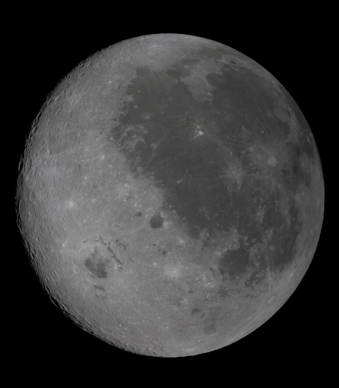
May, 2026, was a true-Blue Moon month! The lunar cycle of the Moon orbiting Earth is 29 ½ days, shorter than most months. But last evening, May 31st, was the second full moon this May, having experienced the first full moon, the Flower Moon, on May 1st.

Astronaut Christine Koch was privileged to fly the 10-day voyage to the dark side of the Moon. One day as she whizzed closer to our mysterious Moon, she called out through her space capsule window: “Hello Earthshine!” Earthshine is that eerie glow that illuminates the unlit part of the Moon; it shows up best when a New Moon is just a sliver in the night sky. Actually, sunlight is responsible for this hide-and-seek view on a clear night. Sun’s rays reflect off Earth (especially oceans, ice, and clouds), traveling onto the Moon which reflects back to human eyes. As sunlight illuminates lunar rocks, they reflect from 3-12% of the sunlight.

This intricate dance of bouncing light is remarkable. Our astronauts are remarkable. Koch advises, “…the seemingly impossible becomes possible if you just believe in it and are willing to work hard and come together to achieve it.” Yes, let’s reflect our best human attributes and come together, as families, neighbors, and citizens of one remarkable solar system.

FYI, according to the Royal Museums Greenwich, the next Blue Moon will be May 20, 2027, when a seasonal Blue Moon opportunity takes place. Don’t miss it!

Pearls of Peace (PoP) Quiz

502. What defines a happy meal preference for you?

503. When do you admire our special Moon?    

Inter-being Connections

Ugo Rondinone, Soul, Galerie Eva Presenhuber, Zurich, 2013

I read the book that my graduate school, Boston University, asked students to read as they began this new academic year. The choice was British novelist Samantha Harvey’s Orbital (2024 Booker Prize winner), about 6 astronauts on the International Space Station (actually 4 astronauts — American, Japanese, British, Italian — and 2 Russian cosmonauts). The novel was a fascinating blend of out-of-this-world details of living/working without benefit of gravity and the daydream/nightdream lives of the intrepid souls onboard.

Purposedly, I had not read the reviews before my own reading. I find that a reviewer’s comments often tell more about the reviewer than about a book. In any case, reviews were mixed. On the plus side, reviewers found Harvey’s writing “beautiful…contemplative.” She describes Earth as having fragility. Through the eyes of astronauts there were worries about personal fragility, like fending off nausea, while zooming around Earth 16 times a day in mind-dizzying circles.

Negative reviewers commented on “minimal plot,” a “lack of traditional character development” and finding “philosophical musings…lacking in substance.”

What caught my attention was how similar the international astronauts were in terms of their emotions. This should not be a surprise. The author places readers into a spacey, weightless interconnection with Planet Earth alongside the sacred space of weighty troubles of everyday people – a mother’s death, another’s unhappy marriage, and a third astronauts’ sick relative.

I agree with the reviewer who noted that the reader feels as if they “were up there with them” for the one day, a Tuesday, that the story unfurls in captivating description: “Over its right shoulder the planet whispers morning – a slender molten breach of light…they have each at some point been shot into the sky on a kerosene bomb, and then through the atmosphere in a burning capsule with the equivalent weight of two black bears upon them.” 

I appreciated a review from James Wood (in New York Times) commenting on earlier literary figures who longed to know what it would be like to travel in an airplane, but they were never afforded the opportunity: “…the poets and novelists who moved naturally from the mundane to the massive, who saw God and knew death and narrated time, who sensed that, beyond this ‘mundane egg’ (Blake) ‘This World is not Conclusion’ (Dickinson).”

Harvey’s haunting narrative can border on the poetic: “Some alien civilization might look on and ask: what are they doing here? Why do they go nowhere but round and round?”

Swiss sculpturer Ugo Rondinone also offers stark commentary on human nature in his Soul figures. While his primitive blocks of bluestone are not chiseled into perfection, as quarry trauma in the form of drill-holes and splits are visible, his overall repetition of forms makes a statement. Each individual sculpture is titled an emotional state – “The “Affectionate,” “The Surprised,” The Frisky,” “The Concerned.” We can identify. It’s called inter-being.

Pearls of Peace (PoP) Quiz

440. What are your views of space travel?

441. How do you interpret your own round-and-round days?