Saying YES to Hope

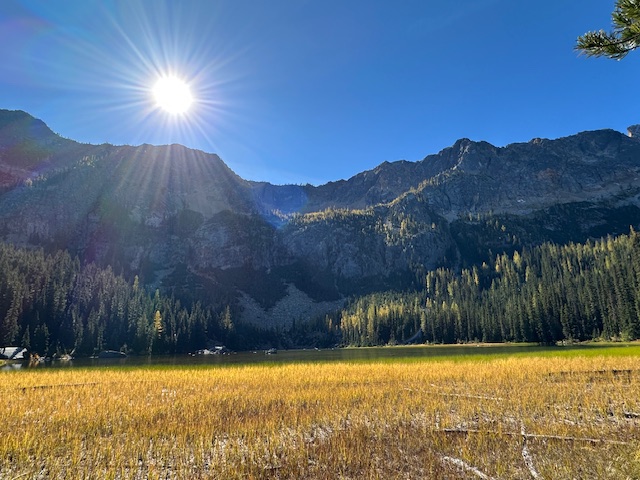
Cutthroat Lake (Named after the local cutthroat trout), North Cascades, WA

English primatologist and anthropologistJane Goodall is an inspirational leader. Her messages for planetary health were still percolating as she entered her 90’s. In celebrating her birthday in 2024, Goodall said in an interview on TODAY,” Slow down, Jane, you’re 90.”  Then she concluded, “I have to speed up because I don’t know how many years left I have.”

Goodall gave her final public interview just 8 days before she died on a U.S. speaking tour 10-01-25 at age 91. Longtime assistant Mary Lewis reported working with Goodall on a document at 10:30 PM just hours before Goodall died while sleeping.

UN Messenger of Peace Goodall found that the question most asked of her was this one: Do you honestly believe there is hope for our world…for the future of our children and grandchildren? Her answer was a stalwart YES — with a call to action: I believe we still have a window of time during which we can start healing the harm we have inflicted on the planet – but that window is closing. If we care about the future of our children and theirs, if we care about the health of the natural world, we must get together and take action…Many people understand the dire state of the planet – but do nothing about it because they feel helpless and hopeless.” 

Goodall sustained a keen sense of hope that can serve as a legacy. She exudes hope in The Book of Hope: A Survival Guide for Trying Times co-authored by Douglas Abrams, with Gail Hudson. Abrams proposed this dialogue-with-Jane book after his Book of Joy with The Dalai Lama and Archbishop Tutu.

Goodall lists 4 reasons for hope despite “a time of fear:”

  1. The amazing Human intellect; 2. The resilience of Nature; 3. The power if young people; and 4. The indomitable Human Spirit.

Roots & Shoots programming initiated by Goodall in 1991 is a prime example of youthful power. While the fledgling environmental project began with 12 high schoolers in Dar es Salaam, Tanzania, today Roots & Shoots hands-on programming exists in 100 countries. The purpose is to train youth to create positive changes for animals, the environment, and their local communities. It is the embodiment of hope.

Saying YES to hope is key to many present-day predicaments. Saying YES means taking power. In the children’s book, A Million YES’s, author D.J Corchin (with illustrator Dan Dougherty) describes the contagion of positive actions: “Word got around quickly. The girl suddenly made more and more friends who all lined up for her incredible YES’s.”

Jane Goodall was a practical and philosophical role model: “You won’t be active unless you hope that your action is going to do some good. So you need hope to get you going, but then by taking action, you generate more hope. It’s a circular thing.”

Say YES to active hope.

Pearls of Peace (PoP) Quiz

436. What gives you hope?

437. How might you say YES more often to make positive environmental changes?
Pearls of Time

Time is both slipping by and an enduring treasure. Time has been on people’s minds, well, for a long time.

  • “Time is the most valuable thing a man [person] can spend.” — Theophrastus, Greek philosopher and naturalist (372 BC-287 BC)
  •  “People don’t take opportunities because the timing is bad, the financial side unsecure. Too many people are overanalyzing. Sometimes you just have to go for it.” —Michelle Zatlyn,  Cloudflare co-founder
  • “Time is what we want most but what we use worst.” — William Penn, British Quaker founder of Pennsylvania
  • “Every tragedy we can imagine comes back to just one: time slipping by.”
    — Simone Weil, French philosopher (1909-1943)
  • “Time management is an oxymoron. Time is beyond our control, and the clock keeps ticking regardless of how we lead our lives.” — John C. Maxwell, American writer on leadership
  • “Liminal moments. Those moments apart from time when you are gripped. Taken. When you are so fully absorbed in what you are doing that time ceases to exist.― Rebecca Wells, Divine Secrets of the Ya-Ya Sisterhood

And from my favorite timekeeper:

  • “…Doesn’t everything die at last, and too soon? Tell me, what is it you plan to do with your one wild and precious life? ― Mary Oliver, The Summer Day

Poetry cuts to the chase on most topics. Poets understand impermanence. They often embrace curiosity for one’s present time.

 Poet and naturalist Derek Sheffield became Washinton state’s 8th poet laureate on 04-30-25. Freelance writer Sarah Neilson summed up his poetry succinctly: Sheffield writes with wildness and wellness as inspiration. In Neilson’s interview for the Seattle Times, Sheffield reflected on his work with a philosophy I can endorse: “An important part of my own journey has been my sense of curiosity and my capacity to feel wonder. I will run across people who don’t seem to have that capacity and don’t seem to be curious…a fair amount of what I do in writing classes is unteaching and trying to get us back to where we all started in third grade. That space, that energy, that trust, that imagination, that engagement with our imagination.”

Yes, who were we in 3rd grade? How did that timeframe influence who we are today? Wasn’t it just yesterday? I recall loving my 3rd grade teacher, Mrs. Anderson. She encouraged creativity and was a font of positivity. I recall her constant smiles. Some teachers’ influence can last a lifetime, either in a good way or a less skillful way. We earthlings are interconnected in a circle of time’s memories.

Consider Derek Sheffield’s poem, Still Time:

“In a wide
and motionless circle, nine

Chinook salmon
below a stilled spillway,

nose to tail-fin, wait,
faint flutterings rounding their backs

in place, each moment
slipping (a white bubble

up from the dark) through the clock face
they make of creek water,

a count we might mistake
as ours.”

Pearls of Peace (PoP) Quiz

407. How do you think about your slipping-by moments?

408. What are your plans for wildness and wellness today?                                                                                                

Can Springtime Jumpstart Social Prescribing?

Winter aconite bulbs in buttercup family (Ranunculaceae)

There is something magical about the warming of days and the return of blooming bulbs unfurling upward, while trees are budding outward, after their winter hibernation. Spring (or vernal) equinox occurred March 20th. Vernal equinox comes from Latin vernal (new or fresh), aequus (equal) and nox (night). Spring equinox delivers daylight in equal amounts of approximately 12 daylight hours and 12 darkness hours as the sun is above the equator at midday.

March equinox in the Northern Hemisphere is the warming trend signaling that summer is not far away as this section of Earth begins showing more hours of sunlight than darkness. Look north for the Big Dipper to be at a high point. In the Southern Hemisphere, March equinox is the polarized opposite; as this region begins tilting away from the sun, the beginning of autumn occurs. According to EarthSky, the fastest sunsets and sunrises of the year occur on the equinoxes. Another Nature tidbit — auroras’ sky dances frequently happen around autumn and spring equinoxes when geomagnetic storms on the sun cause rippling disruptions in Earth’s magnetic field. This awesome feature of Mother Nature reportedly is one of the earliest patterns ever recorded by scientists. https://earthsky.org/sun/aurora-season-auroras-equinox-connection/

I was in Washington state before spring equinox and received an aurora alert on my cell phone! Being an avid sky observer, I set my phone alarm to get up at the prescribed possibility time, but a clear sky did not unfurl any aurora beams of beauty. However, just this possibility of seeing a blooming sky made me smile.

There is something healthy-feeling about warmer temperatures, as more people gather outside and enjoy Nature’s bounty. Doctors are learning to administer social prescriptions. Physicians Alan Siegel and Carla Perissinotto offer this description: “Social prescribing means connecting of people to activities, groups, and support that improve their health and well-being. These often include a range of social services, the arts, nature, volunteerism, movement, companionship and community-building.” Social prescribing is active in 32 countries. I wonder if social prescriptions are refilled more frequently in Nature’s pharmacy in springtime.

Massachusetts has a statewide program in social prescribing. For example, a hypertension research study (Brigham and Women’s Hospital in Boston) utilizes social prescriptions through an art-prescribing company, Art Pharmacy. Based in Atlanta, Art Pharmacy partners with programs in California, Connecticut, Georgia, Massachusetts and New York. Founded in 2022, one goal of Art Pharmacy is to address the loneliness and mental health crises of U.S. citizens. Traditional physical and mental health care can have serious gaps in reaching many individuals’ needs. Social Prescribing USA, a national advocacy organization, has 8 states with pilot projects.

Springtime means the beginning of gardening season for me. All of us need sunshine, both literally and figuratively. Spring delivers more literal sunshine, but the figurative sunshine of well-being is elusive for many.

Pearls of Peace (PoP) Quiz

379. What does springtime mean to you?

380. How might you write your own prescription for social well-being this spring? 

Synergy for Mental Health

“Cognitive Synergy” by Bill Frymire, Olympic, WA

The word synergy comes from Attic Greek sunergos meaning “working together.”

May is America’s Mental Health Awareness Month. In the UK Mental Health Awareness Week is May 13-19 with this year’s theme of “Movement: Moving More for our Mental Health.” I like this emphasis on the whole body working together in movement.

I watch flowers in my spring garden moving together in a constant tableau. It was just yesterday that Virginia Bluebells were a flowing drift of dainty blue flower blooms swaying in the breeze. We also are equipped to bloom and thankfully, most of us have a longer bloom time than spring ephemerals. Today the bluebells are wilting; soon their greenery will disappear and go dormant after flowering and dispersing seeds. Moving into bloom where my bluebells reigned are False Solomon’s Seal perennials with their tiny white stars at the top of flagpole stems.

People wilt for a variety of reasons. It is not easy to be physically and mentally healthy every season. Children especially struggle with conditions that go unnamed for years, often not finding helpful ways to cope until adulthood.                                                             

American songwriter, mixed-media artist and writer Morgan Harper Nichols only received her diagnosis of autism, ADHD, and sensory processing disorder at age 31. She began creating art and poetry as responses to social media messages. Nichols bloomed with her art creating “room to breathe.” She moved her talent in the direction of sharing what she believes is helpful to others:

“Inhale, exhale. Never forget the green lights, stop signs and highways that brought you here. Every single step accounted for, even though you can’t see where the road leads, what matters is that you travel not in pursuit of knowing it all, but in pursuit of boundless peace” (How Far You Have Come).

Nichols initiated a project of sending personalized letters to strangers, making a lifetime goal to compose a million poems to strangers! She invites individuals to share their story with her on her website. She replies to them sending visual art with a letter of encouragement. There are no fees. She keeps names anonymous. Her daily practice of synergistic generosity is a powerful example of her blooming and dispersing seeds of hope. Nichols is completing her MFA (in Interdisciplinary Media Arts) as she works on an online conversational-focused game.

“Art is made in hindsight,” claims Virgil Abloh, fashion designer. Or as Nichols penned, “One day, you will look back and see that all along, you were blooming.”

To keep blooming go to https://www.samhsa.gov/mental-health-awareness-month/toolkit and https://www.nami.org/get-involved/awareness-events/mental-health-awareness-month/ for activities in mental health synergy.

Synergy is “the interaction or cooperation of two or more organizations, substances, or other agents to produce a combined effect greater than the sum of their separate effects.” Springtime is an excellent time for all of us to move together in the growing of mental health for all.

Pearls of Peace (PoP) Quiz

289. When is a time in your life when you were wilting?

290. What did you do to re-bloom?