Ages and Stages

Austrian novelist Marie von Ebner-Eschenbach defined aging: “In youth we learn; in age we understand.” I am rethinking what age means on my birthday.

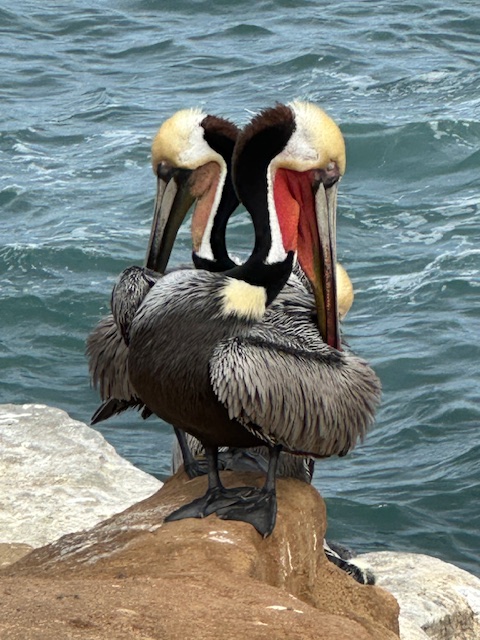
We know 4 aging stages of monarch butterflies: egg, larva (caterpillar), pupa (chrysalis), and adult. This amazing metamorphosis includes caterpillars whizzing through 5 growth spurts, molting skin each time! This reminds me of adolescents making change after change with dizzying speed.

Research from University of Cambridge suggests that adolescence lasts longer than you ever thought. Dr Alexa Mousley and her colleagues found that the brain stays in the adolescent stage until the early 30’s. Key maturation is determined to end around age 32. Studying nearly 4000 individuals’ MRI scans (ages 0-90 years), the researchers concluded that there are 4 pivotal ages for brain turning points or major changes: 9, 32, 66, and 83.

  •  Childhood — Birth to age 9: Brains undergo network consolidation with the most active synapses preserved from a whittling-down process. There is a major boost in cognitive capacity, but also a risk of mental health challenges.
  •  Adolescence – Ages 9 to 32: Brains’ largest directional changes have an efficiency of connections within specific brain regions. There is rapid communication across the whole brain which relates to enhanced cognitive performance. However, this timeframe poses the greatest risk for mental health disorders. Many individuals initiate substance use in this stage. Repeated drug exposure can significantly alter brain development, especially relating to the ways reward and control circuits are wired. A drug habit may become almost automatic, leading to a reduction in prefrontal problem-solving which has many consequences.
  •  Adulthood – Ages 32 to 66: A “plateau in intelligence and personality” (based upon other research) was sustained in this research. Brain functioning appears relatively stable.
  •  Early aging – Ages 66 to 83: A mild and gradual reorganization of brain networks culminates in the mid-60’s, although a variety of health conditions (hypertension or diabetes, for example) may emerge; health issues can place an individual at risk for cognitive decline.
  •  Late aging – Age 83+: Whole brain connectivity reduces and there is more reliance on specific brain regions. However, this participant group was smaller than the other stages studied and merits more study.

The researchers admit their participants were controlled for “healthy” folks. Trauma affects brain ages/stages. An estimated 6 in 10 U.S. adults have experienced trauma (with higher numbers among women than men). Rates for children and adolescents are higher: according to the National Library of Medicine, about 2 out of 3 U.S. individuals experience trauma by age 16. This rate is likely higher among youth in violent war areas around the globe. We need a planetary plan for addressing trauma.  

How do butterflies deal with trauma? According to the Australian Butterfly Sanctuary, butterfly wings are larger than needed for flying. Butterflies can fly with half of their wings missing. My translation for “youth” at any age: keep flying (learning)!

Pearls of Peace (PoP) Quiz

460. What does your age mean to you?

461. What health-proofing practices do you use?  

Lost and Found Pearls

Joy and grief are a whirling wheel [attributed to Hindu philosophy].

The wheels of loss keep whirling, crisscrossing the globe with trails of grief. According to the Geneva Academy of International Humanitarian Law and Human Rights, 110 armed conflicts are being watched; some spill blood into the evening news, yet many escape coverage despite having lasted for decades. Why are there so many unchecked human-rights violations?

The answer is not just having more laws and lawyers trained in international law. International law seemingly cannot keep up with so many atrocities, especially concerning unattended children who cannot tell someone about being abducted and/or trafficked.

The United Nations reports a 25% rise in grave violations against children in the third consecutive year with escalating reported incidents. The report of the UN Secretary-General on Children and Armed Conflict describes a “blatant disregard for international law and the rights and special protections of children by all parties to conflict.” Children under 18 are to be prohibited from recruitment and use as soldiers, but protection edicts are not followed.

The Convention of the Rights of the Child celebrated its 35th anniversary in 2024, yet the crisis of human rights violations keeps whirling. We cannot be complacent and believe that other countries have more abuse of rights than the U.S. Just this past weekend another U.S. school shooting took place. This time the precious student lives lost or injured were college students at Brown University.

You might ask, when does the wheel turn to joy?

It seems that we will have to rely upon the very youth who have been victims of violations to get us out of our collective abyss. A survivor of the 2019 Margory Stoneman Douglas High School shooting in Parkland, FL, Cameron Kasky (now 25), is an ardent activist for gun control. Kasky commands attention and gives hope. He recently announced his bid to run for the Congressional seat of retiring Jerry Nadler.

After the Brown University shooting, Kasky delivered a passionate TV interview. He does not believe that the Parkland, FL perpetrator should be held solely responsible for the horror created. Systemic problems in America need to be addressed according to Kasky. It is joyful to see youthful power step forward with conviction and leadership.

I found posters inside the doors of women’s toilet stalls in the Orlando airport a few years ago: “Stop Human Trafficking – There is a Way Out.” Initially I shuddered to think that this was a necessary intervention. But acknowledging my second thought, I realized that each girl who finds this pearl of help and learns nonverbal hand signals for H (human) and T (trafficking) might save herself. Our youth will lead the way to human rights.

Poet and essayist Maya Angelou reminds us, “You may not control all the events that happen to you, but you can decide not to be reduced by them.” 

Pearls of Peace (PoP) Quiz

454. How might you participate in the promotion of human rights?

455. What is your first step?                   

Men and Well-being

Family therapist Terry Real (yes, his real name) is the founder of Relational Life Therapy. His specialty for 40 years is men. He is the author of 4 books with titles such as I Don’t Want to Talk About It: Overcoming the Secret Legacy of Male Depression and How Can I Get Through to You? Reconnecting Men and Women. He has a reputation for “saving marriages” when hope for repair has dwindled to a couple’s last-ditch effort. “All relationships are about balance/unbalance/repair, harmony/unharmony/repair.”

Real believes men are depressed “because they are terrible at intimacy.” Furthermore, he considers that the U.S. is a “toxic culture of individualism” which does not include nurturing interpersonal relationships. He offers workshops for working with “grandiose men” who lack empathy for themselves as well as empathy for others.

What is a grandiose behavior? According to Real, a grandiose man is apt to minimize, deflect, blame, and rationalize. His grandiosity, similar to intoxication, greatly impairs his judgment. He often has experienced considerable hurt in his life and manages it through a “retreat to the one-up position…If you’re in the one-down, shame state—which is where most women are, overtly—at least you know it. But one of the insidious things about the flight from shame into grandiosity—which is where many men go—is that it doesn’t feel bad. In fact, it often feels pretty good.”   

Real’s experience is that a grandiose man will only change when his partner “starts walking.” If left unchecked, men’s grandiose behaviors often leave a legacy of crippled functioning to their offspring.

It is difficult being a man today (and difficult being a woman also). Online influencers in the “manosphere” blast misogynistic rhetoric alongside physical fitness tips. Women frequently are blamed for whatever ails a man. This toxic “manosphere” is developed through the interplay of certain chatrooms, websites, vlogs, TikTok channels, and gaming platforms. Cynthis Miller-Idriss, founder of Polarization, Extremism Research & Innovation Lab (PERIL) at American University, and author of Man Up, describes grandiosity in the manosphere as often mixed with anger: “They’re performing outrage, it’s salacious, it feels good, it’s like candy for guys who are angry.”

Consider the 18th century story, Robinson Crusoe by British writer, journalist, and spy, Daniel Defoe (1660-1731). Protagonist Crusoe is shipwrecked on a remote island. A sole survivor, he begins to feel regret (and perhaps develops some self-empathy) for his former choices. He does not have a smart phone to influence his thinking, only a Bible. He develops morality. He becomes grateful for his life. He keeps himself alive for 28 years despite harsh circumstances. He defends prisoners from cannibalism. Two of Defoe’s more famous quotes apply here: “All men would be tyrants if they could,” and more hopeful, “But it is never too late to be wise.”   

Pearls of Peace (PoP) Quiz

427. Have you experienced any kind of relationship (as a colleague, family member, or partner) with a grandiose man?

428. How might the U.S. invest in emotional fitness — for everyone?   

Haboob Time

A week ago a tremendous dust storm or haboob dropped a haze-filled blanket over Phoenix. My son was driving at the time. He pulled off a highway for 10-15 minutes. Some choose not to stop driving, the recommended practice, receiving an accident from their choice. Flights were grounded. Homes and businesses lost power. Haboobs are a threat in dry climates, especially in the Southwest. Without warning or a possibility of containment, a haboob whips dust into a mass several thousand feet high in an intense wind that rages for a brief time. As incredible as it sounds, the haboob forcefield of dust can extend up to 100 miles wide. Sudan has an average of 24 such terrorizing dust storms annually. Haboobs also occur in the Sahara Desert across Northern Africa and in Central Australia.

This weekend many are weathering different kinds of storms. In Washington state, two firefighters were apprehended by U.S. Border Patrol while on the job fighting a ferocious wildfire in a remote part of the state. Their reported reason for arrest was “illegal entry and reentry” into the U.S. This wildfire is only 13% contained. These apprehensions of supposed violent behavior are 0% contained.

Meanwhile, in the other Washington (DC), National Guard troops have been ordered to patrol the city to stem violence. Local restaurants and hotels have fewer reservations. Tour guide companies lost revenue. One company reports that typically August is high season for Washington tourists with 80 tours booked; their current number is 40. Canadian bookings have disappeared. Whether crime has been contained depends upon one’s source of statistics. The slogan of the Arizona Department of Transportation regarding haboob time is, “Pull aside, stay alive.” Can we apply this to the National Guard? Hopefully, their duty does not cost them personal street violence that they are expected to contain.

On this Labor Day, celebrations may be as somber as haboob skies. There are many folks without labor to return to on Tuesday morning. Some retired, with many choosing early retirement. Some government workers lost their career post when a termination haboob swept through their office. Without notice, a worker could receive the news at 5:00 PM and not have time to say goodbye to co-workers while being escorted out their work door. Depending upon the worker’s age, some will have difficulty finding new employment. Who helps displaced government workers reenter the labor pool? Who calculates lost revenue in ability to pay federal/local taxes? More importantly, what psychological effects trickle down to their families?

Labor Day is traditionally a time for families to celebrate American workers and to gather for picnics to celebrate the last hurrah of summer as the nation’s children start another school year. America begins this school season with another senseless school shooting. Who provides school security for children and teachers? I have more questions than answers.  

Pearls of Peace (PoP) Quiz

425. What meaning does paid employment have for you?

426. Have you ever experienced a job termination? If so, what happened?

Cultural Change and Climate Change

Receding Nisqually Glacier and its Mount Rainier runoff in 2025

Washington state Nisqually indigenous people are described as people of the river and grass. Nisqually original homeland consisted of nearly 2 million acres encompassing present-day towns of Olympia, Tenino, and Dupont, including a reach as far as Mount Rainier. Nisqually life in the Puget Sound watershed has existed for the past 10,000 years. However, drastic changes for the tribe occurred 150+ years ago with the arrival of Euro-Americans. Many current families live along the Nisqually River 14 miles east of Olympia on a reservation of approximately 5000 acres with tribal land holdings nearby of 1000 acres (which only were reacquired in the past 25 years).

Fort Nisqually was established in 1833 as the first white settlement on Puget Sound. Shifting land allotments for the peaceful Nisqually people are painful reminders of shifting movement of the Nisqually Glacier and Nisqually River on Mount Rainier. Shifting names accompany this impressive mountain: Tahoma, Lushootseed, Cowlitz, Klallam, Upper Chehalis, Twana, and Chinook Wawa preceded Mount Rainier, named for Rear Admiral Peter Rainier. Renaming a mountain is symbolic for relocating communities. Relocation is challenging; forced relocation is traumatic.

Both steep topography and roaring rivers characterize Mount Rainier. When developers situated roads and buildings alongside the grade of a river, they did not anticipate shifting climate changes. Repeat flooding severely damaged the Carbon River Road, taking away car access to some northwestern parts of Mount Rainier National Park. On the western edge, the Longmire development sits adjacent to Nisqually River. The river is “up” 30 feet in elevation higher than park buildings and roads which rely on a levee for protection. In 2006 one storm dumped 17.9 inches of rain over a 36-hour period on Mount Rainier, causing the park to close for 6 months.

Nisqually Glacier is losing land mass and retreating at a more rapid pace in the past century due to rising temperatures. When the summer melt period exceeds winter snow accumulation, receding glaciers pick up their melt pace. At one point Nisqually Glacier was recorded as moving as quickly as 29 inches per day! Glaciers are Nature’s laboratories for climate change. Unless there is some global stabilization of temperatures, the projection is for increased glacial retreats which in turn lead to dangerous debris flows into Mount Rainier’s rivers.

Cultural changes as well as climate changes can impact local ecosystems in some drastic ways. We often do not address the long view on a consistent basis. The concept of “7 generations ahead,” an ancient Haudenosaunee (Iroquois) credo, needs to be everyone’s credo.

 Oh, I did not mention yet that Mount Rainier is an active volcano. A cousin active volcano, Mount St. Helens, blew its lid in 1980, changing the topography in the surrounding valleys. Layers of mud and debris were sent flowing for 17 miles, while ash fell all the way east to Montana. Yikes!

Pearls of Peace (PoP) Quiz

419. When you think of climate change, what are your first thoughts?

420. How are today’s U. S. cultural changes affecting you?         

Truth Pearls

Recently I met new neighbors while taking a walk around the block. A vivacious girl met me exclaiming, “I’m 4! I’m 4!” She just experienced her birthday and was radiant about her milestone. I responded, “I’m 4 too, but with a couple of extra years!” She accepted my description readily because when you are 4, doesn’t everybody celebrate being 4 again? That is wearing your sheen.

I did not tell the adorable one that my blog also celebrated a 4th birthday, as it was too abstract for a concrete thinker! I began my blog during the pandemic. I have posted every Monday for 4 years.

Here are words from my first (7-21-21) blog: “…Pearls seem to need attention. If a pearl necklace is locked away, over time the pearls lose their sheen and become dull. While pearls are categorized as a gemstone, pearls are unique in claiming the only gem status to form within a living creature! Unique among diamonds and other gemstones, pearls require no cutting or polishing before use. Pearls are precious. Pearls represent a fresh start. Peace in the family, post-grief peace, and retirement peace all benefit from a fresh outlook. In these blog posts, we will explore how to string pearls of peace wherever you find yourself on your life’s odyssey.”

Some individuals lose their sheen over time. All of us lose track of peace on a regular basis. We humans must polish our sheen to keep peaceful actions at the forefront of our life odyssey.

Joanna Macy is an individual who kept polishing her sheen. She was a possibility model of visionary and dynamic leadership of peaceful causes in global justice and environmental activism. Macy reportedly died “peacefully” at home from complications after a fall on July 19th. She was 96 (or 24 times 4). In reading about her, I want to share highlights from her workshop called “Truth Mandala” that she presented globally. Groups of individuals gather to sit in a tight circle “to form a containment vessel for holding the truth.” There are 4 quadrants with a symbolic object in each – a stone, dead leaves, a thick stick, an empty bowl. Everyone speaks their truth about a quadrant that represents a significant part of their present life:

  • A stone personifies fear. It exemplifies a tight, contracted heart when one is afraid.
  • Dry leaves stand in for one’s sorrow. Much sadness exists within each of us for the trauma we see in our world.
  • The thick stick represents anger and outrage. One must grasp it with 2 hands but not wave it around or pound the ground.
  • An empty bowl signifies one’s hunger for what is missing in their life, perhaps sharing their feelings of emptiness.

Give truth a fresh start. Then take positive actions.

Pearls of Peace (PoP) Quiz

415. Which of Macy’s 4 quadrants would you speak about if you attended a Truth Mandala workshop?

416. How do we get to a place where people tell the truth about their lives?  

Understand Compassion in Grieving

“I write to understand as much as to be understood,” explained Elie Wiesel, Romanian-American Holocaust survivor and Nobel laureate. Isn’t this true for all writers? If writing is one’s career, there is motivation to put groceries on one’s table, but writing also is a powerful way to grasp and then share some deep understanding of a topic.

The tragic airline crash into Potomac River in Washington, DC grabbed people’s grief strings. An airplane carrying 64 individuals from Wichita, Kansas, and a helicopter carrying 3 soldiers collided just as the larger plane was preparing to land — on a crystal-clear evening. Undoubtedly, passengers were anticipating their meet-up with relatives and rides. Perhaps they were enjoying DC lights and sights. Aviation attorney and experienced pilot Arthur Wolk noted how numerous lights in this crowded airspace can conflict with flight instructions.

Soldiers in the helicopter were conducting a “routine training mission” to practice evacuating government officials if deemed necessary in an emergency. Instead of leading anyone to safety, the unthinkable occurred. Two days later a jet-ambulance crashed in Philadelphia, killing 7 and injuring 22 on the ground, a further tragedy. Smashed dreams and shattered families frighten even those without relationships with the victims. Encountering another’s trauma activates branches of trauma memories in one’s own life.

Journalist Rebecca Soffer, co-founder of online Modern Loss, is keenly aware of sudden death. She was 30 when her mother was killed in a car accident, one hour after giving Rebecca a ride from family camping. Then at age 34, Rebecca’s father died of a heart attack while on a cruise. Co-founder Gabrielle Birkner began her journalism career writing obituaries for a local newspaper. While 27-year-old Gabrielle was in the newsroom working on obituaries, she received unthinkable news that her father and stepmother were murdered in a home invasion. Both young adults sought companionship and compassion from those who might understand their grief.

Gabrielle interviewed psychiatrist M. Katherine Shear, founding director of Columbia University’s Center for Prolonged Grief at Columbia’s School of Social Work. Here is Dr. Shear’s definition of compassion: “Compassion is defined as the feeling of wanting to help someone who is hurting or suffering or has had to confront an untoward experience. Compassion means having a sympathetic awareness of that person’s pain along with a desire to ease the suffering.” She further pointed out that women are better at taking care of others than taking care of themselves. Often women feel that it is selfish to have self-compassion.   

Actually, one needs to hone their self-compassion to be capable of compassion for another’s suffering. It is possible to learn self-compassion skills. Allow yourself to address grief as a form of interdependent love, both for yourself and others. I can vouch for writing 3 things, large and small, in a daily-gratitude journal as one runway to land self-compassion.

Pearls of Peace (PoP) Quiz

365. When have you used writing (in any form) to cope with grieving?

366. In what ways do you show compassion for others?        

Do You Have a Scarcity Mindset?

Quasi, 2016, Ronnie van Hout, New Zealand

The phrase “less is more” was coined by German architect Ludwig Mies van der Rohe. His modern buildings are characterized by minimalism with “few architectural elements to avoid clutter.” Everyone has their own definition of minimalism.

Capturing the bare minimum of a person (perhaps one’s hand) is the Quasi sculpture produced by New Zealand multimedia artist Ronnie van Hout. He used his own face for his minimal man, naming his controversial art for Quasimodo, a tragic hero who was the bellringer in Victor Hugo’s 1831 novel, The Hunchback of Notre-Dame. The prefix quasi- comes from the Latin quasi, meaning “as if, as though.”

When I saw Quasi, I was intrigued. Most people like it or hate it with few in-between opinions. Some find the looming 16-foot sculpture (standing on two fingers on a rooftop) downright disturbing. After five years of controversy among New Zealanders, Quasi was taken down for a second time! Quasi’s first “home” was atop an art gallery in Christchurch and his second airy launch was the roof of City Gallery in Wellington. After receiving flak, Ronnie van Hout responded, “Perhaps the monster just wants to be loved?”

How might wanting-to-be-loved relate to minimalism?

Devin VonderHarr, interior designer and founder of The Modern Minimalist, a weekly newsletter, might respond that one needs to make a list of loved items you want to keep, then review your list, gift new homes the rest, and savor the abundance in your life. She offers “therapy” for your relationship to your home!

VonderHarr believes that a minimal home interior leaves an opening for “an intentional life… aligning soul + space healing.” She defines a scarcity mindset: “…a fear-based mentality that typically is passed down generationally, is learned from parents, or [from] traumatic events that make us see the world as an unsafe place. It can manifest in a variety of ways, but in the home, we see it as the fear of letting go.”

An abundance mindset is freeing according to VonderHarr: “…believing there is always enough. This can apply to food, money, clothes, friends…in the home, it looks like being able to let go of things without emotional resistance.” 

Here are her possible precursors of scarcity mindsets:

  • You experienced poverty or the loss of your home or belongings due to natural disaster traumas or theft.
  • You worry about having enough food, clothing, people in your life, or time.
  • You fear that you may “run out” of money, no matter how much you make or save.
  • You frequently feel like you are “running behind” on your to-do list or in your finances.
  • You have trouble saying no to things because you wonder if another similar opportunity could happen for you.

Minimalist art forms leave one with multiple possibilities for their own interpretations. Whether minimalism in your home leads to more abundance is open for discussion.

Pearls of Peace (PoP) Quiz

359. Do you identify with a scarcity mindset or an abundance mindset?

360. What do you think leads to an intentional life?                           


Music as Change Agent

Translated Vase, Yeesookyung, 2015, Art Institute of Chicago

“We are going to change the world with music,” states one of Venezuelan Ron Davis Alvarez’s music students. Alvarez is a 2024 Top Five CNN Hero; he pieced together his free Dream Orchestra to give refugees, immigrants, and native Swedes an opportunity to learn an instrument. Beginning with 13 students, he characterizes his Dream Orchestra as music “family” with 405 current participants who speak 25 different languages in Gothenburg, Sweden. The 3-56 age-range participants rely on music as their common language. Alvarez’ dream is for Dream Orchestra to help people translate traumas through finding joy and compassionate connections in life.   

Native author Louise Erdrich captures the essence of both day/nighttime dreams: “What are dreams but an internal wilderness and what is desire but a wildness of the soul?” Alvarez could agree; he compares playing his violin to electricity. Music and art are energetic change agents; they can electrify both artists and their audiences.

Dreamer Alvarez grew up in a Caracas slum where drugs and violence were commonplace. His family moved frequently. His grandmother’s house was across the street from El Sistema, a free classical music training program for low-income communities. The young Alvarez heard wafting music from musicians practicing. He loved the sounds and learned to play violin at age 10; his zest for music led him to become a teacher at 14 and a conductor by age 16. He started Greenland’s first youth orchestra before settling in Sweden. Part of his Dream Orchestra is composed of refugee teenagers from Syria and Afghanistan who came to Sweden alone.  

Every Saturday his fledgling musicians gather in a church to make electricity. Alvarez defines music education: “It’s about giving you new opportunities [for] learning about life, about challenges, about dreaming, about…connecting you to your soul.”  

Conductor Alvarez bridges different cultures by having students learn a wide range of works from around the world, including many from their diverse homelands. He also teaches Swedish compositions, so students learn about their newfound home. Alvarez and some members of his orchestra help with housing, food, and connection to outside resources and support. This outgrowth from the music comes from the friendships formed. The Alvarez connection with his musicians runs deep: “When someone comes and says, ‘I have this problem,’ then we all have the problem.”

Hansson-Khorsand says he could not have adjusted to life in Sweden without the financial and emotional support he received from Dream Orchestra. Now married and a father to a young son, he has a job helping refugees find work. Alvarez is mentoring him in preparation for studying music at college.

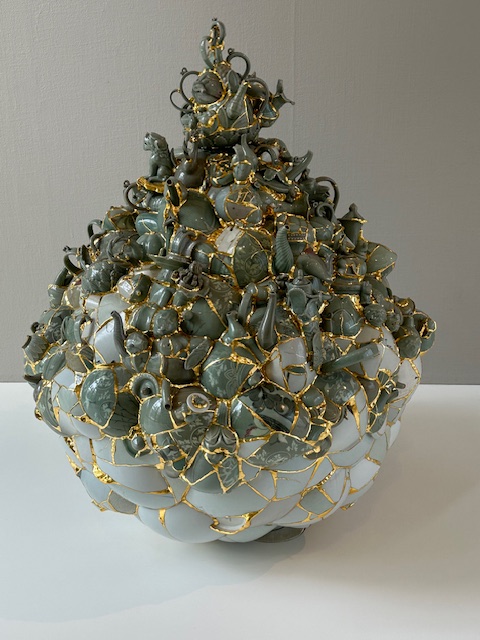
Alvarez’ new dream is finding others to replicate his work. He has supported programs at refugee camps in the West Bank and Greece. Korean artist Yeesookyung also celebrates the beauty of imperfection and “second chances.” Connecting broken shards of pottery delivers a changed vessel.

      Pearls of Peace (PoP) Quiz

349. When has music helped you cope?

350. In what way has music changed you? 

Creativity and Well-being

Michelangelo, Crouching Boy, 1530, The State Hermitage Museum, Saint Petersburg, Russia

Michelangelo created 42 sculptures. His Crouching Boy initially belonged to Italian banking and political dynasty Medici’s of Florence. In preliminary drawings for a double wall tomb for Lorenzo de’ Medici and his assassinated brother, Giuliano, Michaelangelo drew two crouching figures; only one was sketched in a final design. About 250 years later Crouching Boy was purchased by Russia’s Catherine the Great through a banker who did not know it was sculpted by Michelangelo. Its current home is the Hermitage Museum. If only sculptures could speak!

One interpretation is that ambiguous Crouching Boy is removing a thorn from his foot. There was a tumultuous political climate in Florence and Michelangelo was taking shelter in the monastery of San Lorenzo. Is Crouching Boy making a political statement? According to some scholars, Crouching Boy is considered an allegory of mourning – a grieving soul depicted in an unfinished marble statue in an oddly-seated position. A second opinion is that Crouching Boy is a representation of eternal youth. Take your pick.

Michelangelo led a solitary life and worked until dying at age 89. Aside from his renown as a sculptor, he was a poet. His poetry suggests that a younger man was his love interest. Whether or not he was a gay man who had to hide this fact, people in the 1500’s noticed that mostly nude men were his art form. As artist and activist Richard Kamler suggests, “Art is our one true global language…it speaks to our need to reveal, heal, and transform. It transcends our ordinary lives and lets us imagine what is possible.”

What meaning does “removing a thorn” have in today’s world? Wars are notorious for demonizing the other and for name-calling others who are not known personally. One might ask what constitutes a “thorn” today. We live in ambiguous times. Different interpretations for our global future abound.

Perhaps all of us would do well to turn to the arts. As authors Susan Magsamen (Founder/Director of the International Arts + Mind Lab at Johns Hopkins University School of Medicine) and Ivy Ross (VP of Design for hardware products at Google) eloquently write in their 2023 book, Your Brain on Art: How the Arts Transform Us, “…[the] alchemy of art and science is transforming our biology in ways that are both measurable and effective…artistic endeavors…effect beneficial outcomes for our physical and mental health…begin to create personalized arts practices. Like exercise and good nutrition, the arts on a routine basis will support your health.”    

The World Health Organization (WHO) defines mental health as a state of well-being whereby an individual realizes their own abilities, copes with normal life stresses, works productively, and is capable of making contributions to their community.

It took 35+ years to paint the ceiling of the Sistine Chapel. Perhaps you select a slightly smaller project? 

 Pearls of Peace (PoP) Quiz

 347. When have you turned to the arts for transformational time?

348. What do you notice when you are in creative mode?