War OR Peace

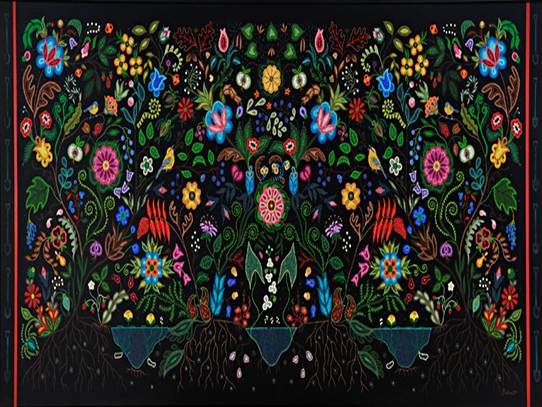
So Much Depends Upon Who Holds the Shovel, Christi Belcourt, 2008

Canadian Métis visual artist Christi Belcourt begins by painting her large canvas black. “I see war, but I paint flowers. I paint what I want for this world…May we live long enough to see humankind turn away from violence and greed…towards creating a world based on caring and giving. May we live long to see the world embrace global disarmament.”

Belcourt paints with a poignant and peaceful hand. An environmentalist and social justice advocate, Belcourt is primarily recognized for her large floral landscapes. Her peace-bearing paintings contain carefully crafted dots (with as many as 200,00 dots) to represent traditional Métis beadwork. She has admired First Nation women’s beadwork patterns since her childhood.

Dazzling circle shapes in Belcourt’s paintings are her symbols for the life cycle “as if they are both molecules and stars.” Her intended purpose is profound: “The roots in my paintings…indicate there is more to life than what we see.” She intends for viewers to detect the smallest of details in order to grasp a bigger picture. Many of her art pieces feature endangered species. For example, a bird on the extinction list is painted with an accompanying bird “calling out.”

Belcourt summarizes her art in simple terms: “My paintings are primarily calls to action…I see…all living beings, including humans, as one…[with] freedom and dignity, care and enough for all.”

Belcourt’s art reminds me of other significant dot art. Aboriginal dot paintings began in the Northern Territory of Australia. They also are symbolic. Aboriginal dots are not merely abstract art. They are meant to hold deeper, sacred meanings from the world’s oldest continuous culture. Aboriginal circles represent waterholes or campsites; their U-shapes stand for people sitting cross-legged. Sacred lands are what tie these different, yet similar, Aboriginal and Métis Nation art forms together.

The earliest form of Aboriginal art depicted tribal stories drawn in desert sand. Fearful of people from different regions “reading” their meanings, artists evolved their sand sketching into abstract dots on cardboard, metal, and other surfaces to preserve sacred stories. This art also conveyed warnings. One theme was displacement from original homelands when outsiders claimed ownership. Observers of Aboriginal art might sense the flat dot paintings appearing to leap off canvass in sparks of energy.

Belcourt speaks for many today: We are witness to the unbearable suffering of species, including humans. Much of this we do to ourselves. It is possible for the planet to return to a state of well-being, but it requires a radical change in our thinking…We are all a part of a whole…When we see ourselves as separate from each other and think of other species, the waters and the planet itself as objects that can be owned, dominated or subjugated, we lose connection with our humanity and we create imbalance on the earth.” 

War OR peace…that is a perennial conundrum.

Pearls of Peace (PoP) Quiz

474. When have you witnessed artwork that left an imprint to enliven you?

475. What calls for action impact you?    

Attachment in Deeds

“Soft power” in politics, especially in international politics, is the practice of shaping another’s point of view through non-coercive means — as opposed to the “hard power” of coercion.  Political scientist Joseph S. Nye Jr., Professor Emeritus and former Dean of Harvard’s Kennedy School of Government, popularized the term in his 1990 book, Bound to Lead: The Changing Nature of American Power.  He further explored his theory in his 2004 book, Soft Power: The Means to Success in World Power. Nye once served as Assistant Secretary of Defense for International Security Affairs in the US. According to Nye, a country’s soft power depends upon 3 important factors in that country:

  • Culture (as attractive to others),
  • Political values (when upheld both at home and abroad), and
  • Foreign policies (when others view them as legitimate as well as possessing moral authority).

I suspect that a leader is far more capable of exercising “soft power” if they possess a secure attachment (See Pearls of Peace blogpost 02-03-25).

On a small scale compared to international political diplomacy, but no less important, let’s understand how one might participate in “soft power.” As I explained in my “Attachment in Words” blog, it is possible to develop a secure attachment even when that is not a caretaker gift offered in earliest childhood.

Let’s consider teddy bear power. I found a teacher example of transforming school discipline into a version of super-soft power. Good teachers mentor in multiple directions. In 2022 New York City middle school teacher Karen Feldman wanted to change the climate among her students. She noticed a rise in hate speech and wanted to take proactive steps. Partnering with Bear Givers, a 501(c)(3) non-profit with a “Leading with Kindness Initiative,” Feldman guided her students in detention in decorating teddy bears to be given to hospitalized children. The students added art and messages on the teddy T-shirts. They attached supportive letters.

The motto of Bear Givers is Making life more bearable (yes) through giving & receiving.” Feldman grasped the importance of having students focus on others’ plight. School populations catching onto this “soft power” approach now extend to students beyond detention walls. Teddy-bear diplomacy has included groups outside schools, such as Bar/Bat Mitzvah, Confirmation, Sweet Sixteen, and others. Bear Givers has donated over 500,000 bears and 500+ charity events have been sponsored with 100+ partnerships. https://www.beargivers.org/about

Mother Bear Project is an international 501(c)(3) non-profit that gives hand-knit or crocheted bears to children, predominantly orphans and those affected by HIVAIDS in Africa. Mother Bear knitters are individuals from all over the US and the world; both women and men knit — from ages ranging from 6-99! While there is one pattern, each creation is unique and bears (yes) the name of it’s Mother Bear. “Mother Bear” Karen McDowell, a retired teacher, shares her photo of some of her bears awaiting shipment. http://motherbearproject.org/

Pearls of Peace (PoP) Quiz

369. When have you exercised “soft power”?

370. What are your ideas for “leading with kindness?”    

Broaden-and-build Purls and Pearls

I cannot give away my grandmother’s crochet hook…yes, this is a scarcity mindset at work (see Pearls of Peace, 1-13-25). I am hooked on warm memories of my childhood hours in my grandparents’ home. I recall many hours that Grandma sat in her rocker, wearing her hand-sewn apron and dress, making one doily after another to gift the many females in her family and friend network. I never learned knit-and-purl stitches, but I watched with fascination as Grandma created with her crochet hook, building one stitch upon the next to broaden her handiwork. Handmade gift-giving was on her unofficial resume.  

Psychologist Barbara Frederickson created her broaden-and-build theory when she realized that there was a greater amount of research on negative emotions than positive emotions. For every positive emotion, there appear to be 3 negative ones! The reason for this disparity is that negative emotions are linked to our survival in big and small ways.

The broaden-and-build theory emphasizes that the expression of positive emotions can expand one’s repertoire of psychological, social, cognitive, and physical resources. Positiveness improves one’s resilience. It may help one’s coping skills. This approach is not meant to erase negative emotions but instead allows for the co-existence of both kinds of emotions.

A negative emotion is a protective signal that something does not “feel right.” When such emotions are brushed off, sometimes there could be dire consequences. The bodymind is a listening machine, always on lookout to protect one from physical and/or psychological harm. The idea with broaden-and-build theory is to make space for ALL emotions.

Expressing frustration in a trusted relationship is often necessary before gaining access to a more centered space where one can choose a positive action. The key is having an awareness of your positive emotions so that you can repair touchy situations. Building upon a growth mindset reminds one that others roll with negative emotions also.    

Here is a list of positive emotions that you can broaden-and-build for more resiliency. You probably do not need a list of negative emotions, as they seem ever-ready for action. However, you may miss out on positivity time if you do not have these positives tucked in your pocket for ready use:  

  • Admiration  
  • Affection
  • Altruism
  • Amusement
  • Anticipation
  • Awe
  • Cheerfulness
  • Confidence
  • Enjoyment
  • Enthusiasm
  • Euphoria
  • Gratitude
  • Happiness
  • Hope
  • Inspiration
  • Interest
  • Joy
  • Love
  • Optimism
  • Pride
  • Relief
  • Serenity
  • Surprise

Best of all, positive emotions are keep-on-giving gifts. I took interest in “crewel” (Welsh word for wool) embroidery when I was in graduate school dealing with a dissertation committee at odds with one another. I needed to broaden my outlook to create something that was positive, one stitch after another, for my own well-being. I realized that one situation is not destiny. Looking back on Grandma’s knit-and-purl self-therapy, I wonder what she was working through in her mind.  

Pearls of Peace (PoP) Quiz

361. When have you used an art form to increase your positive coping skills?  

362. How often do you catch yourself with an initial negative emotion in situations?

Creativity and Well-being

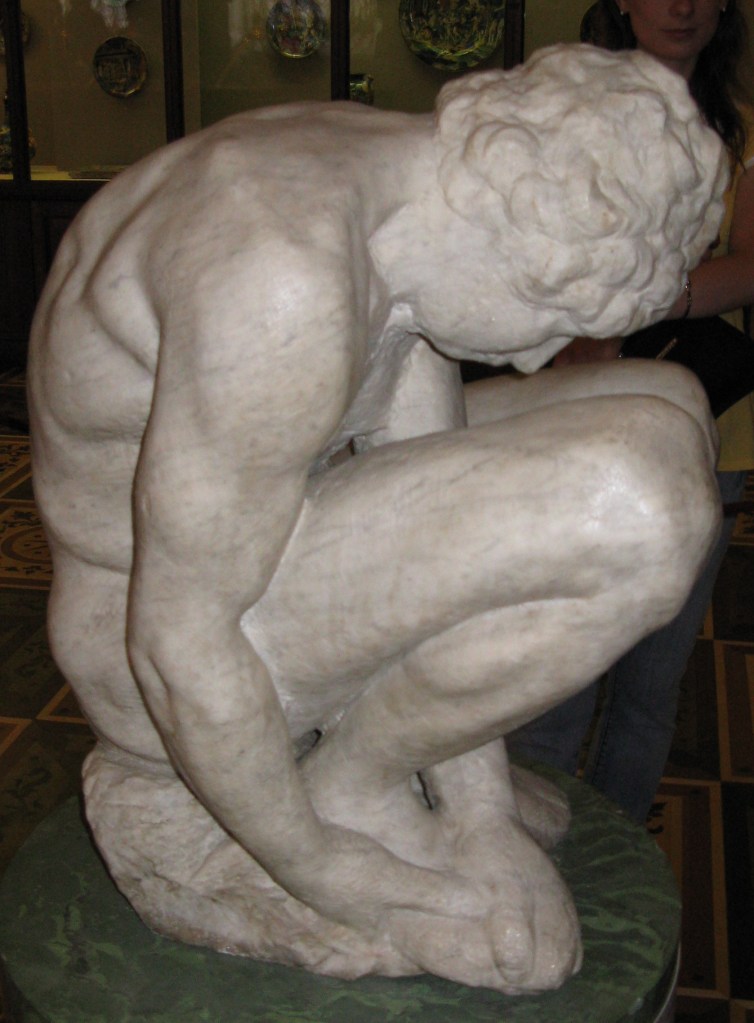
Michelangelo, Crouching Boy, 1530, The State Hermitage Museum, Saint Petersburg, Russia

Michelangelo created 42 sculptures. His Crouching Boy initially belonged to Italian banking and political dynasty Medici’s of Florence. In preliminary drawings for a double wall tomb for Lorenzo de’ Medici and his assassinated brother, Giuliano, Michaelangelo drew two crouching figures; only one was sketched in a final design. About 250 years later Crouching Boy was purchased by Russia’s Catherine the Great through a banker who did not know it was sculpted by Michelangelo. Its current home is the Hermitage Museum. If only sculptures could speak!

One interpretation is that ambiguous Crouching Boy is removing a thorn from his foot. There was a tumultuous political climate in Florence and Michelangelo was taking shelter in the monastery of San Lorenzo. Is Crouching Boy making a political statement? According to some scholars, Crouching Boy is considered an allegory of mourning – a grieving soul depicted in an unfinished marble statue in an oddly-seated position. A second opinion is that Crouching Boy is a representation of eternal youth. Take your pick.

Michelangelo led a solitary life and worked until dying at age 89. Aside from his renown as a sculptor, he was a poet. His poetry suggests that a younger man was his love interest. Whether or not he was a gay man who had to hide this fact, people in the 1500’s noticed that mostly nude men were his art form. As artist and activist Richard Kamler suggests, “Art is our one true global language…it speaks to our need to reveal, heal, and transform. It transcends our ordinary lives and lets us imagine what is possible.”

What meaning does “removing a thorn” have in today’s world? Wars are notorious for demonizing the other and for name-calling others who are not known personally. One might ask what constitutes a “thorn” today. We live in ambiguous times. Different interpretations for our global future abound.

Perhaps all of us would do well to turn to the arts. As authors Susan Magsamen (Founder/Director of the International Arts + Mind Lab at Johns Hopkins University School of Medicine) and Ivy Ross (VP of Design for hardware products at Google) eloquently write in their 2023 book, Your Brain on Art: How the Arts Transform Us, “…[the] alchemy of art and science is transforming our biology in ways that are both measurable and effective…artistic endeavors…effect beneficial outcomes for our physical and mental health…begin to create personalized arts practices. Like exercise and good nutrition, the arts on a routine basis will support your health.”    

The World Health Organization (WHO) defines mental health as a state of well-being whereby an individual realizes their own abilities, copes with normal life stresses, works productively, and is capable of making contributions to their community.

It took 35+ years to paint the ceiling of the Sistine Chapel. Perhaps you select a slightly smaller project? 

 Pearls of Peace (PoP) Quiz

 347. When have you turned to the arts for transformational time?

348. What do you notice when you are in creative mode?                              

Change: A Pearl-in-the-Making

Autumn is a good time to consider something that needs changing in your life. As more leaves change colors and eventually give way to their new legacy of providing mulch, envision a change or two for yourself. As R. Buckminster Fuller said, “You never change things by fighting the existing reality. To change something, build a new model that makes the existing model obsolete.”

Architect Buckminster Fuller was an intuitive systems thinker and futurist. His penchant for creating not just the amazing geodesic dome structure, but also new words, gives us a blueprint for our personal changes. Fuller both coined and initiated the field of Synergistics. His interdisciplinary approach encourages lateral thinking and incorporating nature: “I am confident that humanity’s survival depends on all of our willingness to comprehend feelingly the way nature works.” It is the feelingly comprehension of ALL of us that sent my mind on a search for a further explanation of Fuller’s ideas.

Professor of Leadership at Harvard Business School, Amy C. Edmondson worked as Chief Engineer for Fuller during the last three years of his 87-year life. Edmondson wrote Fuller a letter as an undergraduate student, asking him what people might do to make our planet work for everyone. What a wonderful question for each of us!

Edmonson’s easier-to-comprehend description of Synergistics is ALL about changing our mindset, something that I fully endorse as a psychologist (Fuller Explanation: The Synergistic Geometry of R. Buckminister Fuller). Ready for some mindset change? I have found a few beginner pearls in Synergistics (and life):

  • Let curiosity guide you. Say “image-ination” like Fuller (instead of imagination), because we are the architects of our images.
  • Self-directed examination of patterns and structure in nature will educate you.
  • Stop lying to children by saying, “Watch the sun going down.” This made me wonder why I say, “sunset.”
  • Fuller reminded audiences that we are accustomed to believing that reality is comprised of what one sees, smells, touches and hears, while we actually “live in a world of invisibles.”
  • “…there are no solids; matter consists exclusively of energy.” This is deep.

Most of us will not be known for BIG-C creativity as in Fuller’s producing 28 U.S. patents that gathered recognition in multiple honorary doctorates, but we exhibit little-c creativity whenever we change our mindsets.

Take a peak at Fuller’s childhood. Born to successful leather and tea merchant parents and grand-nephew of Margaret Fuller, the ardent women’s rights advocate, Fuller attended a Froebelian Kindergarten where he was influenced by the same geometric building blocks as Frank Lloyd Wright. This suggests to me that we need to wean school-age children off their gadget dependence to encourage more self-directed mindsets as in creative play, especially in nature.

As British primatologist and anthropologist Jane Goodall reminds us, “Every individual matters. Every individual has a role to play. Every individual makes a difference.”

Pearls of Peace (PoP) Quiz 

335. What difference are you making?

336. What is your current change or pearl-in-the-making?            

Are YOU Meeting 5 Basic Needs?

Autumn Crocus

When asked to give a keynote talk at a fundraiser for a suicide-prevention-curriculum organization, I flashed on a psychology graduate school professor who taught that the most important ingredient a therapist must deliver in any psychotherapy session is to “leave the client with hope.” This simple phrase applies to almost every encounter we have with others.

September is National Self-Care Awareness Month and Suicide Prevention Month (see blog, Prevention is an Intervention). Our best action regarding suicide is to prevent it. Here’s my talk highlights:

What is the opposite of committing suicide? I would say, flourishing! How might you flourish? Fair pay, equal pay for equal work, and other economic factors are important, but today we focus on what you can do to flourish in a bodymind sense.  First, you flourish by meeting your own basic needs. Then you can lend a helping hand to a neighbor, family member, friend, or student who is struggling to meet their basic needs.

Instead of admonishing others with the 19th century foot metaphor, “pull yourself up by your bootstraps” — which Wikipedia says originated from a tall tale where a man told of pulling himself out of a swamp by his own pigtail — we will use a hand as a memory tool…See how moveable and “energetic” your thumb can be!  Let your thumb stand for ENERGY, instead of ennui lethargy…a flexible thumb provides endless possibilities for action. Begin with feeding yourself a nutritious diet, getting 7 hours of sleep, and exercising in a way that suits your body. 

Your pointer finger stands for DISCIPLINE, rather than disorder. Some adults and even teachers (I’ve seen it) point this finger in an emotional, menacing way to deliver “discipline.” Bill Clinton pointed his index finger at the American people, saying, “I did not have sexual relations with that woman, Miss Lewinsky!” Today, Mark Robinson, running for governor in NC, is pointing at voters. Both forgot that their own 3 fingers point back at them!  There is cognitive pointing, as in pointing to the pretty butterfly. We celebrate when a baby learns to point at objects. Try pointing your index finger upward, as a reminder to yourself, that you are interested in raising “up” children (or students or colleagues) using morals and values as your guide. Discipline is a basic need. Having the discipline to eat healthy choices, get enough sleep, exercise, and keep learning with a growth mindset – ALL require some structure. The word discipline has the same root meaning as the word disciple. It means to follow a good lead.

The middle and longest finger has a long history of meaning scorn or insult when held upright. Over 2500 years ago the Greek playwright, Aristophanes, is credited with showing insult by raising the middle finger. He made a crude joke about a certain male body part. It is time for this finger to receive a creative comeback!  CREATIVITY, instead of conformity, is a go-to basic need if you want to flourish.  Creativity involves curiosity, problem-solving, and dreaming new ideas. Albert Einstein once said, “Creativity is intelligence having fun.” Creativity involves personal autonomy, wanting to do something because it’s interesting, enjoyable, or personally challenging. And creativity is not just Big-C creativity, as in becoming a famous artist. Creativity has many little-c possibilities that engage your originality, flexibility, or personal voice.

The ring finger is known for its special BELONGING to close relationships, as in couples sharing wedding rings to symbolize their belonging, rather than the Blues. For those in the mental health field, we are talking about attachment. All these needs are important, but belonging connections are vital. Researchers have found that after food and shelter, positive social connection is our greatest need benefiting bodymind health. People who feel more connected to others have lower rates of anxiety and depression, a 50% increased chance of longevity, a stronger immune system, and faster recovery from disease.

The left “pinky” finger is the one that hits the letter “A” on the keyboard! Recognize your ABILITY, not your apathy. Have competence to believe in your skills to achieve goals and experience a sense of mastery. In the past it was considered that IQ was fixed. This is not true. IQ tests measure what can be done now, not what can be done in the future. The brain can store nearly 10 times more data than previously thought, research confirms. Keep storing new learning!

Our needs are interactive. They can work together, or not. I lined up the backward ABCDE’s — Energy/Discipline/Creativity/Belonging/Ability — handprint to help individuals remember 5 needs. Some days are a challenge to meet even 3 needs. If you live with others, it gets more complicated, because others inevitably want to meet a need — involving YOU — at a different time than you anticipated.

What’s more, we have an integrative core SELF– this is not “ego.” Some might prefer the word spirit, or soul to SELF. It is a calm acceptance, a grounding, a deep reservoir of integrity, wholeness; it is owning OK-ness. Let’s consider a core SELF in the palm of your hand. When we hold hands with another, we can remind ourselves that our core SELF touches another’s core SELF. This is co-regulation or lending a helping hand. And meeting needs, both ours and helping others meet their needs, is flourishing.

Pearls of Peace (PoP) Quiz 

239. How is your self-care flourishing today?

230. What might you do to help another person flourish?        

Courageous Pearls

In the assassination attempt on Donald Trump, the life of an innocent man ended as he sheltered his family. Two other bystanders also captured bullets. As in several other shooter profiles, the 20-year-old gunman was described as the recipient of bullying in school. Why? Who’s teaching the values of democracy which include “…insuring domestic tranquility”?  

In his book, Healing the Heart of Democracy: The Courage to Create a Politics Worthy of the Human Spirit, writer Parker J. Palmer calls for examining our inner lives to reach the “commonwealth” of compassion and creativity found in the wording in “We the People of the United States, in order to form a more perfect Union….” Palmer instructs how to focus on shared values with the claim that “the human heart is the first home of democracy.” His 5 habits of the heart are a courageous blueprint for these troubled times:

  • An understanding that we are all in this together
  • An appreciation of the value of “otherness”
  • An ability to hold tension in life-giving ways
  • A sense of personal voice and agency
  • A capacity to create community

Named one of the most important books of the early 21st Century by Democracy & Education, Palmer’s 2024 updated edition contains a discussion guide augmented by online video interviews. Let’s teach this in schools.

Another courageous source of hope lies in the community effort to end the cycle of gun violence by the Institute for Nonviolence Chicago. In partnership with Northwestern University and the University of Chicago Crime Lab, the Institute identifies community individuals who are at risk of being shot or becoming a shooter. They foster the healing of broken dreams and chaotic emotions of youth, supporting individuals though their program of “relentless engagement.” Block by block, they espouse the vision of Martin Luther King, Jr. in nonviolent problem-solving. Their 6 principles of nonviolence support Palmer’s ideas with added dimension:

  •  Nonviolence is a way of life for courageous people.
  • The Beloved Community is the goal.
  • Attack forces of evil, not persons doing evil.
  • Accept suffering without retaliation for the sake of the cause to achieve a goal.
  • Avoid internal violence of the Spirit as well as external physical violence.
  • The Universe is on the side of Justice.

The Institute creates a “culture of wellness,” including helping individuals find living-wage jobs in the legal economy. I love how their staff keep receiving training in trauma-informed care and have an offering of yoga practice. It is key to heal the healers as well as train individuals in nonviolence.

Palmer’s words inspire: “When democracy is working as it should, it is a complex and confusing mess where we can think and act as we choose, within the rule of law…and can still manage to come together for the sake of the common good.” The common good is inclusive. Democracy is inclusive.

Pearls of Peace (PoP) Quiz 

307. Which of the Institute-for-Nonviolence-Chicago principles might you work on?

308. How can you foster inclusivity in your hometown?    

Writing Pearls

Illinois Women’s Press Association (IWPA) hosts a contest for writers, both professional writers and beginning writers in high school. I became a member after re-reading Natalie Goldberg’s wonderful book, Writing Down the Bones, and realizing that I too might call myself a writer even though I had only “morning pages” under my writing belt. Goldberg received sage advice from a Zen master: “Why do you come to sit meditation? Why don’t you make writing your practice? If you go deep enough in writing, it will take you everyplace.”

Yes, writing takes one everyplace. In 1995 I fell down steep stairs in Chicago on the eve of taking my firstborn to college. Unable to hobble much in my cast, I slowed down. I began writing “morning pages” according to journalist and film/TV writer Julia Cameron’s inspiring book, The Artist’s Way: A Spiritual Path to Higher Creativity. I did not imagine that later I would publish three developmental psychology books and create a weekly blog, Pearls of Peace. The word “blog” was not invented until Jorn Barger coined “weblog” in 1997; Peter Merholz reduced the concept to “blog” in 1999.  

Goldberg is strictly a pen-and-notebook (of a special kind) writer. She prefers writing in a café. I can take notes and write poems with a pen, but I prefer the keyboard at my desktop computer for books and blogs. Classical music is my companion when I write, not extraneous conversation. Reportedly, Ernest Hemingway wrote naked at a lectern. He used a pencil but switched to typing for dialogue. Each writer develops their own writing style.

Cameron wrote her “morning pages” for decades; in a lecture she commented that writing is a way to “zip up a concern.” She believed she was writing her 1992 Artist’s Way for “about 5 people.” She was shocked when 5 million copies sold! I do not have this following, but the people who do read my writing give me compassionate feedback. However, we writers are most in need of saying something when we take our pen or keyboard to hand. Among others, Cameron believes that we teach what we need to learn ourselves.

I feel lucky to discover the stimulation of writing in an encore career. I feel lucky to receive awards from my two submissions to the 2024 IWPA Mate E. Palmer Communications Contest:

  • First Place in Web & Social Media Blog, Nonprofit (Government or Educational), IWPA 2024 – “Banned Pearls” (online 10-2-23) 
  • First Place in Non-Fiction Books for Adult Readers, IWPA 2024 – Transforming Retirement: Rewire and Grow Your Legacy (published 2023)

The best part of the Award luncheon was hearing high school writers’ enthusiasm for their craft! I recommend writing at every age. Take Hemingway’s advice: All you have to do is write one true sentence. Write the truest sentence that you know.” My advice? Write a second sentence. Keep writing.

Pearls of Peace (PoP) Quiz

295. What kind of writing engages you?

296. Is there a type of writing you would like to begin?   

Seasonal Pearls

What color are your pearls? Hint: my interest is in your figurative pearls.

Perhaps Sister Joan Sauro’s words will explain: “There is a pearl in every season. Find it. Then give all you have to claim it” (Whole Earth Meditation: Ecology for the Spirit).

May is a busy month for addressing important populations within the U.S. In addition to May’s Asian American, Native American, Native Hawaiian, and Pacific Islanders Heritage Month (see “Hula Pearls,” 5-6-24) and America Mental Health Awareness Month (see “Synergy for Mental Health,” 5-13-24), May also is Older Americans Month. Some individuals relate to all 3 of these populations.

Numbers of older adults coping with depression range from 7.7% (adults 50+) to an estimated 31% in some groups (ages 65+). Older adults’ symptoms of depression may not be recognized by their physicians. Compounding caretaking, older adults may view mental health help as a stigma, especially in non-English speaking individuals.

A population bumper crop of older adults is ripening: it is estimated that 4.1 million Americans will reach age 65 every year from 2024-2027. Reportedly, more than 11,200 Americans turn 65 every day (The Alliance for Lifetime Income). Regardless of exact numbers, depression, anxiety and loneliness plague too many older adults.

An exciting program to address this looming population, created 20 years ago at the University of Washington in Seattle, Program to Encourage Active, Rewarding Lives (PEARLS) coaches older adults to be proactive about their wellbeing. Depression is defined in everyday examples by coaches for participants (identified in community organizations); problem-solving skills are taught to enable self-sufficiency for more active lives. The free program takes place in homes or preferred community settings. Online PEARLS began during the pandemic. One-hour sessions for 6-8 weeks (over 4-5 months) start with each person’s daily routines of “where they are.” Coaches have supervision with mental health practitioners. PEARLS coaching has reached adults across 26 states, including our Memorial Day veterans, people of all ages with disabilities, and especially those 65+.

American education is not forward-thinking regarding older adults. My doctoral program in counseling psychology had courses on childhood, adolescent development, and psychology of young adults, but no specific coursework on midlife (since identified as ages 35-64) or gerontology.  Relatively few colleges and universities offer a gerontology major, despite a growing need. Of the 5 institutions graduating the most students in gerontology, 89.9% are females. We need more compassion and creativity in our thinking about seasoned citizens.

Recently I was asked to talk about creativity enhancing aging on a podcast, “Older Women and Friends” (interviewed by host Jane Leder). Check it out:  https://www.buzzsprout.com/2054889/15102414  

Seasonal growth is important at every age, but retirement age is a reminder that our true wealth consists of time, how positively we spend it, and bodymind health. Let’s meet aging with colorful pearls of creativity!

Pearls of Peace (PoP) Quiz

293. What season of your life has been your most creative time?

294. What about now?          

Unmet Needs

Bound Hand, 1973, Christina Ramberg

If you can visit The Art Institute of Chicago before August 11th, do not miss the exhibit, “Christina Ramberg: A Retrospective.” In 2025 the Ramberg exhibit travels to art museums in L.A. and Philadelphia.

Ramberg was a devoted artist; she drew, painted, sewed, quilted, and compiled scrapbooks. Her sometimes-edgy art without faces (and only parts of a body represented in each production) leaves much open to interpretation. Everyone flies their own perceptions into any piece of art, but with unsettling cut-offs there is a provocative quality to Ramberg’s work. What was she thinking as she cropped her art? She once answered this question about a corseted headless-legless woman. The curvy mid-section was bent over; Ramberg recalled watching her mother wriggle into tight undergarments to cinch her waist, popular in women’s fashion in the 50’s. The restraints suggested in cut-off torsos were further emphasized with subdued colors.

Here is what grabbed me when I first saw Ramberg’s Bound Hand. I use my hand to teach people about 5 basic needs. Partly as a mnemonic, and partly as a visual representation of what is at hand for us daily, my 5 EDCBA basic needs (as illustrated on a hand or drawn on a handprint) provide a handy chart. Consider how you meet this handful: Energy (thumb), Discipline (index finger), Creativity (middle finger), Belonging (ring finger) and Ability (little finger).    

These needs are not hierarchical, but ideally are interdependent and flow into one another, grounded in a core self. Your met needs are a collaborative effort for your wellbeing. However, the daily-needs story gets complicated when needs are unmet; it is challenging when you are confronted by others trying to meet different needs (or disagreeing with how you meet needs). Bound-up needs stifle one’s equality and growth.

As insightful writer Ann Patchett writes in These Precious Days: Essays, “People want you to want what they want. If you want the same things they want, then their want is validated. If you don’t want the same things, your lack of wanting can, to certain people, come across as judgment.”

Despite critiques, Ramberg (1946-1995) kept evolving her creativity, although her life was cut short by Pick’s disease (frontotemporal dementia). Her creativity is contemporary in its cropped views of both femininity and masculinity. The headless-legless male and female torsos are riveting.

Ramberg frequently visited garage sales and flea markets where she collected the 155 dolls mounted on one wall of the exhibit. The dolls (some headless) represent ethnic, racial, and gender stereotypes. Ramberg said this about Doll Wall: “I was only interested in the dolls that had been owned by someone. The ones where the face was worn off and redrawn in, or where something very strange had transpired…I’m interested in what is implied. And the simple fact that they had a life.”

Let’s embrace life. Who needs wars?

Pearls of Peace (PoP) Quiz

291. What (if any) are your unmet needs?

292. How do you meet your need for creativity?