Who is a Foreigner?

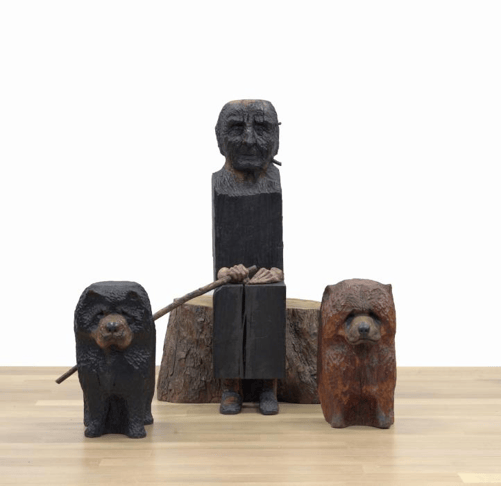
Marisol, Portrait of Georgia O’Keeffe with Dogs, 1977, graphite and oil on wood, Collection Buffalo AKG Art Museum. Photo: Brenda Bieger, Buffalo AKG Art Museum

“I am the Venezuelan, born in France, living in Italy – that has an English car with North American plates and Swiss insurance – and they want to ask me what nationality I am.” — Marisol, born María Sol Escobar (1930 – 2016), held citizenship in Venezuela, France, and the U.S.

National Hispanic Heritage Month 2026 is from September 15th to October 15th when we celebrate Latinx history, traditions, and the cultural diversity of Americans whose heritage originated in Spain and 19 countries and territories: Mexico, Guatemala, Honduras, El Salvador, Nicaragua, Costa Rica, Panama, Colombia, Venezuela, Ecuador, Peru, Bolivia, Paraguay, Chile, Argentina, Uruguay, Cuba, Puerto Rico, and the Dominican Republic. Chosen by the National Council of Hispanic Employment Program Managers, the 2026 theme — “Unidos, Somos Más” (Together, We Are More) — emphasizes the pervasive cultural and economic impact of Hispanic and Latino communities. As the largest racial or ethnic minority in America, over 70 million ethnically Hispanic/Latino residents make up 1/5 of the U.S. total population according to census data.

Initially Hispanic Heritage Week, Mexican American U.S. Rep. Edward R. Roybal (Los Angeles) sponsored legislation and President Lyndon B. Johnson signed it into law in 1968. President Ronald Reagan expanded the week to a full month in 1988, giving more time for educational events and community celebrations.

September 15th pays tribute to the anniversary of “El Grito de Dolores” (The Cry of Dolores), a call to battle in 1810 in Mexico’s war for independence from Spain. El Salvador and Guatemala also celebrate their independence in September. Columbus Day/Indigenous Peoples Day, or Día de la Raza, occurs just before October 15th.

From 1500’s onward, Latinx Americans have impacted U.S. history. A documentary, Latino Americans: The 500-year Legacy That Shaped a Nation, offers interviews with 100+individuals. We forget that “the border” has experienced shifting demarcations between Mexico and U.S. over the years. Mexican people became “foreigners” in their own land from 1565-1880. Eventually, Cubans and Puerto Ricans crossed borderlands, followed by Salvadorans, Nicaraguans, and Guatemalans who often were escaping civil wars, death squads, gang terror and/or family issues.

Marisol came to America due to family issues. Her mother committed suicide when Marisol was 11. Marisol made a drastic decision after her mother’s death: she chose not to speak except to answer questions in school classes. She remained predominantly mute until her early twenties. In Marisol’s religious adolescence, she walked on her knees until they bled and tied ropes tightly around her waist. Her father sent her to a boarding school in Long Island, New York, and then to high school in L.A. where the traumatized teen was expelled for “not fitting in.” Was she considered a “foreigner?”

American-born Georgia O’Keefe was of Irish and Hungarian descent. Was she a “foreigner?” Today, many American-born Latinx folks are once again viewed as “foreigner” in the U.S. and are endangered.

Pearls of Peace (PoP) Quiz

534. How many ethnic identities do you possess?

535. Did family issues ever cause your family to cross borders?

Are YOU Meeting 5 Basic Needs?

Autumn Crocus

When asked to give a keynote talk at a fundraiser for a suicide-prevention-curriculum organization, I flashed on a psychology graduate school professor who taught that the most important ingredient a therapist must deliver in any psychotherapy session is to “leave the client with hope.” This simple phrase applies to almost every encounter we have with others.

September is National Self-Care Awareness Month and Suicide Prevention Month (see blog, Prevention is an Intervention). Our best action regarding suicide is to prevent it. Here’s my talk highlights:

What is the opposite of committing suicide? I would say, flourishing! How might you flourish? Fair pay, equal pay for equal work, and other economic factors are important, but today we focus on what you can do to flourish in a bodymind sense.  First, you flourish by meeting your own basic needs. Then you can lend a helping hand to a neighbor, family member, friend, or student who is struggling to meet their basic needs.

Instead of admonishing others with the 19th century foot metaphor, “pull yourself up by your bootstraps” — which Wikipedia says originated from a tall tale where a man told of pulling himself out of a swamp by his own pigtail — we will use a hand as a memory tool…See how moveable and “energetic” your thumb can be!  Let your thumb stand for ENERGY, instead of ennui lethargy…a flexible thumb provides endless possibilities for action. Begin with feeding yourself a nutritious diet, getting 7 hours of sleep, and exercising in a way that suits your body. 

Your pointer finger stands for DISCIPLINE, rather than disorder. Some adults and even teachers (I’ve seen it) point this finger in an emotional, menacing way to deliver “discipline.” Bill Clinton pointed his index finger at the American people, saying, “I did not have sexual relations with that woman, Miss Lewinsky!” Today, Mark Robinson, running for governor in NC, is pointing at voters. Both forgot that their own 3 fingers point back at them!  There is cognitive pointing, as in pointing to the pretty butterfly. We celebrate when a baby learns to point at objects. Try pointing your index finger upward, as a reminder to yourself, that you are interested in raising “up” children (or students or colleagues) using morals and values as your guide. Discipline is a basic need. Having the discipline to eat healthy choices, get enough sleep, exercise, and keep learning with a growth mindset – ALL require some structure. The word discipline has the same root meaning as the word disciple. It means to follow a good lead.

The middle and longest finger has a long history of meaning scorn or insult when held upright. Over 2500 years ago the Greek playwright, Aristophanes, is credited with showing insult by raising the middle finger. He made a crude joke about a certain male body part. It is time for this finger to receive a creative comeback!  CREATIVITY, instead of conformity, is a go-to basic need if you want to flourish.  Creativity involves curiosity, problem-solving, and dreaming new ideas. Albert Einstein once said, “Creativity is intelligence having fun.” Creativity involves personal autonomy, wanting to do something because it’s interesting, enjoyable, or personally challenging. And creativity is not just Big-C creativity, as in becoming a famous artist. Creativity has many little-c possibilities that engage your originality, flexibility, or personal voice.

The ring finger is known for its special BELONGING to close relationships, as in couples sharing wedding rings to symbolize their belonging, rather than the Blues. For those in the mental health field, we are talking about attachment. All these needs are important, but belonging connections are vital. Researchers have found that after food and shelter, positive social connection is our greatest need benefiting bodymind health. People who feel more connected to others have lower rates of anxiety and depression, a 50% increased chance of longevity, a stronger immune system, and faster recovery from disease.

The left “pinky” finger is the one that hits the letter “A” on the keyboard! Recognize your ABILITY, not your apathy. Have competence to believe in your skills to achieve goals and experience a sense of mastery. In the past it was considered that IQ was fixed. This is not true. IQ tests measure what can be done now, not what can be done in the future. The brain can store nearly 10 times more data than previously thought, research confirms. Keep storing new learning!

Our needs are interactive. They can work together, or not. I lined up the backward ABCDE’s — Energy/Discipline/Creativity/Belonging/Ability — handprint to help individuals remember 5 needs. Some days are a challenge to meet even 3 needs. If you live with others, it gets more complicated, because others inevitably want to meet a need — involving YOU — at a different time than you anticipated.

What’s more, we have an integrative core SELF–– this is not “ego.” Some might prefer the word spirit, or soul to SELF. It is a calm acceptance, a grounding, a deep reservoir of integrity, wholeness; it is owning OK-ness. Let’s consider a core SELF in the palm of your hand. When we hold hands with another, we can remind ourselves that our core SELF touches another’s core SELF. This is co-regulation or lending a helping hand. And meeting needs, both ours and helping others meet their needs, is flourishing.

Pearls of Peace (PoP) Quiz 

239. How is your self-care flourishing today?

230. What might you do to help another person flourish?        

Prevention is an Intervention

September is Suicide Prevention Month. While suicidal thoughts may be common among individuals, regardless of age, gender or background, they are the tip of an iceberg. Suicidal thoughts signal underlying issues that need attention.

Suicide is the cause of death of 49,476 individuals in the U.S. in the most recent year of verified records — 2022, making suicide the 11th leading cause of death. Even more concerning is CDC’s estimate of 1.6 million attempted suicides in 2022. These numbers reflect a massive call for help. The U. S. government stepped up and partnered with the CDC and SAMHSA (Substance Abuse and Mental Health Services Administration) to provide a 10-year strategy to tackle mental health and overdose issues in suicide. This Federal Action Plan sponsored by the Biden and Harris administration has a comprehensive approach to suicide prevention.

Systems thinker Peter Senge wisely suggests, “Today’s problem comes from yesterday’s solution.” Many “solutions” of yesterday were flawed. Wars are flawed. Of particular concern is the rise in suicides committed by veterans.

The 2023 annual report of the National Veteran Suicide Prevention effort (based on 2021 data) found that veteran suicide rates increased by 11.6% from 2020. This increase has escalated since the wars linked to 9/11 terrorism. Countless soldiers suffer from traumatic brain injury, PTSD, and other bodymind wounding.

This escalation translates into more than 17 veterans taking their own lives each day with the highest percentage occurring in ages 50 or older. This is twice the suicide rate for non-veteran individuals ages 55+. Guns are the chosen vehicle for 53% of all suicide deaths. Veterans were taught to use guns.

As Italian physician and educator Maria Montessori outlined, “Preventing war is the work of politicians, establishing lasting peace is the work of educators.” Each one of us can increase peace within ourselves and educate others about warning signs of suicide (https://www.nami.org/about-mental-illness/common-with-mental-illness/risk-of-suicide/):

  • Increased substance use (alcohol and drugs)
  • Aggressive behavior
  • Withdrawal from friends, family and community
  • Dramatic mood swings
  • Impulsive or reckless behavior

Possible behavior changes prior to suicide include:

  • Collecting and saving pills or buying a weapon
  • Giving away possessions
  • Tying up loose ends, like organizing personal papers or paying off debts
  • Saying goodbye to friends and family      

We know what is helpful in daily living:

  • A sense of purpose: feeling valued and contributing to a job, family, and/or community;
  • Social connections: positive relationships with co-workers, family, and friends;
  • Financial stability: financial security (helps but is not 100% protective);
  • Access to resources: access to mental health assistance;
  • Routine and structure: a daily routine through employment, taking classes, or volunteer work.

Let’s respectfully acknowledge those who have attempted suicide, died by suicide, and their families/friends.

The 988 Suicide and Crisis Lifeline has received more than 10.8 million calls, texts and chats since its 2022 launch. 988 is available 24/7 for anyone in crisis.

Pearls of Peace (PoP) Quiz 

325. Do you know anyone at risk for suicide?

326. How might you extend a lifeline to them?