Eclipse Pearls

Photography by Tobias Yoder

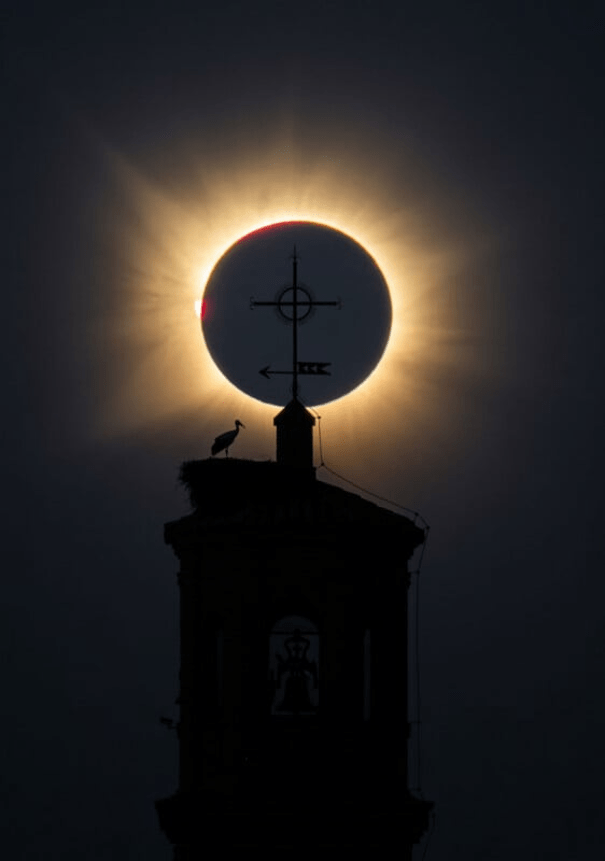
Two photographers changed the notion that photography is a solo venture by teaming up for a year-long research gig on how to get the best pics of the next total eclipse. Canadian wildlife and nature photographer Liron Gertsman and Texas bird photographer Tobias Yoder traveled together to Spain. Each had taken spectacular eclipse photos in 2024 and were on a quest to capture the perfect eclipse photo in 2026.  They were not just looking for perfect weather conditions. They also were in search of a great white stork!

It turns out that Spain held the best eclipse opportunity. Spain also lays claim to possessing the largest stork breeding population in Europe. The pairing of this great bird with an eclipse shot was irresistible. With over 50,000 breeding pairs of white storks to choose from in Spain, the intrepid photographers went on a stork-nest hunt.

Oh, there was a third element desired in the perfect shot – either a church bell tower or a castle tower, please! Yoder created an app to help define eclipse possibilities, utilizing his background in software development. The determined photographers split up their tracking map, each searching for appropriate sites. They drove to nest locations, always on the lookout for nests on towers.

A particular church bell tower with a stork nest perched on top was pre-selected as “the one.” Yet, the big unknown (in addition to weather), was whether a given stork would return to its bell-tower nest by 8:30 PM local time. The stork-nest hunters visited their ideal location for 3 evenings before the big day. On two of the evenings, the picture-perfect stork returned to roost before the 8:30 time slot. One evening was a late night out, but Gertsman reasoned that their stork shot would be successful due to effects of an early darkened eclipse sky. Only arriving 30 seconds before eclipse totality that special night, the chosen stork became a collaborator, offering its silhouette in stunning stillness.

Just to make sure their photo adventure would not be a bust, the photographer innovators had set up backup cameras in a location far away. They programmed this second shoot to begin 15 minutes pre-eclipse and keep snapping away approximately every 5 seconds. Fortunately, their secondary location also delivered. It was an awesome photography evening!

For more photos from that lucky night, see https://petapixel.com/2026/08/19/two-photographers-spent-a-year-planning-the-perfect-eclipse-photo-and-success-came-down-to-30-seconds/?ck_subscriber_id=2584255186&utm_source=convertkit&utm_medium=email&utm_campaign=Start%20packing%20to%20avoid%20this%20common%20regret%20-%2023021000

How much of our lives do we overshadow our own curiosity and creativity? We can be inspired by the grit (passion + perseverance) shown by these photographers. Their intention to collaborate paid off with unique results. How might we encourage others to take on peaceful projects that inspire creativity? As “Nickel Creek” Grammy Award-winning guitarist and singer-songwriter Sean Watkins suggests, “Only the curious have something to find. “  

Pearls of Peace (PoP) Quiz

528. When have you captured a photo of a unique slice of nature?

529. What has to happen to you to feel awesome joy?                    
Curiosity Saved the Cat

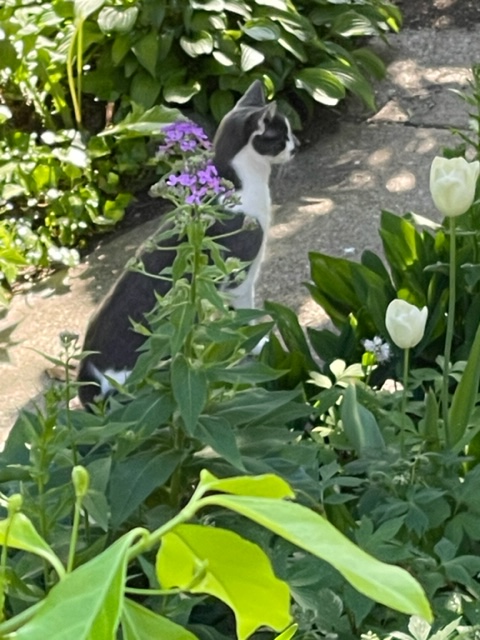
I grew up with cats – not house pets, but the outdoor-mouse-catching kind. They were a source of hours of play and intrigue. I learned curiosity and considerable caretaking from my stray-cat collection. Why anyone believes that “Curiosity killed the cat” does not know felines. Curiosity saved cats. Curiosity is a necessary ingredient for effective problem-solving which requires generating alternative possibilities. Catching a mouse takes alternative strategies, as first attempts may fail. Curiosity is helpful not just for cats, but for stray humans.

Of course I was curious about the phrase, “Curiosity killed the cat.” Originally, phrasing was “Care killed the cat!” Care represented worry, sorrow, or grieving, with the connotation of excessive worrying is detrimental for one’s health. William Shakespeare used this “care” version. However, by late 19th century phrasing, “curiosity” took the place of “care,” referring to nosiness!

Lead researcher Charan Ranganath and his colleagues published a study at University of California (Davis) in Neuron using fMRI scanning of human brains while participants were reading trivia questions. Participants rated how curious they were to know correct answers. Those with intense curiosity about trivia answers had 2 brain areas that “lit up”: the dopamine-releasing midbrain as well as the hippocampus. Dopamine-releasing neurons have many functions – controlling voluntary movements, processing rewards, as well as regulating motivation and cognition. The hippocampus is key to  memory functioning. The super-curious responders were better able to recall unrelated information presented during their curiosity about trivia questions. Better cognition depends on oiling your neurons with curiosity!

The message is clear – rewire your curiosity if you have forgotten how to be curious.

Developmental psychologist Susan Engel at Williams College tracked how many questions children ask per hour. She found that the average 5-year-old asks 107 questions per hour! Why is Grandpa’s hair white? Why is the sky blue?  These are just a sample of the questions from astute 5-year-old curiosity experts. Then the inquisitive beings go to school. By age 6 and in first grade, Engel found that one entire class asked 2-3 questions per hour combined. And by 5th grade that number dropped to .48 questions per hour. Described another way, a room of 11-year-olds asked less than 1 question every 2 hours.

Engel recalled her observation in the back of a science classroom where students were running experiments to test weights with a balance scale. The teacher squashed curiosity when abruptly saying, “Enough of that. I’ll give up time to experiment at recess. There’s no time for experiments now. We’re doing science.” Engel made a scary conclusion: if you lose your curiosity by age 11, you probably don’t get it back. Does schooling kill kids’ curiosity?

If cats are capable of alternative problem-solving, can’t kids recalibrate their curiosity? I have a lot of curiosity and I hope that you, dear reader, do too.

Pearls of Peace (PoP) Quiz

526. When did any adult curb your curiosity?

527. How curious do you see yourself at your present age?