Pearls of Passionate Aging

“The Prima Ballerina Still Going Strong After 75 Years” (Wall Street Journal)

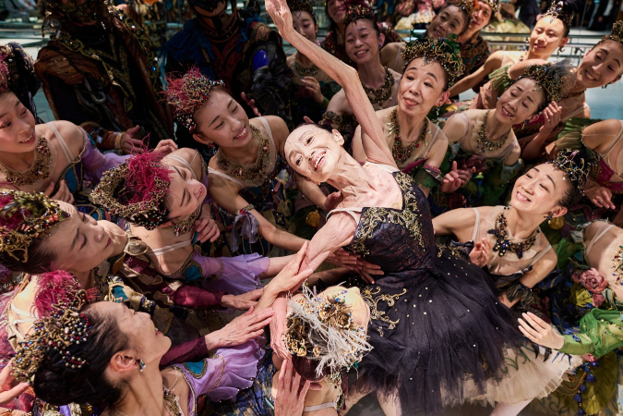
Yoko Morishita has the titles of  “Pearl of the Orient” and “Prima Ballerina of the World” according to Jason Douglas and Junko Fukutome, writers for Wall Street Journal. Beginning lessons at age 3, Morishita has the distinction of being en pointe for 7 decades. Her esteemed teacher and idol, British ballerina Margot Fonteyn, retired at age 62. Retirement is not in Morishita’s vocabulary; as a disciplined dancer, she practices her craft 6 hours a day, 6 days a week (stretching the 7th day). Morishita espouses the belief, “We can express passion in calmness.“  If you watch her online, you feel her dynamic passion. And you appreciate that she has persisted to polish her calm charisma.

Let’s admire grit (passion plus perseverance) in Morishita. She is the world’s oldest ballerina. She is rehearsing her beloved role as Clara in “The Nutcracker” for November, a role she has performed for 45 years.  She maintains positive expectations: “Once today is over, I think about tomorrow’s lesson.”

We might look to Morishita’s childhood to understand her incredible drive. Born in Hiroshima, 3 years after the city’s deadly destruction from an atomic bomb, she references the resilience of her family and neighbors as her guiding motivation. Her grandmother sustained serious injuries from the blast.

Morishita was slight and frail in childhood. A physician prescribed physical exercise, so her parents enrolled her in ballet classes in a kindergarten (across the street from the family home) that taught ballet after school. Morishita’s first ballet performance occurred as a first-grade fledgling. With a strict “old school” teacher, the little girl endured strikes on her feet from the handle of a feather duster if she was clumsy from pain for enduring en pointe too long. Morishita described parents not complaining about such harsh treatment; instead, they applied ointment to wounds.

At age 12 Morishita asked her parents to send her to ballet school in Tokyo. Her career flourished over the decades. She performed with legendary Rudolf Nureyev for Queen Elizabeth II’s Silver Jubilee Royal Variety Gala. The two renowned ballet stars danced together 200 times in one decade. Despite a 4-foot-9-inch frame, Morishita remains a powerhouse on stage. A dance critic describes her captivating style as “uniquely Japanese.”

The frightful attacks on Hiroshima on August 6, 1945, and Nagasaki on August 9, 1945, remain as a terrifying reminder of the perils of war. Hiroshima lost 80,000 people instantly (with a total death count of 140,00 by the end of 1945). A 5-mile section of the city was obliterated. Nagasaki lost an estimated 74,000 individuals. Another 91,105 survivors alive today suffer from ongoing health challenges of cancer and radiation sickness; thousands die each year. Remaining survivors were infants or young children in 1945.

Morishita is like a phoenix rising from literal ashes in Hiroshima to remind us of peaceful possibilities in life.

Pearls of Peace (PoP) Quiz

522. What is the background of your motivation story?

523. How might Morishita inspire your passion plus perseverance?

Self-Communication Grit

Social work researcher Brené Brown teaches employees how to fail. She calls this training “Daring Leadership.” Millennial employees and interns make up half of her staff. She reports that nearly every Millennial who works with her has confided some version of a kind of innocence: “I never learned how to have these kinds of conversations.” “I never learned about emotions or how to talk so openly about failure, and I’ve never seen it modeled.” “When you’re used to using technology for everything, these hard face-to-face conversations are awkward and so intense.”

If tough communication skills are not taught at home, then public education might pick up the slack. However, schools do not like the word “failure” any better than parents. This communication grit training then falls to OJT, or on-the-job training, the great teacher in most work settings.

I recently read that researchers report evidence for humans speaking as many as20,000 to 75,000 different languages in a timeframe between 1,000 and 3,000 years ago. I wondered if early humans had vocabulary for failure or disappointment in any of their languages. According to an internet search, every culture has a linguistic version of mistakes, or lack of success. However, it is impossible to know vocabulary from thousands of years ago! Many questions have few clear answers.

Irish organizational consultant Annette Clancy did her PhD research on emotion in organizations with a questioning focus on disappointment. She found that the wider the gap between expectation and reality, the greater the disappointment. Major disappointment entails a grieving process, even if the reality of some special thing happening never existed. This applies to one’s work as well as one’s relationships, but disappointment frequently is masked by distracting or numbing oneself. Most of us have little training in addressing our disappointments.

Disappointments need communication, often first with ourselves.  And we need passion plus perseverance (grit) to be frank in our self-communication. Why exactly are we disappointed? It is only one part of one’s personality, but it can link up with a chain of personality parts that exude vulnerability, blame and/or anger, the other parts that we try to avoid.

Your disappointment has roots. This simple recognition is a starting place for some investigation. What were your expectations about a given situation? What were some earlier times when you were disappointed? Can you think of any disappointments from your childhood years? Was some failure ignored or denied at that time? It is time to admit failures, flubs, and disappointments. In fact, learning from failure may be key to creativity. Post-it Notes were created from “failed” weak glue.

Let’s adopt Brené Brown’s approach: “No vulnerability, no creativity. No tolerance for failure, no innovation. It is that simple. If you’re not willing to fail, you can’t innovate. If you’re not willing to build a vulnerable culture, you can’t create.”

Pearls of Peace (PoP) Quiz

520. When has a disappointment eventually led you to innovate?

521. What gets in the way of meeting your goals?

What Makes a Champion?

Pearls of Peace was a “champion” blog multiple times in its every-Monday 5-year run of 500 words. Recognized by Illinois Press Women’s Association (IWPA) and National Federation of Press Women (NFPW), here are some reviewer comments:

“One of the more compelling and emotional statements I have read with an associated entry…the blog is…inquisitive…and with a firm perspective.” It is an honor to have positive acceptance of my musings on disparate topics. My goal is to offer curious connections that might lead readers to pause for mindful moments.

What does firm perspective mean to me? It encompasses my belief in cultivating a growth-and-grit mindset to live one’s life with meaning. It takes both continual learning and considerable grit – passion plus perseverance – to keep working on some goal for any extended amount of time.

Writing a blog is not the same as being a soccer player, but a firm perspective about one’s craft is also necessary for the passionate and persistent soccer players making their way to World Cup championship rounds. I cheered for many different teams, but mostly I cheered for players’ relentless resolve, their stick-to-itiveness in their performances. Being a champion is not just about winning accolades.

Another champion is a boy named Mattie J.T. Stepanek who died at age 13 from a rare genetic neuromuscular disease that also claimed the lives of all 3 of his older siblings. His mother, Dr. Jeni Stepanek, did not know that she possessed an adult-onset form of this genetic condition. Mattie lived with a firm perspective when it might have been otherwise. He embodied a growth-and-grit mindset in his short lifetime. Beginning to read and write at age 3, Mattie wrote poetry to grieve the death of his brother. He named his poetry Heartsongs and eventually published 7 books of poetry and peace essays. Here is his 9-year-old poem, On Being a Champion:  

A champion is a winner, / A hero…  / Someone who never gives up / Even when the going gets rough…Someone who overcomes challenges / Even when it requires creative solutions / A champion is an optimist.  /A hopeful spirit…  / Someone who plays the game, / Even when the game is called life…  / Especially when the game is called life.  / There can be a champion in each of us, / If we live as a winner, / If we live as a member of the team, / If we live with a hopeful spirit, / For life.

Mattie advocated for improved hospice laws for children. He referred to “global neighbors…in the mosaic of humanity.” His call for “pathways and choices” for personal and global peace were messages for world leaders. Mattie’s birthday on July 17th is honored in his hometown (Rockville, Maryland) as Peace Day.

My blog’s 5th birthday is July 21st. Let’s share Mattie’s hopeful passion for peace among global neighbors.

Pearls of Peace (PoP) Quiz

516. What are you passionate about?

517. Where does your resolve and perseverance take you these days?