Beauty in Character

May is Mental Health Awareness Month, although every month needs to have perennial awareness of bodymind health. The ancient words attributed to Chinese philosopher Confucius or K’ung Fu-tzu (551 BCE-479 BCE) reflect how important mentally healthy families are to a peaceful planet: “If there is righteousness in the heart, there will be beauty in the character. If there is beauty in the character, there will be harmony in the home. If there is harmony in the home, there will be order in the nations. When there is order in the nations, there will be peace in the world.” 

While we do not have any accurate accounting of the childhood or family life of Confucius, there is undisputed history about China being in a time of ideological crisis then. The Zhou Empire had held ruling power for a 500-year span, but feuding hereditary families began eroding a sense of Chinese traditions. Some elite regional rulers lost track of a concept of beauty in the greater good. They became competitive with their dynasty ruler for  wealth and women.

Diminished moral principles were the impetus for Confucius’ ideas. He spoke with a systemic view of his beloved country’s leadership. Confucius taught that a leader must lead by positive example – teaching virtue, living with integrity, exercising self-discipline, remaining humble, and treating people with compassion. Confucius believed that mutual moral obligations were a country’s unifying force. His teachings promoted learning virtue so that a leader’s subjects would follow lawful living. This plan-ahead approach is as true for effective parenting as for wise politics.    

While Confucius died believing that his philosophy had not reached people in any significant way, his teachings prevailed, becoming the recognized official philosophy of China for a time. He had attracted a motley crew of disciples — aristocrats, merchants, farmers, artisans, and criminals. Some Chinese still follow Confucianism, as well as some folks in Japan, Korea, and Vietnam.

Confucianism is not an organized religion, but rather a guiding discipline for “beauty” in one’s character (ethical behavior). Treating others well is a mainstay in mental wellness. Confucius and his followers promoted love for humanity, ancestor worship, respect for elders (seasoned citizens in my words), self-discipline and compassion. Loving others while possessing self-discipline (ren) is summarized by his rendition of the “Golden Rule” — “What you do not wish for yourself, do not do to others.” (Lunyu or The Analects of Confucius, 12.2, 6.30).

This familiar teaching is part of every world religion. It is repeated multiple times in the Analects. The beauty-in-character message does not imply easy solutions. Another impact saying attributed to Confucius involves how to teach (or parent) another: A teacher only “...points out one corner of a square;” their mentee must “…come back with the other three.” (Analects, 7.8).

Pearls of Peace (PoP) Quiz

393. What are the 3 top virtues that you choose to live by?

394. How do you believe we might reinforce beauty-in-character lessons for today’s children?

Can Springtime Jumpstart Social Prescribing?

Winter aconite bulbs in buttercup family (Ranunculaceae)

There is something magical about the warming of days and the return of blooming bulbs unfurling upward, while trees are budding outward, after their winter hibernation. Spring (or vernal) equinox occurred March 20th. Vernal equinox comes from Latin vernal (new or fresh), aequus (equal) and nox (night). Spring equinox delivers daylight in equal amounts of approximately 12 daylight hours and 12 darkness hours as the sun is above the equator at midday.

March equinox in the Northern Hemisphere is the warming trend signaling that summer is not far away as this section of Earth begins showing more hours of sunlight than darkness. Look north for the Big Dipper to be at a high point. In the Southern Hemisphere, March equinox is the polarized opposite; as this region begins tilting away from the sun, the beginning of autumn occurs. According to EarthSky, the fastest sunsets and sunrises of the year occur on the equinoxes. Another Nature tidbit — auroras’ sky dances frequently happen around autumn and spring equinoxes when geomagnetic storms on the sun cause rippling disruptions in Earth’s magnetic field. This awesome feature of Mother Nature reportedly is one of the earliest patterns ever recorded by scientists. https://earthsky.org/sun/aurora-season-auroras-equinox-connection/

I was in Washington state before spring equinox and received an aurora alert on my cell phone! Being an avid sky observer, I set my phone alarm to get up at the prescribed possibility time, but a clear sky did not unfurl any aurora beams of beauty. However, just this possibility of seeing a blooming sky made me smile.

There is something healthy-feeling about warmer temperatures, as more people gather outside and enjoy Nature’s bounty. Doctors are learning to administer social prescriptions. Physicians Alan Siegel and Carla Perissinotto offer this description: “Social prescribing means connecting of people to activities, groups, and support that improve their health and well-being. These often include a range of social services, the arts, nature, volunteerism, movement, companionship and community-building.” Social prescribing is active in 32 countries. I wonder if social prescriptions are refilled more frequently in Nature’s pharmacy in springtime.

Massachusetts has a statewide program in social prescribing. For example, a hypertension research study (Brigham and Women’s Hospital in Boston) utilizes social prescriptions through an art-prescribing company, Art Pharmacy. Based in Atlanta, Art Pharmacy partners with programs in California, Connecticut, Georgia, Massachusetts and New York. Founded in 2022, one goal of Art Pharmacy is to address the loneliness and mental health crises of U.S. citizens. Traditional physical and mental health care can have serious gaps in reaching many individuals’ needs. Social Prescribing USA, a national advocacy organization, has 8 states with pilot projects.

Springtime means the beginning of gardening season for me. All of us need sunshine, both literally and figuratively. Spring delivers more literal sunshine, but the figurative sunshine of well-being is elusive for many.

Pearls of Peace (PoP) Quiz

379. What does springtime mean to you?

380. How might you write your own prescription for social well-being this spring? 

Pearls of Brain Awareness

Brain scan data, Human Connectome Project: Credit Matthew F. Glasser, David C. Van Essen

Growing up in farmland with paternal grandparents who produced their own beef and pork, I was offered cow brains for dinner in butcher season. While my parents relished this delicacy, I recoiled and could not partake of this unique delicacy. I had no awareness about missing the nutritional benefits of beef brains (vitamins A, B6, B12, C, D, E, K, phosphatidylserine, folate, niacin, magnesium, zinc, and choline, among others), but I still am not a proponent today. I am a proponent of taking care of one’s own 3-pound brain at mealtimes, sleep times, exercise times, and well, any time!

I like the global focus on Brain Awareness Week (the third week of every March), which serves as an annual launch for year-round brainy activities. This is the 30th annual Brain Awareness Week, the “brainchild” (I could not resist) of the Dana Alliance for Brain Initiatives and the European Dana Alliance for the Brain. The Dana Foundation is a nonprofit organization with the lofty goal of promoting brain science internationally to create better futures for everyone.

Dana foundation-sponsored programs such as one in Bamenda, Cameroon, and promoted by physician, Mundih Noelar Njohjam (founder of Cameroon Epilepsy Awareness and Aid Foundation), delivered brain science education to 5000 students. Njohjam provided her grant feedback: It was really interesting to watch [the students] as we explained the wonderful nature of the brain and how neurological diseases occur…especially epilepsy, because in our country epilepsy is often attributed to witchcraft. After listening to us talk, one student openly told us that before we came, he was one of those who usually stigmatized people with epilepsy,” she said. “So many confessed after the presentation that their mindset about epilepsy has really changed.” Truth matters.

Consider some facts offered by the Global Council on Brain Health: https://extension.illinois.edu/blogs/family-files/2025-02-24-celebrate-brain-awareness-week-all-year-long

  • Most of us are capable of learning at ANY age, especially getting involved with cognitively stimulating activities such as meeting new people, growing new hobbies or expanding knowledge.
  • Dementia is NOT normal aging. Typical age-related changes in the brain are different from those caused by disease.
  • Children are not the only ones who can master a foreign language – age does not prevent you from learning a new language.
  • Memory skills can improve with practice. The adage, “Use it or lose it,” is as important to memory skill training as it is to taking care of one’s physical health. 
  • Retaining details is just easier for some people than others, but this is true for all ages.
  • Strategies can ripen your memory. Chunk information into smaller bits for enhanced memorization. Use mnemonic devices. Practice retrieval (spacing out repetition works better than cramming). Make flash cards. Quiz yourself.
  • Neurons are created throughout your lifetime.

Being a life-long learner is invigorating! I am grateful for my many opportunities to keep my workhorse brain on the move.

Pearls of Peace (PoP) Quiz

377. What new learning have you embraced recently?

378. How might you become a better caretaker of your brain? 

Attachment in Words

Are you aware of how your words land on a listener’s ear? Words can be like poison arrows or love letters. Both your flying-missile words and thoughtful spoken or written words of caring have staying power. They are not taken back easily. Words can boomerang across generations.

Whose words are you speaking on a regular basis? We do not ask ourselves this question, as we may not be aware of the answer.  I can recall the stunned look on a client’s face when she admitted that she suddenly caught herself “sounding just like her mother” in a heated exchange with her feisty teenager in my therapy office. Her insight provided an incredible starting place for real change in the parent-child relationship. Admitting that her lashing-out response was not what she had intended, but it just “slipped out,” was a healing moment for broader family dynamics.

Much of the time adults attempt to manage activated parts of their personalities with little recognition that they replicate another’s response patterns. Generations share not only DNA but some embedded ways of speaking to one another. Rage reactions do not “come out of the blue,” but often are solidly anchored in caretaker attachment issues. Early relationships in childhood can set the pace for later attachments.

Neuropsychiatrist Dan Siegel suggests that (as early as age 7) children pick up on attachment patterns of adults in their world. Based on the early theory of British psychiatrist John Bowlby and later research by American-Canadian psychologist Mary Ainsworth and others, there are four attachment patterns. Here are representative take-away words from each pattern:

  • Secure — “People will respect what I say.”
  • Avoidant/dismissive – “I did not get what I needed; I don’t need anybody for anything.”
  • Anxious/ambivalent – “I don’t know if you are my friend or not.”
  • Disorganized – “I can’t regulate my emotions; I fragment. Under stress I can’t think straight.”

Michigan poet Will Carleton cautions: “Boys flying kites haul in their white winged birds; you can’t do that when you’re flying words. ‘Careful with fire,’ is good advice we know. ‘Careful with words,’ is ten times doubly so.”

Dan Siegel believes that parents are capable of creating secure attachments with their children even if they did not receive such caring from their caretakers. The key is being aware of an honest and coherent narrative of one’s own upbringing.

Siegel’s 4 S’s remind us how to foster secure attachments. ALL adults can improve their approach to family life and work life. Employers, heads up!

What a different world we would have if parents and employers had secure attachments!

Pearls of Peace (PoP) Quiz

367. What are your words for making sense of your childhood?

368. How do you view your attachment pattern today?     

Creativity and Well-being

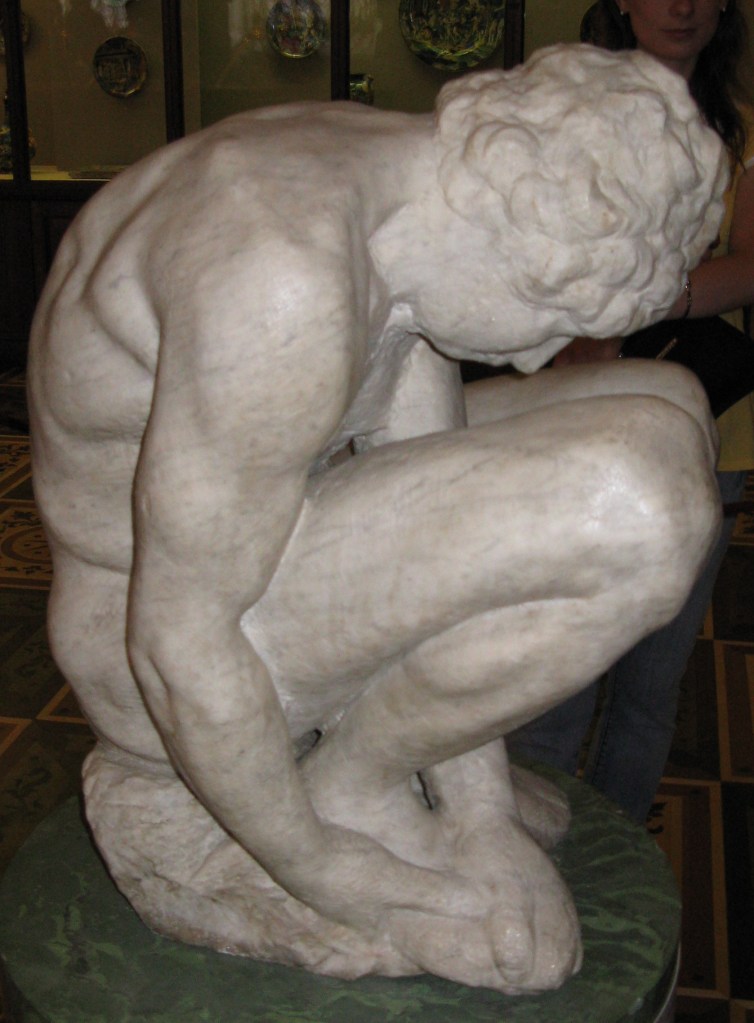
Michelangelo, Crouching Boy, 1530, The State Hermitage Museum, Saint Petersburg, Russia

Michelangelo created 42 sculptures. His Crouching Boy initially belonged to Italian banking and political dynasty Medici’s of Florence. In preliminary drawings for a double wall tomb for Lorenzo de’ Medici and his assassinated brother, Giuliano, Michaelangelo drew two crouching figures; only one was sketched in a final design. About 250 years later Crouching Boy was purchased by Russia’s Catherine the Great through a banker who did not know it was sculpted by Michelangelo. Its current home is the Hermitage Museum. If only sculptures could speak!

One interpretation is that ambiguous Crouching Boy is removing a thorn from his foot. There was a tumultuous political climate in Florence and Michelangelo was taking shelter in the monastery of San Lorenzo. Is Crouching Boy making a political statement? According to some scholars, Crouching Boy is considered an allegory of mourning – a grieving soul depicted in an unfinished marble statue in an oddly-seated position. A second opinion is that Crouching Boy is a representation of eternal youth. Take your pick.

Michelangelo led a solitary life and worked until dying at age 89. Aside from his renown as a sculptor, he was a poet. His poetry suggests that a younger man was his love interest. Whether or not he was a gay man who had to hide this fact, people in the 1500’s noticed that mostly nude men were his art form. As artist and activist Richard Kamler suggests, “Art is our one true global language…it speaks to our need to reveal, heal, and transform. It transcends our ordinary lives and lets us imagine what is possible.”

What meaning does “removing a thorn” have in today’s world? Wars are notorious for demonizing the other and for name-calling others who are not known personally. One might ask what constitutes a “thorn” today. We live in ambiguous times. Different interpretations for our global future abound.

Perhaps all of us would do well to turn to the arts. As authors Susan Magsamen (Founder/Director of the International Arts + Mind Lab at Johns Hopkins University School of Medicine) and Ivy Ross (VP of Design for hardware products at Google) eloquently write in their 2023 book, Your Brain on Art: How the Arts Transform Us, “…[the] alchemy of art and science is transforming our biology in ways that are both measurable and effective…artistic endeavors…effect beneficial outcomes for our physical and mental health…begin to create personalized arts practices. Like exercise and good nutrition, the arts on a routine basis will support your health.”    

The World Health Organization (WHO) defines mental health as a state of well-being whereby an individual realizes their own abilities, copes with normal life stresses, works productively, and is capable of making contributions to their community.

It took 35+ years to paint the ceiling of the Sistine Chapel. Perhaps you select a slightly smaller project? 

 Pearls of Peace (PoP) Quiz

 347. When have you turned to the arts for transformational time?

348. What do you notice when you are in creative mode?                              

Giving-Thanks

Let’s put Giving before Thanks in Thanksgiving.

 To set the record straight, Native Wampanoag people gave a successful corn crop to the immigrants who then declared a successful harvest in their first settler year. The two groups had a harvest gathering of the wary; at least 90 Native men and 50 Englishmen attended according to Plimouth Plantation colonial food expert, Kathleen Wall. Where were the women? Reportedly, Native givers dined on the ground according to their custom; the English sat at a table according to their custom. Why didn’t the thankful English join their benefactors by sitting with them?

Wampanoag leader Massasoit negotiated a treaty between his tribe and Plymouth settlers in 1620. They agreed that no individual of their respective groups would harm anyone from the other group. But tragedy was not averted; there was bloodshed. Complicating the fragile relationship between Native land dwellers and their nemesis neighbors, about 25,000 European colonizers crossed borders between 1630-1642. Including violent conflicts with settlers, the Native population lost more than half of their tribes as smallpox, measles, typhus and cholera decimated the indigenous people who had no immunity to newcomer diseases.

The holiday “Thanksgiving” became a U.S. national celebration after writer and magazine editor Sarah Josepha Hale petitioned four prior Presidents before President Lincoln agreed, issuing a gratitude proclamation in 1863. Nearly a hundred years later (in 1970) Native people gathered in Plymouth for a National Day of Mourning, not gratitude. Who tells the true story to school children?

Massachusetts celebrated the 350th Anniversary of the first landing of the Mayflower in 1970. Wampanopag leader Wamsutta Frank James was invited to speak at the banquet. Organizers requested a copy of his prepared remarks and then rescinded the invitation when James refused to read a redacted speech prepared by the PR team. The National Day of Mourning was initiated; 500 indigenous people (from 25 tribes) attended in Plymouth. As a commemoration of the suffering of Native people and a protest against racism, this gathering continues each year on the fourth Thursday of November. Listening to the granddaughter, Kisha James, of Wamsutta Frank James at a recent National Day of Mourning is a sobering experience: https://www.umassp.edu/deia/resources/supporting-indigenous-people/national-day-mourning

November was dubbed Native American Heritage Month by President George H.W. Bush in 1990. It also is called American Indian and Alaska Native Heritage Month. The Department of Defense reports that American Indians and Alaska Natives have one of the highest representations in the U.S. Armed Forces. When does America give thanks to indigenous people?  

Perhaps our country can introduce a nonprofit program meant for school children to all individuals. GiveThx defines the school behaviors expected for belonging and mental health in a given schools’ culture. At Lanai High and Elementary School in Hawaii these TORCH values were locally defined: Tenacious, Observant, Respectful, Compassionate, and Honorable. I am grateful that my children exercise these values.

Pearls of Peace (PoP) Quiz

345. What are your beliefs about Thanksgiving? 

346. Who might benefit from your gifting on this holiday?    

Are YOU Meeting 5 Basic Needs?

Autumn Crocus

When asked to give a keynote talk at a fundraiser for a suicide-prevention-curriculum organization, I flashed on a psychology graduate school professor who taught that the most important ingredient a therapist must deliver in any psychotherapy session is to “leave the client with hope.” This simple phrase applies to almost every encounter we have with others.

September is National Self-Care Awareness Month and Suicide Prevention Month (see blog, Prevention is an Intervention). Our best action regarding suicide is to prevent it. Here’s my talk highlights:

What is the opposite of committing suicide? I would say, flourishing! How might you flourish? Fair pay, equal pay for equal work, and other economic factors are important, but today we focus on what you can do to flourish in a bodymind sense.  First, you flourish by meeting your own basic needs. Then you can lend a helping hand to a neighbor, family member, friend, or student who is struggling to meet their basic needs.

Instead of admonishing others with the 19th century foot metaphor, “pull yourself up by your bootstraps” — which Wikipedia says originated from a tall tale where a man told of pulling himself out of a swamp by his own pigtail — we will use a hand as a memory tool…See how moveable and “energetic” your thumb can be!  Let your thumb stand for ENERGY, instead of ennui lethargy…a flexible thumb provides endless possibilities for action. Begin with feeding yourself a nutritious diet, getting 7 hours of sleep, and exercising in a way that suits your body. 

Your pointer finger stands for DISCIPLINE, rather than disorder. Some adults and even teachers (I’ve seen it) point this finger in an emotional, menacing way to deliver “discipline.” Bill Clinton pointed his index finger at the American people, saying, “I did not have sexual relations with that woman, Miss Lewinsky!” Today, Mark Robinson, running for governor in NC, is pointing at voters. Both forgot that their own 3 fingers point back at them!  There is cognitive pointing, as in pointing to the pretty butterfly. We celebrate when a baby learns to point at objects. Try pointing your index finger upward, as a reminder to yourself, that you are interested in raising “up” children (or students or colleagues) using morals and values as your guide. Discipline is a basic need. Having the discipline to eat healthy choices, get enough sleep, exercise, and keep learning with a growth mindset – ALL require some structure. The word discipline has the same root meaning as the word disciple. It means to follow a good lead.

The middle and longest finger has a long history of meaning scorn or insult when held upright. Over 2500 years ago the Greek playwright, Aristophanes, is credited with showing insult by raising the middle finger. He made a crude joke about a certain male body part. It is time for this finger to receive a creative comeback!  CREATIVITY, instead of conformity, is a go-to basic need if you want to flourish.  Creativity involves curiosity, problem-solving, and dreaming new ideas. Albert Einstein once said, “Creativity is intelligence having fun.” Creativity involves personal autonomy, wanting to do something because it’s interesting, enjoyable, or personally challenging. And creativity is not just Big-C creativity, as in becoming a famous artist. Creativity has many little-c possibilities that engage your originality, flexibility, or personal voice.

The ring finger is known for its special BELONGING to close relationships, as in couples sharing wedding rings to symbolize their belonging, rather than the Blues. For those in the mental health field, we are talking about attachment. All these needs are important, but belonging connections are vital. Researchers have found that after food and shelter, positive social connection is our greatest need benefiting bodymind health. People who feel more connected to others have lower rates of anxiety and depression, a 50% increased chance of longevity, a stronger immune system, and faster recovery from disease.

The left “pinky” finger is the one that hits the letter “A” on the keyboard! Recognize your ABILITY, not your apathy. Have competence to believe in your skills to achieve goals and experience a sense of mastery. In the past it was considered that IQ was fixed. This is not true. IQ tests measure what can be done now, not what can be done in the future. The brain can store nearly 10 times more data than previously thought, research confirms. Keep storing new learning!

Our needs are interactive. They can work together, or not. I lined up the backward ABCDE’s — Energy/Discipline/Creativity/Belonging/Ability — handprint to help individuals remember 5 needs. Some days are a challenge to meet even 3 needs. If you live with others, it gets more complicated, because others inevitably want to meet a need — involving YOU — at a different time than you anticipated.

What’s more, we have an integrative core SELF– this is not “ego.” Some might prefer the word spirit, or soul to SELF. It is a calm acceptance, a grounding, a deep reservoir of integrity, wholeness; it is owning OK-ness. Let’s consider a core SELF in the palm of your hand. When we hold hands with another, we can remind ourselves that our core SELF touches another’s core SELF. This is co-regulation or lending a helping hand. And meeting needs, both ours and helping others meet their needs, is flourishing.

Pearls of Peace (PoP) Quiz 

239. How is your self-care flourishing today?

230. What might you do to help another person flourish?        

Real Pearls, Real Information

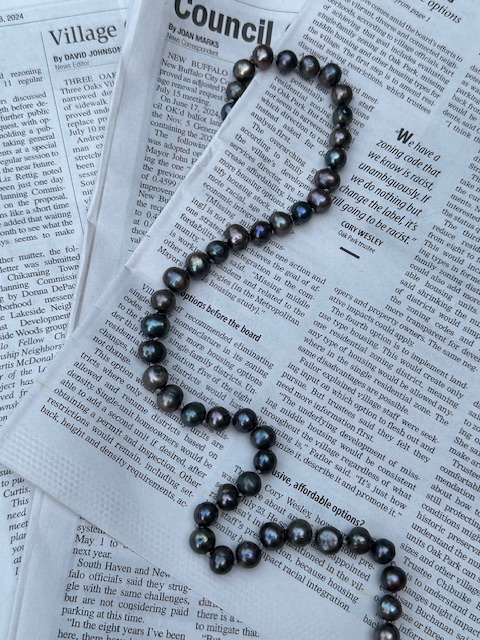
How do you tell a real pearl from a “cultured” pearl? It is difficult to tell the difference with a cursory look at outer appearances. An x-ray of the internal pearl is not available for most of us. A natural pearl may show ongoing “growth lines” where concentric layers of nacre build up. Nacre is often called mother-of-pearl; while it is whitish, it shines with different colors and is used to make buttons and other jewelry. Real pearls have special appeal, as their nacre layers can “bounce” light, making better “color.” Cultured pearls only have a thin outer layer of nacre.

One method of testing your pearls is to look at the holes drilled into the pearls; imitation pearls often have larger holes than real pearls. Now, gently rub two pearls together; imitation pearls will slide smoothly against one another while real pearls’ nacre is “gritty.” Grit is one of my favorite words, so you know that I admire the real deal. A growth-and-grit mindset is necessary for navigating the real world.

How do you tell real information from misinformation? Unfortunately, this is more difficult than detecting a real pearl! In the July/August edition of Monitor on Psychology, the magazine of the American Psychological Association, an article highlights the intense work of psychological scientists to increase their efforts to stop the life-threatening spread of false information about health.

Psychologist William Klein, associate director of behavioral research at the National Cancer Institute, regrets how politicized the term “misinformation” has become; he sees how social media is often responsible for rumors about health. It is especially disheartening when organized disinformation campaigns deliberately mislead folks with their layers of lies. Research shows that individuals tend to engage more and spread more false information online, compared with factual information. In one Canadian survey, 73% of 18- to 24-year-olds followed at least one influencer who spreads anti-science information. In the U.S. only 37% of adults had trust in CDC recommendations in 2022. So far, interventions regarding misinformation on health have limited success.

Carol Graham, Senior Fellow at nonprofit public policy organization Brookings Institute, cites not just political polarization as a factor in misinformation, but also the decline of local newspapers, the lack of post-secondary education opportunities in impoverished communities, as well as the mounting stress of reduced health and longevity in these neighborhoods.

Investment in declining communities is a critical issue, along with changing how Americans view mental health care. Funding for local newspapers can foster a sense of community, a dwindling concept. Vital communities take pride in their schools. Most of all, education is key in curbing misinformation. Wouldn’t a “cultured” society reform our schools so that all students can enter the labor market successfully?

To make misinformation less credible it will take a growth-and-grit mindset and layers of ongoing gritty change in tax-dollar choices.

Pearls of Peace (PoP) Quiz 

313. How do you detect misinformation?

314. What can you do to stop the spread of misinformation?