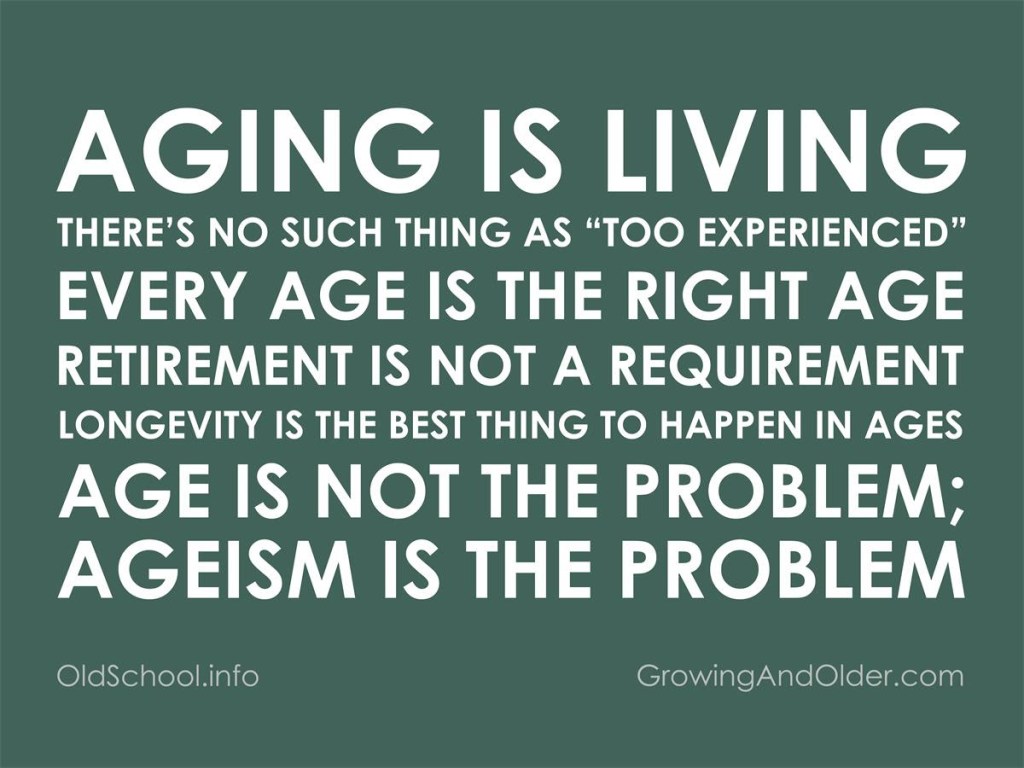
Age-inclusion Please

Ageism Awareness Day is October 9. The American Society on Aging (ASA) Ageism & Culture Advisory Council has a  Fact Sheet for those who want more details on ageism: https://asaging.org/wp-content/uploads/2025/09/Ageism-Awareness-Day-Fact-Sheet-2025.pdf

Ageism is common and yet overlooked as one of the most socially accepted forms of prejudice. A poll reported that 82% of adults in ages 50-80 experience ageism words or actions daily. And to make matters worse, we often are ageist about ourselves! Other highlights from the ASA report include these issues:

  • Ageism covers people of many ages, both as recipients of prejudice and offenders of prejudice.
  • By age 3 children pick up age stereotypes.
  • Ageism refers to stereotypes (how we think), prejudice (how we feel) and discrimination (how we act) toward others — or ourselves — based on age.
  • Cultural ageism slips into our movies, literature, songs, news reporting, and especially our jokes.
  • One research study found that a mere 1.5% of the characters on TV in the U.S. are older adults. If present, they tend to have minor roles and/or are portrayed in stereotypic ageist behavior.
  • Ageism is even more prevalent when it intersects with racism, sexism and ableism.
  • Those who experience multiple forms of ageism are reported to have more chronic health conditions and depression.
  • Ageism has economic implications; AARP estimates that $850 billion in lost gains to the CDP results from involuntary retirement, underemployment, and unemployment in older adults.
  • Older adults support the U.S. economy; ages 50+ support over 88 million jobs (through jobs they hold or create).
  • More than half of small business owners are 50+ years old.
  • Work contributions of older adults are overlooked: caregivers ages 65+ are often unpaid caregivers for their family, friends or neighbors.
  • In 2022 data, 1.1 million grandparents ages 60+ were providing most of the basic care of grandchildren living with them.
  • Older adults have longer periods of unemployment, face discrimination during the hiring process, and receive fewer professional development possibilities.
  • 64% of older workers report age discrimination in their place of work.
  • In one study 1 out of 5 adults over 50 experienced discriminations in their healthcare settings.
  • There are few geriatricians treating the older adult population; the average salary for a geriatrician is half of the salary for an anesthesiologist, cardiologist, or radiologist.
  • Medication-related problems are estimated to be one of the top 5 causes of death in older adults.

I have experienced ageism and while I know about the unconscious bias that exists in the U.S., it is still unsettling as I feel useful, not over-the-hill. I like author and poet Gertrude Stein’s approach: “We are always the same age inside.” Her statement can be taken in many ways, but there is a timeless quality to believing in a core self with an ability to have consciousness to each present moment. There are positive possibilities when we embrace age-inclusion.

Pearls of Peace (PoP) Quiz

434. Have you experienced ageism lately?

435. What do you say when you hear ageism bias tossed into conversations?

Ageism Discrimination

Ageism Awareness Day is on October 9th, but let’s make every day an ageism awareness day as the Baby-Boom generation mushrooms into seasoned citizen territory.

 The World Health Organization posts these alarming findings:  Ageism costs billions annually in the U.S. from age discrimination — the economic cost of age discrimination against older workers was estimated to cost $850 billion in lost GDP in 2018 (from factors such as the inability to find work and earn promotions).                                                                                                               1 in 2 people worldwide are ageist against older people.

It is also possible to be ageist against young people, as in saying, “She’s too green for the job,” likely a sexist attitude and ageist. These discriminatory attitudes often travel together, along with a particularly damaging attitude — racism. “Ageism intersects and exacerbates all the other ‘isms,’ including racism, sexism and ableism,” according to the Ageism Fact Sheet compiled by the American Society on Aging (https://asaging.org/sites/default/files/2024-08/Ageism%20Fact%20Sheet%20-%20Ageism%20Awareness%20Day_0.pdf ).

Here is how journalist Connie Chung, first woman to co-anchor the CBS Evening News, describes the career hoops she jumped through at age 23 in Connie: A Memoir: “…Since I stood only five feet, three and a half inches (don’t forget the half), I compensated by wearing stilettos. I wanted to be as close as I could be, eye to eye with the men. I did not want to look up at them. I wanted to be their equal. I tried to lower my voice to mimic theirs and copied their on-air cadence. I knew they could easily bully me, and I was powerless to fight them, so I joined them. I knew I could never be one of the boys, but surely, I could adopt pages from their playbook. It was easy to imagine myself as just another white guy. I became aggressive, tough, bawdy, and extremely competitive. Yes, I looked like a lotus blossom, but I talked like a sailor with a raw sense of humor.”

There is more ageism discrimination for older adults. 64% of older workers maintain that they face age discrimination; 41% report ageism experiences in their workplace. Often companies have expected ages for “retirement.” For some individuals, leaving a demanding career may be a welcome life development; for others, a mandatory age for retirement seems dismissive of one’s talents.  

• Age diversity is not foremost in planning a company’s workforce, although organizations might gain a competitive advantage from multigenerational employees. Acknowledging age equity increases worker feelings of belonging, along with enhancing productivity.                                                                                                                                                         

 • Healthcare is ageist: In ages 50+, 1 in 5 experiences discrimination in healthcare settings.

Now for the good news, if you are lucky enough to live into your 70’s and beyond: people who possess more positive self-perceptions of aging live 7.5 years longer than those with less positive perceptions, according to Yale University researcher Becca Levy.

Find resources to advocate against ageism (https://asaging.org/ageism-awareness).

Pearls of Peace (PoP) Quiz 

331. How often do you catch yourself being ageist?

332. What might you say to another when you hear an ageist remark?