Restorative Justice (RJ) is an evidence-based practice whose time has not only come, but it is abundantly clear that our entire planet could use a justice reset. RJ is based upon reconciliation, where criminal and inappropriate actions are first viewed as a violation of people and relationships, and not just a violation of social norms and law. Key to the RJ approach is understanding that punitive “treatment” or forced submission in an offender does not produce any increased probability that the offender will engage in appropriate behavior in the future. Actually, such “treatment” is likely to increase resentment in the offender which may lead to future aggression. Only punishing an offender can further damage a fragile relationship between individuals, leaving the survivor(s) with unresolved hurt and suffering.
RJ is a process with trained mediators where the desired focus is upon dialogue between offenders and survivors. Notice that the language for RJ practice is different from the predominant descriptions of perpetrators and victims. This language difference moves away from courtroom apology attempts to actual accountability with an emphasis on repairing harm where possible. Prison time may follow serious infractions, but an accompanying RJ approach allows each person’s history or herstory to be shared in an unhurried and safe environment. Other family or community members, also affected by the harm of the offender, might participate in a RJ peace circle. The opportunity for truth-telling accountability, healing, and prevention of further conflict are desired outcomes.
Circles can also support survivors and work with individuals who are responsible for harm separately. Extensive preparation occurs before bringing together someone impacted and someone responsible for harm for a joint circle, and that only happens when everyone agrees to participate.
Schools are an excellent beginning place to hold RJ peace circles. Instead of treating an offending student with outdated discipline of in-school/out-of-school suspensions, RJ intervention might include teacher, coach, or hall monitor voices, along with the offender and survivor, in a peace circle with a Circle Keeper. If you consider that Black students are referred for “suspensions” (and/or school expulsion) about 3 times more frequently than white students, you begin to link this discriminatory pattern to similar lopsided numbers in prison populations. Black Americans are incarcerated in state prisons at 5 times the rate of white Americans.
Who listens to the stories of youth who may have been survivors in their homes and/or communities before they became offenders at school? Many students feel unsafe at an early age. This is a beginning time to intervene with reconciliation that promotes accountability.
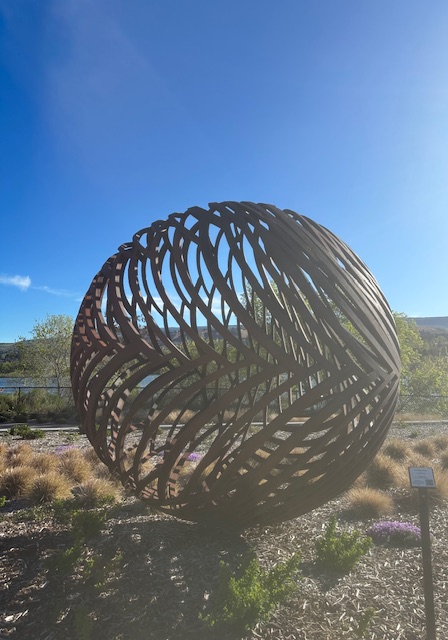
Bernard Hosey’s rusted steel sculpture in a sphere of twisted V shapes and curved arcs is described as “a relic from an ancient civilization or a blueprint for intersteller travel.” The title, Pre-Mathematics, recognizes that there is an origin for everything. This notion when applied to human aggressive behaviors — including lethal behavior like family or societal war — addresses causes that came before a current provocative cause. Aggression and violence erupt out of a lineup of causes. When will we take the time to address the causes proactively that came before the straw-that-broke-the-camel’s-back cause?
Pearls of Peace (PoP) Quiz
490. Who are you when you feel safe?
491. Who are you when you feel unsafe?