Lost and Found Pearls

Joy and grief are a whirling wheel [attributed to Hindu philosophy].

The wheels of loss keep whirling, crisscrossing the globe with trails of grief. According to the Geneva Academy of International Humanitarian Law and Human Rights, 110 armed conflicts are being watched; some spill blood into the evening news, yet many escape coverage despite having lasted for decades. Why are there so many unchecked human-rights violations?

The answer is not just having more laws and lawyers trained in international law. International law seemingly cannot keep up with so many atrocities, especially concerning unattended children who cannot tell someone about being abducted and/or trafficked.

The United Nations reports a 25% rise in grave violations against children in the third consecutive year with escalating reported incidents. The report of the UN Secretary-General on Children and Armed Conflict describes a “blatant disregard for international law and the rights and special protections of children by all parties to conflict.” Children under 18 are to be prohibited from recruitment and use as soldiers, but protection edicts are not followed.

The Convention of the Rights of the Child celebrated its 35th anniversary in 2024, yet the crisis of human rights violations keeps whirling. We cannot be complacent and believe that other countries have more abuse of rights than the U.S. Just this past weekend another U.S. school shooting took place. This time the precious student lives lost or injured were college students at Brown University.

You might ask, when does the wheel turn to joy?

It seems that we will have to rely upon the very youth who have been victims of violations to get us out of our collective abyss. A survivor of the 2019 Margory Stoneman Douglas High School shooting in Parkland, FL, Cameron Kasky (now 25), is an ardent activist for gun control. Kasky commands attention and gives hope. He recently announced his bid to run for the Congressional seat of retiring Jerry Nadler.

After the Brown University shooting, Kasky delivered a passionate TV interview. He does not believe that the Parkland, FL perpetrator should be held solely responsible for the horror created. Systemic problems in America need to be addressed according to Kasky. It is joyful to see youthful power step forward with conviction and leadership.

I found posters inside the doors of women’s toilet stalls in the Orlando airport a few years ago: “Stop Human Trafficking – There is a Way Out.” Initially I shuddered to think that this was a necessary intervention. But acknowledging my second thought, I realized that each girl who finds this pearl of help and learns nonverbal hand signals for H (human) and T (trafficking) might save herself. Our youth will lead the way to human rights.

Poet and essayist Maya Angelou reminds us, “You may not control all the events that happen to you, but you can decide not to be reduced by them.” 

Pearls of Peace (PoP) Quiz

454. How might you participate in the promotion of human rights?

455. What is your first step?                   

Nonverbal Cues as Personality Parts

Pablo Picasso. Bust of a Woman in a Flowery Hat (Dora Maar), 1943. Courtesy Lucien Paris. This painting existed in a private collection for 8 decades but entered public space this month and will be sold at auction October 24, 2025.

Picasso’s paintings of faces can intrigue or annoy. One does not move away quickly. There is a depth that holds one’s focus, allowing one’s mind to travel sideways. My mind travels to Internal Family Systems “parts” model (originated by marriage and family therapist Richard Schwartz). This evidence-based psychotherapy is one I studied and find practical in explaining human behavior.

When I look at Picasso’s portrayal of lover and muse Dora Maar, I see multiple parts of personality depicted. Picasso is a master painter of Rorschach-like faces. There is color shock, but more importantly, there is shock from differing facial details from what one expects. Was Picasso capturing complexities of Dora or was he projecting his own complexities onto canvas? Dora’s words would suggest the latter, referencing her lover’s fragmented renditions of her with disdain: “All his portraits of me are lies…they’re all Picassos. Not one is Dora Maar.”

Well, that is no surprise! We project our “stuff” (“parts” or feelings, beliefs, sensations and actions) all the time, although we often fail to “catch” what we are revealing about ourselves.

Have you ever watched a person’s face turn “colors” when they told you their story about an event? Did their ruby cheeks of embarrassment then shift into your own feelings of embarrassment about some time in your life? We frequently act as mirrors of one another. I see fear in the eyes of this painting. Is this because I have a fearful part about the current violence on our world stage? According to a Smithsonian report, Picasso had fears of Nazis in the time frame of both this painting and his anti-war Guernica masterpiece with its horse-eye fears. Both painter and observer project personality “parts” in varying degrees.

Have you noticed when a person is lying that they often do not maintain eye contact? (There are other possibilities for not keeping eye contact, but lying is one possibility). Other than eyes, perhaps the most obvious thing we watch in another is whether they are smiling at us and how wide their smile is. A smirk smile is vastly different from a friendship smile. These seemingly small details send nonverbal signals between individuals that there is safety, or not, in current relating.

One interpretation of the limited smile on the portrait of Picasso’s lover is intriguing: “[it] perhaps hints at the shadow of a faint, sorrowful smile,” states Agnés Sevestre-Barbé, a Picasso specialist. This painting occurred during World War II during Hitler’s reign when Nazis forces had surrounded Paris where Picasso’s studio was located. The time also coincided with an impending break-up of the 9-year relationship between Picasso and Maar. Picasso met Maar when he was 54 years-old and she was 28. The part plot thickens. Picasso reportedly left Maar after meeting his next conquest, 21-year-old Francoise Gilot.

Pearls of Peace (PoP) Quiz

432. When have you looked at another’s face and made an instant leap to “read” them?

433. Do you practice “catching” the part(s) of you projecting onto another?

Communicate Perils or Pearls

Jitish Kallat, Public Notice 3 (The words communicate 2 historical moments: A speech by social reformer Swami Vivekananda on 9-11-1893 and the terrorist attacks on 9-11-2001), Art Institute of Chicago

In an interview with psychologist Jill Suttie, journalist Nicholas Carr details social media history and its variable effects upon the public. The telegraph and telephone arrived in the 1800’s. The first commercial radio station followed in 1920. As a wireless telegraph, radios provided Morse codes to ships and lighthouses where wires could not reach. Then came an onslaught of radio news, music, and perhaps most important – opinions that dominated the one-size-fits-all airwaves for mass consumption. Some complained that radio was “dumbing down the population.” A dangerous force of radio’s power was when German Nazis took over radio stations in the 1930’s and communicated their propaganda.

Carr makes the argument in his book, Superbloom: How Technologies of Connection Tear Us Apart, that more efficient communication does not equate with better communication. He refers to research that suggests that learning more about other people does not lead to liking them more or even understanding them more. In fact, finding out the various ways that another person is different from one’s self-perception can lead to disliking that person. Simply put, people tend to focus on differences more than similarities and we dislike “the other” who is “different.”

Currently our online lives can overwhelm us with massive amounts of information which we filter through our existing biases. Another problematic issue is that folks are addicted to social media. Carr states it well: “We’re not being manipulated to act in opposition to our desires. We’re being given what we want in quantities so generous, we can’t resist gorging ourselves.”

Social media outlet algorithms find what we use regularly and then load us with similar topics. With the oncoming AI locomotive barreling down media tracks, who can escape this runaway train? AI offers virtual “companions.” Is this communication or manipulation?

A sidecar in social media is the “Influencer.” The definition of an Influencer is an individual who is able to generate interest in something by posting about it on social media. Initially an Influencer was a celebrity (think Elon Musk who was, or still is, an Influencer of the U.S. President), but today’s Influencers can be anyone with a large following on social media. This is enough content about communication perils.

Where are the communication pearls? Communication skills are key in relationships, careers, and world diplomacy. We simply must teach children effective communication and problem-solving skills. Early in my career I was part of a small group of psychologists teaching Myrna Shure and collaborator George Spivak’s Interpersonal Cognitive Problem Solving, later renamed I Can Problem Solve (ICPS). I worked with Myrna at Hahnemann Medical College and Hospital (Philadelphia) and her 8-week curriculum for students from preschool to 6th grade. ICPS engages both teachers and parents in training children on how to think and communicate with an understanding of alternatives. Much communication requires alternative problem-solving steps.

Who teaches adult versions of I Can Problem Solve?

Pearls of Peace (PoP) Quiz

403. Who are your social media Influencers? ‘

404. What communication skills do you use daily? 

Memorial Mammals

Blue whale skeleton, Natural History Museum, London

Gigantic blue whales (100+ feet long) were rescued from extinction in the 1960’s. Hunters gorged on profits from whale meat, oil, and baleen. Blue whale numbers fell from nearly 350,000 to approximately 400 in the late 20th century. While these mammals slowly grow in numbers, they remain an endangered species due to marine pollution and climate change on an uptick.

Today is Memorial Day when we mourn a different mammal’s demise – humans (average height 5.5 feet). In addition to pollution and climate changes that threaten humankind, our species seems fixated on wars. It is impossible to know an approximate numbers of soldiers and civilians who lost life in war-related “hunting” in different desired profits, especially land grabs, and/or power over certain “others.”

I received an education about war and its lingering trauma effects when working with veterans in my family therapy private practice. I cannot imagine being sent to a far-away place and then hunting down the people who live there, whether soldier or civilian. How could one know from a distance if a person was the intended target? The term “collateral damage” bothers me. Civilian casualties are considered murder in circumstances not bound by military definitions. Veterans in countless wars shot their guns “in the air” rather than killing another of their kind. When we give air to all the stories from veterans, perhaps we then might engage in civil problem-solving.

However, it is no wonder that veterans decline to speak about their experiences. They carry an emotional backpack that they believe they must hide and protect. Who can make the personal decision to dishonor their government’s orders? Returning Vietnam soldiers felt scammed when realizing the war hoax of a President who did not know how to end disastrous results. Coupled with personal value systems shattered, soldiers suffer silently.

I once participated as a volunteer in an innovative program called Vet Art. We used forms of art to engage Vietnam War veterans in coping with their lingering trauma. Like my veteran clients, both men and women soldiers told war grief stories of shame and guilt. While listening to and caring for other vets in a safe group environment, soldiers discovered that their emotions were universal although each had unique ways of exiling the pain they lugged through current life.

Americans have a lot to learn about grieving from the Dutch. Beginning in 1945 Dutch citizens “adopted” the graves of 8,301 U.S. soldiers buried in the Margraten American Cemetery. Considering U.S. soldiers their liberators in preserving democracy, Dutch families have preserved this grave adoption for 70 years. Many graves are passed on, generation to generation, even writing the respectful grieving ritual into wills. Dutch families search for and contact families of their adopted fallen soldier. On Memorial Days, some biological family members attend ceremonies with their Dutch-adopting family. Might such cross-culture caring keep us from extinction?

Pearls of Peace (PoP) Quiz

397. What stories linger for you about war experiences?

398. How might you honor cross-culture sacrifices today? 

Big-picture Peace

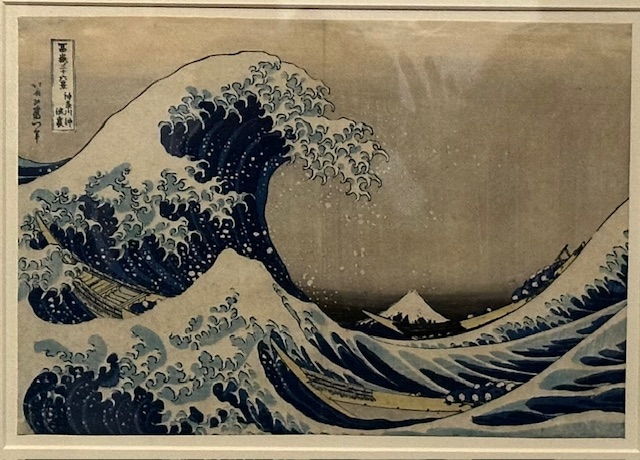
Under the Wave off Kanagawa, Katsushika Hokusai (1769-1849)

The United Nations International Day of Peace, annually set for September 21st, has a request: a 24-hour ceasefire of all hostilities on the planet. This year’s theme, “Cultivating a Culture of Peace,” calls for teaching the values of dialogue (see blog, “Mend Differences through Dialogue,” 8-19-24) and mutual respect to the 1.2 billion youth worldwide. Have we given up on adults knowing how to use dialogue and mutual respect in resolving conflicts?

It seems that adult problem-solving efforts to create peace on earth are like the tiny boats facing the looming giant wave in Katsushika Hokusai’s color woodblock print, Under the Wave off  Kanagawa. I must admit that the first time I saw this captivating image in Chicago’s Art Institute years ago, I was so focused on the wave action that initially I did not see the boats! Due to being on paper, the print is only on view for 3-4 months every 5 years. This original gem has re-surfaced from protective storage and again is on display (September 5, 2024–January 6, 2025) in the Art Institute’s Ando Gallery, my favorite room in the entire museum. This time, I knew to look for the boats. What if we are looking for world peace in all the wrong places?

Most museum visitors never see the Tadao Ando Gallery, or Gallery 109, as it sits in an innermost corner of the Art Institute’s Japanese collections. It is a compact space compared to many roomy galleries in other sections of the museum. Also, it is one of the few darkened spaces.

Ando was a self-taught architect. His haunting 16 free-standing wood columns in the womb-like environment compel one to slow down, take deeper breaths, and realize that this is a bodymind immersion into a different sense of time and space. Walking through the “forest” of oak pillars creates an atmosphere of peaceful reverence; the message is to refocus your gaze and get ready to look for what is beyond this “forest” grove.

We have English writer John Heywood to thank for his catchy proverb from 1546: “Can’t see the forest for the trees.” It seems to apply to many situations today, but especially to country leaders who lack the capacity to grasp the disastrous consequences of continuing wars. While dwelling solely on certain details, the big picture is often far from sightlines. Combating inequality, advocating for human rights, and championing climate actions for our planet are factors that lie beyond the immediate details of our international conflicts.

Re-look at Hokusai’s masterpiece. Mount Fuji holds still beyond the crashing wave. Again, we almost miss seeing beyond first details. This mountain is considered a spiritual place. How might we look for big-picture peace and create an interfaith spiritual culture for world dialogues? Isn’t peace first within a baby’s heart?

Pearls of Peace (PoP) Quiz 

327. When have you caught yourself missing some big-picture viewpoint?

328. How often do you refocus your gaze in looking for solutions to your personal sense of peace? 

Prevention is an Intervention

September is Suicide Prevention Month. While suicidal thoughts may be common among individuals, regardless of age, gender or background, they are the tip of an iceberg. Suicidal thoughts signal underlying issues that need attention.

Suicide is the cause of death of 49,476 individuals in the U.S. in the most recent year of verified records — 2022, making suicide the 11th leading cause of death. Even more concerning is CDC’s estimate of 1.6 million attempted suicides in 2022. These numbers reflect a massive call for help. The U. S. government stepped up and partnered with the CDC and SAMHSA (Substance Abuse and Mental Health Services Administration) to provide a 10-year strategy to tackle mental health and overdose issues in suicide. This Federal Action Plan sponsored by the Biden and Harris administration has a comprehensive approach to suicide prevention.

Systems thinker Peter Senge wisely suggests, “Today’s problem comes from yesterday’s solution.” Many “solutions” of yesterday were flawed. Wars are flawed. Of particular concern is the rise in suicides committed by veterans.

The 2023 annual report of the National Veteran Suicide Prevention effort (based on 2021 data) found that veteran suicide rates increased by 11.6% from 2020. This increase has escalated since the wars linked to 9/11 terrorism. Countless soldiers suffer from traumatic brain injury, PTSD, and other bodymind wounding.

This escalation translates into more than 17 veterans taking their own lives each day with the highest percentage occurring in ages 50 or older. This is twice the suicide rate for non-veteran individuals ages 55+. Guns are the chosen vehicle for 53% of all suicide deaths. Veterans were taught to use guns.

As Italian physician and educator Maria Montessori outlined, “Preventing war is the work of politicians, establishing lasting peace is the work of educators.” Each one of us can increase peace within ourselves and educate others about warning signs of suicide (https://www.nami.org/about-mental-illness/common-with-mental-illness/risk-of-suicide/):

  • Increased substance use (alcohol and drugs)
  • Aggressive behavior
  • Withdrawal from friends, family and community
  • Dramatic mood swings
  • Impulsive or reckless behavior

Possible behavior changes prior to suicide include:

  • Collecting and saving pills or buying a weapon
  • Giving away possessions
  • Tying up loose ends, like organizing personal papers or paying off debts
  • Saying goodbye to friends and family      

We know what is helpful in daily living:

  • A sense of purpose: feeling valued and contributing to a job, family, and/or community;
  • Social connections: positive relationships with co-workers, family, and friends;
  • Financial stability: financial security (helps but is not 100% protective);
  • Access to resources: access to mental health assistance;
  • Routine and structure: a daily routine through employment, taking classes, or volunteer work.

Let’s respectfully acknowledge those who have attempted suicide, died by suicide, and their families/friends.

The 988 Suicide and Crisis Lifeline has received more than 10.8 million calls, texts and chats since its 2022 launch. 988 is available 24/7 for anyone in crisis.

Pearls of Peace (PoP) Quiz 

325. Do you know anyone at risk for suicide?

326. How might you extend a lifeline to them?                     

Mend Differences through Dialogue

Egyptian Stela, Middle Kingdom, about 1870-1770 BCE

Interpretations of ancient Egyptian art are fascinating. According to the hieroglyphs on the above stela (a commemorative monument), scholars find that a son and his mother (Amenemhat and Yatu) are depicted with objects they might use in the afterlife. Along with clothing and food supplies (bread and beer), there is a cosmetic container under Yatu’s chair (a red and white container of “ointment”). One scholar refers to a blue jar under Amenemhat’s chair as eye paint (kohl); a second opinion labels this a “beer jar with a drinking straw.” Take your pick.   

Four horizontal lines of hieroglyph text offer a prayer: “A royal offering of Osiris, Lord of ‘Life of the Two Lands.’ May he give a mortuary offering of bread and beer, oxen and geese, linen, clothing, every good and pure thing whereon [the god] lives, for the ka [soul] of the guardsman Amenemhat, deceased, born of Yatu, deceased, and for the ka [soul] of his mother, his beloved, Yatu, deceased, born of Tita, deceased.”

Ever curious, I offer questions: Why is guardsman Amenemhat depicted with his mother, Yatu? What did he guard? Why is no father named in the stela story? Did the mother/son duo die at the same time? Was there a plague or war? Or was this gravestone initiated when a mother was dying and the two family members shared a final dialogue?

The definition of “dialogue” is a conversation between two or more individuals where discussion leads to resolving an issue or problem.

Too many families do not dialogue about important stuff. As psychiatrist Murray Bowen points out, “The person who runs away from his family of origin is as emotionally dependent as the one who never leaves home. They both need emotional closeness, but they are allergic to it.”

Too many countries do not dialogue about their differences and subsequently devolve into war. Are people allergic to problem-solving dialogues? Or do they lack the training to have dialogues?

It takes compassion to have a dialogue. I wrote about this in Transforming Retirement: Rewire and Grow Your Legacy: “Relating well with compassion for others takes the consciousness of the fittest. The most useful compassion description I have found is from Austrian Jewish philosopher Martin Buber. He differentiated I-Thou relating, or accepting the other person as sacred, from I-It relating where people treat others more as objects useful for one’s benefit. In I-Thou relationships there is a genuine dialogue where you discuss issues with another with your whole being. Such conscious relating can remove arbitrary boundaries between individuals. If both partners in a relationship believe in I-Thou dialoguing, they stop themselves from projecting their own painful stories onto the other.”

We might use Buber’s dialogue messaging to mend differences and negotiate an end to stuff — like barbaric wars.

Pearls of Peace (PoP) Quiz 

317. When have you dialogued successfully to resolve some tricky issue?

318. When in your life has dialogue broken down so that it seemed impossible to have individuals listen to one another?                      

Christmas Pearls

Christmas Eve 100+ years ago (2014) found German, British, Belgian and French soldiers celebrating the holiday by singing together in the midst of World War I. Territorial battlelines were crossed. Language borders were crossed. Soldier orders were crossed. The newly installed Catholic Pope, Benedict XV, had asked for a Christmas truce, but his earnest request did not receive any blessing from officers.

Reports from soldiers over the years have blurred war memories, but certain survivors remember a fragile peace on a moonlit night: “First the Germans would sing one of their carols and then we would sing one of ours until we started ‘O Come, All Ye Faithful,’ the Germans immediately joined in singing the same hymn to the Latin words Adeste Fideles, and I thought, well, this is really a most extraordinary thing…nations singing the same carol in the middle of a war.” Other versions of that extraordinary night focus on the singing of Silent Night, Holy Night. No one seems to know exactly where the first singers emerged.

I am reminded of words attributed to anthropologist Margaret Mead: “Never doubt that a small group of thoughtful, committed citizens can change the world; indeed, it’s the only thing that ever has.” It can take a long time to change the world, but never doubt that any small change has depth. This 100-year-old Christmas story provides a legacy blessing for our times.

On Christmas Day in 1914 some German soldiers ditched the precarious protection of their trenches and held up signs: “You no shoot, we no shoot.” Some soldiers traded gifts of cigarettes, food, buttons, and hats. The Christmas truce even delivered the ability to bury opposing fallen soldiers who were frozen in place, struck down in territory between trenches. Stories vary, but Adolf Hitler, a Corporal of the 16th Bavarians, reportedly reprimanded German soldiers: “Such a thing should not happen in wartime. Have you no German sense of honor?”

If you look up the word honor, the noun means “adherence to what is right or to a conventional standard of conduct.” As a verb, honor means “to regard or treat (someone) with admiration and respect.” An argument must be made that war defies what is “right” – killing, looting, and other horrors do not treat others with respect. Yet, Hitler found followers to tear down decency.    

Many people on our precious planet commit to peaceful problem solving where we build up one another in times of disaster. It is a possibility that more folks will become thoughtful citizens and change agents in the new year. Might we begin with school children on the playground? Before recess can kids create personal posters with their version of “You don’t shove, I don’t shove?”

A pearl can take from 6 months to 4 years for mature development. Surely, people are capable of maturity. It is our birthright.

Pearls of Peace (PoP) Quiz

249. How do you define what is honorable?

250. What peaceful problem solving will you engage in today?