Ages and Stages

Austrian novelist Marie von Ebner-Eschenbach defined aging: “In youth we learn; in age we understand.” I am rethinking what age means on my birthday.

We know 4 aging stages of monarch butterflies: egg, larva (caterpillar), pupa (chrysalis), and adult. This amazing metamorphosis includes caterpillars whizzing through 5 growth spurts, molting skin each time! This reminds me of adolescents making change after change with dizzying speed.

Research from University of Cambridge suggests that adolescence lasts longer than you ever thought. Dr Alexa Mousley and her colleagues found that the brain stays in the adolescent stage until the early 30’s. Key maturation is determined to end around age 32. Studying nearly 4000 individuals’ MRI scans (ages 0-90 years), the researchers concluded that there are 4 pivotal ages for brain turning points or major changes: 9, 32, 66, and 83.

  •  Childhood — Birth to age 9: Brains undergo network consolidation with the most active synapses preserved from a whittling-down process. There is a major boost in cognitive capacity, but also a risk of mental health challenges.
  •  Adolescence – Ages 9 to 32: Brains’ largest directional changes have an efficiency of connections within specific brain regions. There is rapid communication across the whole brain which relates to enhanced cognitive performance. However, this timeframe poses the greatest risk for mental health disorders. Many individuals initiate substance use in this stage. Repeated drug exposure can significantly alter brain development, especially relating to the ways reward and control circuits are wired. A drug habit may become almost automatic, leading to a reduction in prefrontal problem-solving which has many consequences.
  •  Adulthood – Ages 32 to 66: A “plateau in intelligence and personality” (based upon other research) was sustained in this research. Brain functioning appears relatively stable.
  •  Early aging – Ages 66 to 83: A mild and gradual reorganization of brain networks culminates in the mid-60’s, although a variety of health conditions (hypertension or diabetes, for example) may emerge; health issues can place an individual at risk for cognitive decline.
  •  Late aging – Age 83+: Whole brain connectivity reduces and there is more reliance on specific brain regions. However, this participant group was smaller than the other stages studied and merits more study.

The researchers admit their participants were controlled for “healthy” folks. Trauma affects brain ages/stages. An estimated 6 in 10 U.S. adults have experienced trauma (with higher numbers among women than men). Rates for children and adolescents are higher: according to the National Library of Medicine, about 2 out of 3 U.S. individuals experience trauma by age 16. This rate is likely higher among youth in violent war areas around the globe. We need a planetary plan for addressing trauma.  

How do butterflies deal with trauma? According to the Australian Butterfly Sanctuary, butterfly wings are larger than needed for flying. Butterflies can fly with half of their wings missing. My translation for “youth” at any age: keep flying (learning)!

Pearls of Peace (PoP) Quiz

460. What does your age mean to you?

461. What health-proofing practices do you use?  

Holiday Relationships & Wellness

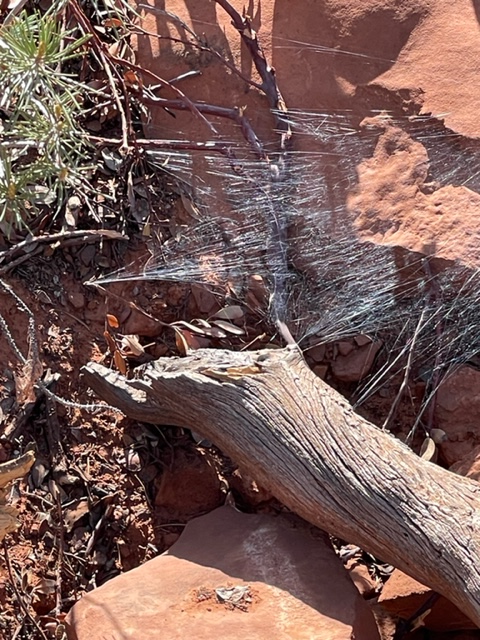
In a spider web, everything is connected. Everything you do is connected to others. No one can do everything alone. Celebrating holidays is best when celebrating in healthy ways with others!

Blackfoot scholar Dr. Leroy Little Bear looks at the big picture and captures everything: “Existence is a web of relationships. What you do to the land, to the animals, to the water, you do to yourself.”

Little Bear tells about dreaming that he was a bubble. His wife also was a bubble. He joined their bubbles. Half awake, he asked if his dream was real; the joined-bubble dream appeared a second time. When Little Bear shared his dream with his wife, she gave this interconnected interpretation: “I know what you are thinking…if we spread this among relatives, things will happen. Everybody is of one mind.”

As we roll through this holiday season, interconnected relationships are a key ingredient. In fact, relationships are key everywhere. According to Little Bear, the Western mind focuses on the social values of bigger and faster. To consider the social values in the Blackfoot mind, think about energy waves always in a state of flux. This is also scientific-minded territory. For an example of how this relational way of thinking might translate to the workforce, think team building, shared authority, and treating employees like a work family. As Little Bear suggests, this approach often results in team players producing better quality work.

Little Bear was instrumental in being part of creating Indigenous studies 50 years ago (in college at the University of Lethridge in Canada). Since many of us were not privy to Indigenous college courses, try on some Indigenous ways of relating:

  • Think holistically and relationally, rather than through the narrow lens of an individual paradigm;
  • Emphasize interconnectedness not just with your relatives and best friends, but also with land, spirit, and community for mental wellness and healing — understand life as energy, not just facts; 
  • Consider how language, story, dreams, and holiday rituals may shape pathways to healing.

Considering a lifetime of teaching, advocacy, and cultural stewardship, Little Bear challenges us to understand what thinking globally means as a rhythm of relational connections. He recalls his childhood when he heard both of his parents always singing! Yes, music is one of our best connectors. I go to many choral concerts and always feel a sense of renewal in the company of singers who harmonize with each other as if they are of one mind.   

What about the times when you are with relatives or friends and you do not sense any renewal of lifelong tuning in one-mind relating? There are good reasons, you say. Figure out where the disconnect story began. I have a “throw” pillow that says, “Home is where your story begins.” Start there.  

Pearls of Peace (PoP) Quiz

458. Do recall any dreams that hold special meaning for you?

459. How does telling your stories to a good listener bring lifelong tuning?  

Pearls of Time

Time is both slipping by and an enduring treasure. Time has been on people’s minds, well, for a long time.

  • “Time is the most valuable thing a man [person] can spend.” — Theophrastus, Greek philosopher and naturalist (372 BC-287 BC)
  •  “People don’t take opportunities because the timing is bad, the financial side unsecure. Too many people are overanalyzing. Sometimes you just have to go for it.” —Michelle Zatlyn,  Cloudflare co-founder
  • “Time is what we want most but what we use worst.” — William Penn, British Quaker founder of Pennsylvania
  • “Every tragedy we can imagine comes back to just one: time slipping by.”
    — Simone Weil, French philosopher (1909-1943)
  • “Time management is an oxymoron. Time is beyond our control, and the clock keeps ticking regardless of how we lead our lives.” — John C. Maxwell, American writer on leadership
  • “Liminal moments. Those moments apart from time when you are gripped. Taken. When you are so fully absorbed in what you are doing that time ceases to exist.― Rebecca Wells, Divine Secrets of the Ya-Ya Sisterhood

And from my favorite timekeeper:

  • “…Doesn’t everything die at last, and too soon? Tell me, what is it you plan to do with your one wild and precious life? ― Mary Oliver, The Summer Day

Poetry cuts to the chase on most topics. Poets understand impermanence. They often embrace curiosity for one’s present time.

 Poet and naturalist Derek Sheffield became Washinton state’s 8th poet laureate on 04-30-25. Freelance writer Sarah Neilson summed up his poetry succinctly: Sheffield writes with wildness and wellness as inspiration. In Neilson’s interview for the Seattle Times, Sheffield reflected on his work with a philosophy I can endorse: “An important part of my own journey has been my sense of curiosity and my capacity to feel wonder. I will run across people who don’t seem to have that capacity and don’t seem to be curious…a fair amount of what I do in writing classes is unteaching and trying to get us back to where we all started in third grade. That space, that energy, that trust, that imagination, that engagement with our imagination.”

Yes, who were we in 3rd grade? How did that timeframe influence who we are today? Wasn’t it just yesterday? I recall loving my 3rd grade teacher, Mrs. Anderson. She encouraged creativity and was a font of positivity. I recall her constant smiles. Some teachers’ influence can last a lifetime, either in a good way or a less skillful way. We earthlings are interconnected in a circle of time’s memories.

Consider Derek Sheffield’s poem, Still Time:

“In a wide
and motionless circle, nine

Chinook salmon
below a stilled spillway,

nose to tail-fin, wait,
faint flutterings rounding their backs

in place, each moment
slipping (a white bubble

up from the dark) through the clock face
they make of creek water,

a count we might mistake
as ours.”

Pearls of Peace (PoP) Quiz

407. How do you think about your slipping-by moments?

408. What are your plans for wildness and wellness today?                                                                                                

Pearls of Brain Awareness

Brain scan data, Human Connectome Project: Credit Matthew F. Glasser, David C. Van Essen

Growing up in farmland with paternal grandparents who produced their own beef and pork, I was offered cow brains for dinner in butcher season. While my parents relished this delicacy, I recoiled and could not partake of this unique delicacy. I had no awareness about missing the nutritional benefits of beef brains (vitamins A, B6, B12, C, D, E, K, phosphatidylserine, folate, niacin, magnesium, zinc, and choline, among others), but I still am not a proponent today. I am a proponent of taking care of one’s own 3-pound brain at mealtimes, sleep times, exercise times, and well, any time!

I like the global focus on Brain Awareness Week (the third week of every March), which serves as an annual launch for year-round brainy activities. This is the 30th annual Brain Awareness Week, the “brainchild” (I could not resist) of the Dana Alliance for Brain Initiatives and the European Dana Alliance for the Brain. The Dana Foundation is a nonprofit organization with the lofty goal of promoting brain science internationally to create better futures for everyone.

Dana foundation-sponsored programs such as one in Bamenda, Cameroon, and promoted by physician, Mundih Noelar Njohjam (founder of Cameroon Epilepsy Awareness and Aid Foundation), delivered brain science education to 5000 students. Njohjam provided her grant feedback: It was really interesting to watch [the students] as we explained the wonderful nature of the brain and how neurological diseases occur…especially epilepsy, because in our country epilepsy is often attributed to witchcraft. After listening to us talk, one student openly told us that before we came, he was one of those who usually stigmatized people with epilepsy,” she said. “So many confessed after the presentation that their mindset about epilepsy has really changed.” Truth matters.

Consider some facts offered by the Global Council on Brain Health: https://extension.illinois.edu/blogs/family-files/2025-02-24-celebrate-brain-awareness-week-all-year-long

  • Most of us are capable of learning at ANY age, especially getting involved with cognitively stimulating activities such as meeting new people, growing new hobbies or expanding knowledge.
  • Dementia is NOT normal aging. Typical age-related changes in the brain are different from those caused by disease.
  • Children are not the only ones who can master a foreign language – age does not prevent you from learning a new language.
  • Memory skills can improve with practice. The adage, “Use it or lose it,” is as important to memory skill training as it is to taking care of one’s physical health. 
  • Retaining details is just easier for some people than others, but this is true for all ages.
  • Strategies can ripen your memory. Chunk information into smaller bits for enhanced memorization. Use mnemonic devices. Practice retrieval (spacing out repetition works better than cramming). Make flash cards. Quiz yourself.
  • Neurons are created throughout your lifetime.

Being a life-long learner is invigorating! I am grateful for my many opportunities to keep my workhorse brain on the move.

Pearls of Peace (PoP) Quiz

377. What new learning have you embraced recently?

378. How might you become a better caretaker of your brain? 

Synergy for Mental Health

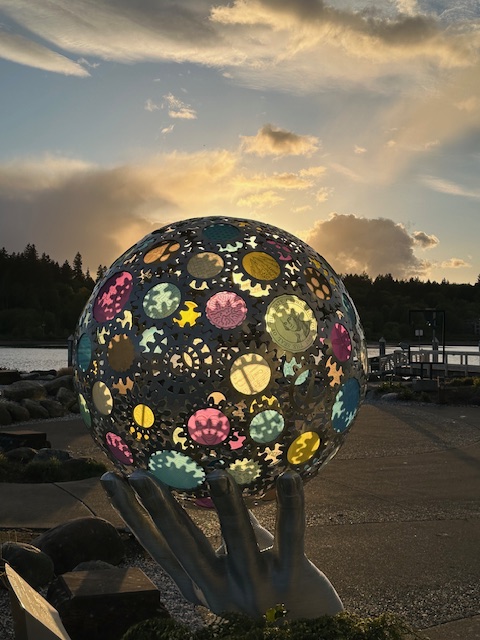
“Cognitive Synergy” by Bill Frymire, Olympic, WA

The word synergy comes from Attic Greek sunergos meaning “working together.”

May is America’s Mental Health Awareness Month. In the UK Mental Health Awareness Week is May 13-19 with this year’s theme of “Movement: Moving More for our Mental Health.” I like this emphasis on the whole body working together in movement.

I watch flowers in my spring garden moving together in a constant tableau. It was just yesterday that Virginia Bluebells were a flowing drift of dainty blue flower blooms swaying in the breeze. We also are equipped to bloom and thankfully, most of us have a longer bloom time than spring ephemerals. Today the bluebells are wilting; soon their greenery will disappear and go dormant after flowering and dispersing seeds. Moving into bloom where my bluebells reigned are False Solomon’s Seal perennials with their tiny white stars at the top of flagpole stems.

People wilt for a variety of reasons. It is not easy to be physically and mentally healthy every season. Children especially struggle with conditions that go unnamed for years, often not finding helpful ways to cope until adulthood.                                                             

American songwriter, mixed-media artist and writer Morgan Harper Nichols only received her diagnosis of autism, ADHD, and sensory processing disorder at age 31. She began creating art and poetry as responses to social media messages. Nichols bloomed with her art creating “room to breathe.” She moved her talent in the direction of sharing what she believes is helpful to others:

“Inhale, exhale. Never forget the green lights, stop signs and highways that brought you here. Every single step accounted for, even though you can’t see where the road leads, what matters is that you travel not in pursuit of knowing it all, but in pursuit of boundless peace” (How Far You Have Come).

Nichols initiated a project of sending personalized letters to strangers, making a lifetime goal to compose a million poems to strangers! She invites individuals to share their story with her on her website. She replies to them sending visual art with a letter of encouragement. There are no fees. She keeps names anonymous. Her daily practice of synergistic generosity is a powerful example of her blooming and dispersing seeds of hope. Nichols is completing her MFA (in Interdisciplinary Media Arts) as she works on an online conversational-focused game.

“Art is made in hindsight,” claims Virgil Abloh, fashion designer. Or as Nichols penned, “One day, you will look back and see that all along, you were blooming.”

To keep blooming go to https://www.samhsa.gov/mental-health-awareness-month/toolkit and https://www.nami.org/get-involved/awareness-events/mental-health-awareness-month/ for activities in mental health synergy.

Synergy is “the interaction or cooperation of two or more organizations, substances, or other agents to produce a combined effect greater than the sum of their separate effects.” Springtime is an excellent time for all of us to move together in the growing of mental health for all.

Pearls of Peace (PoP) Quiz

289. When is a time in your life when you were wilting?

290. What did you do to re-bloom?