Indigenous Peoples’ Day and/or Columbus Day

What did the traffic light say to the car? “Don’t look now. I’m changing!”

Change is cumbersome even if you have a traffic-light mentality of its-green-for-MY-car.

According to https://renamecolumbusday.org/ over 200 cities and 29 states have renamed Columbus Day as Indigenous Peoples’ Day. Some states acknowledge Indigenous Peoples’ Day in terms of a proclamation; others celebrate it as federal holiday. Name changes include “Native American Day” in South Dakota, “Columbus Day + American Heritage Day” in Alabama, and “Discovery Day” in Hawaii.

Regarding Christoper Columbus, he reportedly never reached the North America continent; on October 12, 1492, Columbus reached an island that today is part of the British Bahamas. Believing his discovery was a grand route to India, he called the people he met “Indians.” Columbus was not the first European “discovery” explorer to cross the Atlantic successfully, as Vikings reportedly kept a short-lived second home in Newfoundland in the 11th century…so our grade school stories about Columbus were fake news? A factual Founding Father, Thomas Paine, wisely captured such disparities as the Columbus distortion in his 1776 Common Sense pamphlet: “A long habit of not thinking a thing wrong gives it a superficial appearance of being right.”  

While some have this opinion, “You’re trying to change history – you’re confusing our grandchildren,” others want to rename the second Monday in October “Italian Heritage Day.” Still others would like to take a vote on whether to rename Columbus Day. With a current divided country, it could end up being a 50/50 election.

Ever curious about people’s values and how they think about a topic, I did an informal survey over the weekend. I asked individuals to vote for their naming preference. More people favored Indigenous People’s Day, although combo-naming was one person’s opinion in being inclusive and honoring Italian heritage. A tongue-in-cheek response likely speaks for many: “I call it a day off work.”

Indigenous People’s Day has enjoyed federal recognition since 2021, with the Biden administration proclaiming the second Monday in October “a day in honor of our diverse history and the Indigenous peoples who contribute to shaping this Nation.” Wording in the 2024 Indigenous Peoples’ Day presidential proclamation is critical language for today: “…we recognize that it is hard work to heal the wrongs of the past and to change course and move forward, but together, nothing is beyond our capacity.” 

Discrimination continues to hamper needed changes. Why do we recall the names of the three ships of the Columbus expedition decades later? Schools may teach the ship names (the Niña, the Pinta, and the Santa Maria, in case you forgot), but we do not represent Native American names in our current entertainment industry. Less than 1% of Native Americans work in this field.

Pearls of Peace (PoP) Quiz 

333. What is your vote for naming the second Monday in October?

334. Beyond saying the names of the early people who settled our city lands at community gatherings, how might we correct cultural narratives about Indigenous people?             

Ageism Discrimination

Ageism Awareness Day is on October 9th, but let’s make every day an ageism awareness day as the Baby-Boom generation mushrooms into seasoned citizen territory.

 The World Health Organization posts these alarming findings:  Ageism costs billions annually in the U.S. from age discrimination — the economic cost of age discrimination against older workers was estimated to cost $850 billion in lost GDP in 2018 (from factors such as the inability to find work and earn promotions).                                                                                                               1 in 2 people worldwide are ageist against older people.

It is also possible to be ageist against young people, as in saying, “She’s too green for the job,” likely a sexist attitude and ageist. These discriminatory attitudes often travel together, along with a particularly damaging attitude — racism. “Ageism intersects and exacerbates all the other ‘isms,’ including racism, sexism and ableism,” according to the Ageism Fact Sheet compiled by the American Society on Aging (https://asaging.org/sites/default/files/2024-08/Ageism%20Fact%20Sheet%20-%20Ageism%20Awareness%20Day_0.pdf ).

Here is how journalist Connie Chung, first woman to co-anchor the CBS Evening News, describes the career hoops she jumped through at age 23 in Connie: A Memoir: “…Since I stood only five feet, three and a half inches (don’t forget the half), I compensated by wearing stilettos. I wanted to be as close as I could be, eye to eye with the men. I did not want to look up at them. I wanted to be their equal. I tried to lower my voice to mimic theirs and copied their on-air cadence. I knew they could easily bully me, and I was powerless to fight them, so I joined them. I knew I could never be one of the boys, but surely, I could adopt pages from their playbook. It was easy to imagine myself as just another white guy. I became aggressive, tough, bawdy, and extremely competitive. Yes, I looked like a lotus blossom, but I talked like a sailor with a raw sense of humor.”

There is more ageism discrimination for older adults. 64% of older workers maintain that they face age discrimination; 41% report ageism experiences in their workplace. Often companies have expected ages for “retirement.” For some individuals, leaving a demanding career may be a welcome life development; for others, a mandatory age for retirement seems dismissive of one’s talents.  

• Age diversity is not foremost in planning a company’s workforce, although organizations might gain a competitive advantage from multigenerational employees. Acknowledging age equity increases worker feelings of belonging, along with enhancing productivity.                                                                                                                                                         

 • Healthcare is ageist: In ages 50+, 1 in 5 experiences discrimination in healthcare settings.

Now for the good news, if you are lucky enough to live into your 70’s and beyond: people who possess more positive self-perceptions of aging live 7.5 years longer than those with less positive perceptions, according to Yale University researcher Becca Levy.

Find resources to advocate against ageism (https://asaging.org/ageism-awareness).

Pearls of Peace (PoP) Quiz 

331. How often do you catch yourself being ageist?

332. What might you say to another when you hear an ageist remark?                                       

Are YOU Meeting 5 Basic Needs?

Autumn Crocus

When asked to give a keynote talk at a fundraiser for a suicide-prevention-curriculum organization, I flashed on a psychology graduate school professor who taught that the most important ingredient a therapist must deliver in any psychotherapy session is to “leave the client with hope.” This simple phrase applies to almost every encounter we have with others.

September is National Self-Care Awareness Month and Suicide Prevention Month (see blog, Prevention is an Intervention). Our best action regarding suicide is to prevent it. Here’s my talk highlights:

What is the opposite of committing suicide? I would say, flourishing! How might you flourish? Fair pay, equal pay for equal work, and other economic factors are important, but today we focus on what you can do to flourish in a bodymind sense.  First, you flourish by meeting your own basic needs. Then you can lend a helping hand to a neighbor, family member, friend, or student who is struggling to meet their basic needs.

Instead of admonishing others with the 19th century foot metaphor, “pull yourself up by your bootstraps” — which Wikipedia says originated from a tall tale where a man told of pulling himself out of a swamp by his own pigtail — we will use a hand as a memory tool…See how moveable and “energetic” your thumb can be!  Let your thumb stand for ENERGY, instead of ennui lethargy…a flexible thumb provides endless possibilities for action. Begin with feeding yourself a nutritious diet, getting 7 hours of sleep, and exercising in a way that suits your body. 

Your pointer finger stands for DISCIPLINE, rather than disorder. Some adults and even teachers (I’ve seen it) point this finger in an emotional, menacing way to deliver “discipline.” Bill Clinton pointed his index finger at the American people, saying, “I did not have sexual relations with that woman, Miss Lewinsky!” Today, Mark Robinson, running for governor in NC, is pointing at voters. Both forgot that their own 3 fingers point back at them!  There is cognitive pointing, as in pointing to the pretty butterfly. We celebrate when a baby learns to point at objects. Try pointing your index finger upward, as a reminder to yourself, that you are interested in raising “up” children (or students or colleagues) using morals and values as your guide. Discipline is a basic need. Having the discipline to eat healthy choices, get enough sleep, exercise, and keep learning with a growth mindset – ALL require some structure. The word discipline has the same root meaning as the word disciple. It means to follow a good lead.

The middle and longest finger has a long history of meaning scorn or insult when held upright. Over 2500 years ago the Greek playwright, Aristophanes, is credited with showing insult by raising the middle finger. He made a crude joke about a certain male body part. It is time for this finger to receive a creative comeback!  CREATIVITY, instead of conformity, is a go-to basic need if you want to flourish.  Creativity involves curiosity, problem-solving, and dreaming new ideas. Albert Einstein once said, “Creativity is intelligence having fun.” Creativity involves personal autonomy, wanting to do something because it’s interesting, enjoyable, or personally challenging. And creativity is not just Big-C creativity, as in becoming a famous artist. Creativity has many little-c possibilities that engage your originality, flexibility, or personal voice.

The ring finger is known for its special BELONGING to close relationships, as in couples sharing wedding rings to symbolize their belonging, rather than the Blues. For those in the mental health field, we are talking about attachment. All these needs are important, but belonging connections are vital. Researchers have found that after food and shelter, positive social connection is our greatest need benefiting bodymind health. People who feel more connected to others have lower rates of anxiety and depression, a 50% increased chance of longevity, a stronger immune system, and faster recovery from disease.

The left “pinky” finger is the one that hits the letter “A” on the keyboard! Recognize your ABILITY, not your apathy. Have competence to believe in your skills to achieve goals and experience a sense of mastery. In the past it was considered that IQ was fixed. This is not true. IQ tests measure what can be done now, not what can be done in the future. The brain can store nearly 10 times more data than previously thought, research confirms. Keep storing new learning!

Our needs are interactive. They can work together, or not. I lined up the backward ABCDE’s — Energy/Discipline/Creativity/Belonging/Ability — handprint to help individuals remember 5 needs. Some days are a challenge to meet even 3 needs. If you live with others, it gets more complicated, because others inevitably want to meet a need — involving YOU — at a different time than you anticipated.

What’s more, we have an integrative core SELF– this is not “ego.” Some might prefer the word spirit, or soul to SELF. It is a calm acceptance, a grounding, a deep reservoir of integrity, wholeness; it is owning OK-ness. Let’s consider a core SELF in the palm of your hand. When we hold hands with another, we can remind ourselves that our core SELF touches another’s core SELF. This is co-regulation or lending a helping hand. And meeting needs, both ours and helping others meet their needs, is flourishing.

Pearls of Peace (PoP) Quiz 

239. How is your self-care flourishing today?

230. What might you do to help another person flourish?        

Big-picture Peace

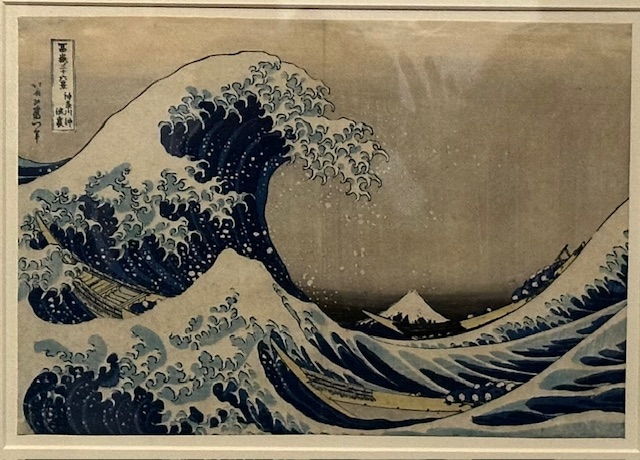
Under the Wave off Kanagawa, Katsushika Hokusai (1769-1849)

The United Nations International Day of Peace, annually set for September 21st, has a request: a 24-hour ceasefire of all hostilities on the planet. This year’s theme, “Cultivating a Culture of Peace,” calls for teaching the values of dialogue (see blog, “Mend Differences through Dialogue,” 8-19-24) and mutual respect to the 1.2 billion youth worldwide. Have we given up on adults knowing how to use dialogue and mutual respect in resolving conflicts?

It seems that adult problem-solving efforts to create peace on earth are like the tiny boats facing the looming giant wave in Katsushika Hokusai’s color woodblock print, Under the Wave off  Kanagawa. I must admit that the first time I saw this captivating image in Chicago’s Art Institute years ago, I was so focused on the wave action that initially I did not see the boats! Due to being on paper, the print is only on view for 3-4 months every 5 years. This original gem has re-surfaced from protective storage and again is on display (September 5, 2024–January 6, 2025) in the Art Institute’s Ando Gallery, my favorite room in the entire museum. This time, I knew to look for the boats. What if we are looking for world peace in all the wrong places?

Most museum visitors never see the Tadao Ando Gallery, or Gallery 109, as it sits in an innermost corner of the Art Institute’s Japanese collections. It is a compact space compared to many roomy galleries in other sections of the museum. Also, it is one of the few darkened spaces.

Ando was a self-taught architect. His haunting 16 free-standing wood columns in the womb-like environment compel one to slow down, take deeper breaths, and realize that this is a bodymind immersion into a different sense of time and space. Walking through the “forest” of oak pillars creates an atmosphere of peaceful reverence; the message is to refocus your gaze and get ready to look for what is beyond this “forest” grove.

We have English writer John Heywood to thank for his catchy proverb from 1546: “Can’t see the forest for the trees.” It seems to apply to many situations today, but especially to country leaders who lack the capacity to grasp the disastrous consequences of continuing wars. While dwelling solely on certain details, the big picture is often far from sightlines. Combating inequality, advocating for human rights, and championing climate actions for our planet are factors that lie beyond the immediate details of our international conflicts.

Re-look at Hokusai’s masterpiece. Mount Fuji holds still beyond the crashing wave. Again, we almost miss seeing beyond first details. This mountain is considered a spiritual place. How might we look for big-picture peace and create an interfaith spiritual culture for world dialogues? Isn’t peace first within a baby’s heart?

Pearls of Peace (PoP) Quiz 

327. When have you caught yourself missing some big-picture viewpoint?

328. How often do you refocus your gaze in looking for solutions to your personal sense of peace? 

Prevention is an Intervention

September is Suicide Prevention Month. While suicidal thoughts may be common among individuals, regardless of age, gender or background, they are the tip of an iceberg. Suicidal thoughts signal underlying issues that need attention.

Suicide is the cause of death of 49,476 individuals in the U.S. in the most recent year of verified records — 2022, making suicide the 11th leading cause of death. Even more concerning is CDC’s estimate of 1.6 million attempted suicides in 2022. These numbers reflect a massive call for help. The U. S. government stepped up and partnered with the CDC and SAMHSA (Substance Abuse and Mental Health Services Administration) to provide a 10-year strategy to tackle mental health and overdose issues in suicide. This Federal Action Plan sponsored by the Biden and Harris administration has a comprehensive approach to suicide prevention.

Systems thinker Peter Senge wisely suggests, “Today’s problem comes from yesterday’s solution.” Many “solutions” of yesterday were flawed. Wars are flawed. Of particular concern is the rise in suicides committed by veterans.

The 2023 annual report of the National Veteran Suicide Prevention effort (based on 2021 data) found that veteran suicide rates increased by 11.6% from 2020. This increase has escalated since the wars linked to 9/11 terrorism. Countless soldiers suffer from traumatic brain injury, PTSD, and other bodymind wounding.

This escalation translates into more than 17 veterans taking their own lives each day with the highest percentage occurring in ages 50 or older. This is twice the suicide rate for non-veteran individuals ages 55+. Guns are the chosen vehicle for 53% of all suicide deaths. Veterans were taught to use guns.

As Italian physician and educator Maria Montessori outlined, “Preventing war is the work of politicians, establishing lasting peace is the work of educators.” Each one of us can increase peace within ourselves and educate others about warning signs of suicide (https://www.nami.org/about-mental-illness/common-with-mental-illness/risk-of-suicide/):

  • Increased substance use (alcohol and drugs)
  • Aggressive behavior
  • Withdrawal from friends, family and community
  • Dramatic mood swings
  • Impulsive or reckless behavior

Possible behavior changes prior to suicide include:

  • Collecting and saving pills or buying a weapon
  • Giving away possessions
  • Tying up loose ends, like organizing personal papers or paying off debts
  • Saying goodbye to friends and family      

We know what is helpful in daily living:

  • A sense of purpose: feeling valued and contributing to a job, family, and/or community;
  • Social connections: positive relationships with co-workers, family, and friends;
  • Financial stability: financial security (helps but is not 100% protective);
  • Access to resources: access to mental health assistance;
  • Routine and structure: a daily routine through employment, taking classes, or volunteer work.

Let’s respectfully acknowledge those who have attempted suicide, died by suicide, and their families/friends.

The 988 Suicide and Crisis Lifeline has received more than 10.8 million calls, texts and chats since its 2022 launch. 988 is available 24/7 for anyone in crisis.

Pearls of Peace (PoP) Quiz 

325. Do you know anyone at risk for suicide?

326. How might you extend a lifeline to them?                     

Be an Architect of Health

All are architects of Fate, / Working in these walls of Time; / Some with massive deeds and great, / Some with ornaments of rhyme….

Henry Wadsworth Longfellow captures some possibilities of spending our precious time in his poem, “The Builders.” Everyone is their own architect in building healthy patterns of living. September is Healthy Aging Month, a time to pause and reflect on our pro-and-con health habits built up over decades. Are your habits as healthy as possible with your age, genetics, and current circumstances?

National Institute on Aging (NIA) researchers found that participants who practiced a certain 4-5 healthy behaviors had a 60% lower risk of Alzheimer’s Disease than those exhibiting none or only one factor: 1) no smoking; 2) limited alcohol consumption; 3) a healthy diet with half of your plate in colorful fruits and veggies (as in the MIND diet or the Mediterranean diet); 4) regular cognitive activities; and 5) at least 150 minutes each week of moderate-to-vigorous physical activity. Just committing to 2-3 of these body-happy habits offered a 37% lower risk of dementia among study participants.                                     

Further suggestions for aging well are scaffolding layers for supporting one’s healthy habits. A concerted effort in blood pressure control significantly reduces the risk of mild cognitive impairment (often a forerunner to Alzheimer’s). Hearing aids reduce the rate of cognitive decline in nearly 50% in older adults who are at risk for developing dementia. Taking a daily multivitamin supplement for 3 years can improve the brain’s memory and executive function.  

If such building blocks seem daunting, just start building health-filled habits somewhere.    

  • Make physical activity possible for yourself! I am an early-bird riser. I love early morning stretching to classical music, tai chi in a park with others, and gardening. You might prefer walking. Walk (with someone if that is fun for you) 3-4 days per week.
  • When you include physical activity as an ongoing habit, it will lower your blood pressure, blood cholesterol, and blood sugar levels.
  • Avoid processed foods with ingredients you cannot pronounce. Stay hydrated.
  • Find social engagement that links with cognitive activities of interest to you.
  • Practice mindfulness. I participate on an online 20-minute silent mindfulness reflection group every morning. You may want only 5-10 solo minutes and at another time of day. Try it. You will surprise yourself with body-happy results.

According to CDC data, nearly 20% of adults ages 55+ experience a mental health condition or concern. Data from the National Council on Aging find that 85% of adults ages 55+ experience at least one chronic physical condition (such as hypertension, arthritis, or heart disease).

Bird brains know what to feed upon–mostly seeds–and they are especially adept at movement without needing any fancy equipment. I am not sure if they meditate when singing, but bird song is meditative for those of us missing feathers.  

Pearls of Peace (PoP) Quiz 

323. When do you feel healthy?

324. How might you increase the times you feel healthy?

Pearls of Labor

“School days, school days, good old golden rule days….” The kids are back in school, but how many educators pay heed to this 1907 phrase? Rather, the “…tune of a hick’ry stick” might be educators’ go-to behavior management, as corporal punishment is legal in private schools in every state except Illinois, Iowa, Maryland, New Jersey and New York. Furthermore, the outdated discipline is legal in public schools in 17 states and practiced in Alabama, Arkansas, Georgia, Louisiana, Mississippi, Oklahoma, Tennessee, and Texas. Students of color and those with disabilities disproportionately receive corporal punishment.

The Senate introduced the Protecting our Students in Schools Act of 2023, which would prohibit corporal punishment in schools that receive federal funding. Investments are recommended to transform school discipline with restorative justice practices. When students are taught problem-solving skills, benefits ripple into their lives beyond the classroom.

According to the August 2024 Centers for Disease Control and Prevention Report (Part IV), students’ health, mental health, and well-being has worsened over the past 10 years —  https://bit.ly/3T3JNv8. An increased percentage of U.S. adolescents report facing school-based violence and/or bullying. Absenteeism due to students’ safety concerns is a related issue. While eliminating school corporal punishment is not a total solution, adults model coping strategies for students. Hitting children is not a coping strategy. Hands are for helping, not hurting.

While pandemic levels were higher, current student mental health statistics suggest that schools might re-consider their methods:

  • 40% of students overall are experiencing persistent feelings of sadness/hopelessness with a higher percentage among female students (53%), some of whom have considered suicide;
  • 42% of Hispanic students feel persistently sad or hopeless, 26% experience poor mental health, 18% have considered suicide, and 16% have made suicide plans;
  • 10% of Black students have attempted suicide.

The 2023 statistics for female students and LGBTQ+ students are staggering:

  • Nearly 2 in 10 female students experienced sexual violence (1 in 10 being physically forced to have sex);
  • More than 3 in 5 LGBTQ+ students experienced persistent feelings of sadness/hopelessness;
  • Nearly 3 in 10 LGBTQ+ students were bullied at school;
  • 1 in 5 LGBTQ+ students attempted suicide during the past year.

As a former school psychologist, these statistics are disturbing. I worked in a progressive school system in Massachusetts where prevention was a main driver of my work. We administered kindergarten screening to each 5-year-old to provide appropriate help from day one. In second grade, each student was administered an individual IQ test. Later I worked in a progressive Illinois high school within a self-contained special education program with students who were in danger of becoming dropouts. Our labor-of-love Problem Solving Conferences were created to nurture and teach students how to dialogue about issues with teachers, classmates, and family members. While we did not call it modeling the golden rule, that is what we were doing.

Pearls of Peace (PoP) Quiz 

321. How many youth do you know who may be in need of problem-solving training?

322. What opportunities do you have for mentoring youth?    

Pearls of Awe

Moments of awe are artfully described by psychologist David Elkins (who studied under Viktor Frankl): “… the most important, transformative experiences of life…Awe is a lightning bolt that marks in memory those moments when the doors of perception are cleansed, and we see with startling clarity what is truly important in life.”And yet,in our rush to accomplish the next thing on invisible to-do lists, we skip momentary opportunities of basking in awe.    

I am enjoying reading psychotherapist Jake Eagle and physician Michael Amster’s 2023 book, The Power of Awe: Overcome Burnout & Anxiety, Ease Chronic Pain, Find Clarity & Purpose—In Less Than 1 Minute Per Day. I am usually dubious of what might “stick” in less than 1 minute per day, but I believe these two mindfulness-instructor authors have their eyes on a simple prize. Afterall, life is lived in present moments. When you pay attention, in everyday as well as special moments, there is an aliveness that grabs you, perhaps by oozing goose bumps or watery eyes. You tend to remember such moments.

The authors advise: “Finding awe isn’t a goal. Goals are for the future. Awe is here now, a sense of wonder coming from firsts, lasts, and experiences that continue to amaze us…Firsts: First kiss…first time you rode a bike, swam in the ocean…Lasts: The last mountain you’ll climb, your last kiss…last words you’ll hear [from someone]… Experiences that continue to amaze: Sunrise. Shooting stars. Redwood trees…a sense of oneness…the depth of love we can feel.”

To help you tune in more frequently to awe, the 3-part A.W.E. Method is free online as “A.W.E. Guide and Journal” at https://thepowerofawe.com/  — where A.W.E. represents Attention, Wait, Exhale and Expand in five-to-fifteen-second intense moments of focus. The research on the health benefits of this 1-minute “microdosing mindfulness” (in just 3 awe-filled segments each day) is impressive.

The magic happens when you have the intention for ATTENTION, then pause — or in this model termed WAIT – WAIT with intention before elongating an EXHALE-and-EXPAND consciousness. I offer a recent example from my garden. With intention, I was admiring a profusion of phlox plumes when suddenly, a hummingbird darted in front of me and landed on a nearby ‘Blue Fortune’ hyssop plant. With as much stealth as I could muster, I slowly removed my cell phone from my pants pocket and etched my memory with those fluttering feathers. Usually when I attempt this move with birds or butterflies, they flit away. For some reason, this hummer was not threatened by my presence. I shared close-up eye contact with awe.  

Psychologist Dacher Keltner also wrote a book on awe – AWE: The New Science of Everyday Wonder and How It Can Transform Your Life (2023). I’m all in on this topic! Keltner believes that                               awe is “almost always nearby.”

Let’s savor awesome moments!

Pearls of Peace (PoP) Quiz 

319. When did you recently experience an awe-filled moment?  

320. Would you be willing to share this awesome time in the comment section?  

Mend Differences through Dialogue

Egyptian Stela, Middle Kingdom, about 1870-1770 BCE

Interpretations of ancient Egyptian art are fascinating. According to the hieroglyphs on the above stela (a commemorative monument), scholars find that a son and his mother (Amenemhat and Yatu) are depicted with objects they might use in the afterlife. Along with clothing and food supplies (bread and beer), there is a cosmetic container under Yatu’s chair (a red and white container of “ointment”). One scholar refers to a blue jar under Amenemhat’s chair as eye paint (kohl); a second opinion labels this a “beer jar with a drinking straw.” Take your pick.   

Four horizontal lines of hieroglyph text offer a prayer: “A royal offering of Osiris, Lord of ‘Life of the Two Lands.’ May he give a mortuary offering of bread and beer, oxen and geese, linen, clothing, every good and pure thing whereon [the god] lives, for the ka [soul] of the guardsman Amenemhat, deceased, born of Yatu, deceased, and for the ka [soul] of his mother, his beloved, Yatu, deceased, born of Tita, deceased.”

Ever curious, I offer questions: Why is guardsman Amenemhat depicted with his mother, Yatu? What did he guard? Why is no father named in the stela story? Did the mother/son duo die at the same time? Was there a plague or war? Or was this gravestone initiated when a mother was dying and the two family members shared a final dialogue?

The definition of “dialogue” is a conversation between two or more individuals where discussion leads to resolving an issue or problem.

Too many families do not dialogue about important stuff. As psychiatrist Murray Bowen points out, “The person who runs away from his family of origin is as emotionally dependent as the one who never leaves home. They both need emotional closeness, but they are allergic to it.”

Too many countries do not dialogue about their differences and subsequently devolve into war. Are people allergic to problem-solving dialogues? Or do they lack the training to have dialogues?

It takes compassion to have a dialogue. I wrote about this in Transforming Retirement: Rewire and Grow Your Legacy: “Relating well with compassion for others takes the consciousness of the fittest. The most useful compassion description I have found is from Austrian Jewish philosopher Martin Buber. He differentiated I-Thou relating, or accepting the other person as sacred, from I-It relating where people treat others more as objects useful for one’s benefit. In I-Thou relationships there is a genuine dialogue where you discuss issues with another with your whole being. Such conscious relating can remove arbitrary boundaries between individuals. If both partners in a relationship believe in I-Thou dialoguing, they stop themselves from projecting their own painful stories onto the other.”

We might use Buber’s dialogue messaging to mend differences and negotiate an end to stuff — like barbaric wars.

Pearls of Peace (PoP) Quiz 

317. When have you dialogued successfully to resolve some tricky issue?

318. When in your life has dialogue broken down so that it seemed impossible to have individuals listen to one another?                      

Birthday Time

We are not first in making up catchphrases about time, but our cultural time fragments tell a lot about who we are when we say…

“Take your time…[It’s] time to…Running out of time… Free time…Time-strapped…Be on time…Time stopped …[It’s] high time…Time machine…Kill time…Time is money…A waste of time…Manage your time…Save time…Spend time…Time is of the essence…What time is it?”

Time flies, as the saying goes. Roman poet Virgil (70-19 BC) is credited with this timely slogan, first given as “Fugit irreparabile tempus” or “It escapes, irretrievable time.”

And yes, time appears to “escape,” even going faster as we age! After finding how frequently time was mentioned in my retirement survey of 125 individuals (ages 55-96), I wrote about this accelerating phenomenon in Transforming Retirement: Rewire and Grow Your Legacy: “Research backs up this perception. The release of dopamine, the body’s main neurotransmitter involved in time processing, has a drop-off beginning after age 20. This leads to the appearance that time passes faster. Also, your perceptions are different from younger years when you had to process many new events. There are possibilities to combat the speeding timeclock. To make time-travel slow down, do something different! When you are in flow-mode, you do not count hours.”

I just celebrated this blog’s 3-year birthday. Where did the time go? I began writing Pearls of Peace weekly when Mom (1922-2022) was about to turn 99-years-old. I chose Monday morning for online delivery. Why Mondays? At the time, I could not tell you why. Later I realized that my activist mother talked about “Moral Mondays,” as she and her peace colleagues would stand on the corner of the Federal Building in her hometown of South Bend, Indiana, every Monday (yes, even in snow) at evening rush hour to protest ongoing U.S. involvement in war. I stood with Mom a few times when I was visiting her for a long weekend.

As the Middle East/U.S. conflicts churned on, the Heartland reactions of those witnessing this small group of anti-war protestors appeared to change over time. Initially, there were some obscenities shouted out car windows, but people became war weary. I later saw individuals roll down car windows to smile and flash a peace V sign to the protestors. Maybe Margaret Mead was right when she said, “Never doubt that a small group of thoughtful, committed citizens can change the world; indeed, it’s the only thing that ever has.” 

Peace seems more elusive today than in earlier post-9-11 days. Wars today are like surround-sound, coming from multiple directions. I make no pretense that weekly writing about pluses and minuses of human nature — to stir a few readers’ thinking about everyday possibilities — might change the world. My Moral Mondays look different from Mom’s, but perhaps we just keep time in our own way.

Thinking of your legacy, Mom, in your Birthday week.

Pearls of Peace (PoP) Quiz 

315. What does the concept of time mean to you?

316. How do you spend time that is meaningful to you?