Real Pearls, Real Information

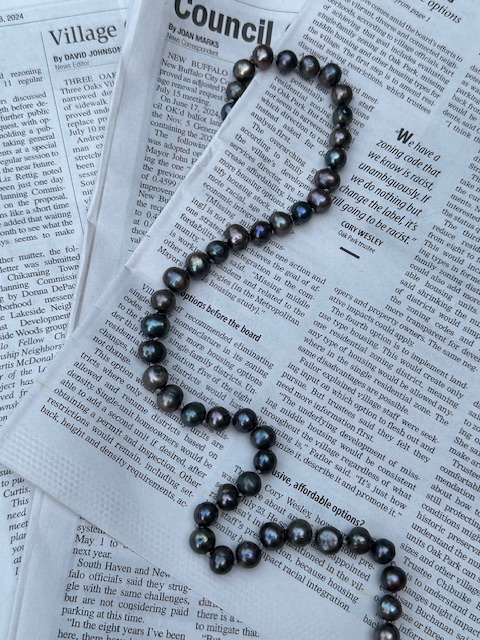
How do you tell a real pearl from a “cultured” pearl? It is difficult to tell the difference with a cursory look at outer appearances. An x-ray of the internal pearl is not available for most of us. A natural pearl may show ongoing “growth lines” where concentric layers of nacre build up. Nacre is often called mother-of-pearl; while it is whitish, it shines with different colors and is used to make buttons and other jewelry. Real pearls have special appeal, as their nacre layers can “bounce” light, making better “color.” Cultured pearls only have a thin outer layer of nacre.

One method of testing your pearls is to look at the holes drilled into the pearls; imitation pearls often have larger holes than real pearls. Now, gently rub two pearls together; imitation pearls will slide smoothly against one another while real pearls’ nacre is “gritty.” Grit is one of my favorite words, so you know that I admire the real deal. A growth-and-grit mindset is necessary for navigating the real world.

How do you tell real information from misinformation? Unfortunately, this is more difficult than detecting a real pearl! In the July/August edition of Monitor on Psychology, the magazine of the American Psychological Association, an article highlights the intense work of psychological scientists to increase their efforts to stop the life-threatening spread of false information about health.

Psychologist William Klein, associate director of behavioral research at the National Cancer Institute, regrets how politicized the term “misinformation” has become; he sees how social media is often responsible for rumors about health. It is especially disheartening when organized disinformation campaigns deliberately mislead folks with their layers of lies. Research shows that individuals tend to engage more and spread more false information online, compared with factual information. In one Canadian survey, 73% of 18- to 24-year-olds followed at least one influencer who spreads anti-science information. In the U.S. only 37% of adults had trust in CDC recommendations in 2022. So far, interventions regarding misinformation on health have limited success.

Carol Graham, Senior Fellow at nonprofit public policy organization Brookings Institute, cites not just political polarization as a factor in misinformation, but also the decline of local newspapers, the lack of post-secondary education opportunities in impoverished communities, as well as the mounting stress of reduced health and longevity in these neighborhoods.

Investment in declining communities is a critical issue, along with changing how Americans view mental health care. Funding for local newspapers can foster a sense of community, a dwindling concept. Vital communities take pride in their schools. Most of all, education is key in curbing misinformation. Wouldn’t a “cultured” society reform our schools so that all students can enter the labor market successfully?

To make misinformation less credible it will take a growth-and-grit mindset and layers of ongoing gritty change in tax-dollar choices.

Pearls of Peace (PoP) Quiz 

313. How do you detect misinformation?

314. What can you do to stop the spread of misinformation?   

Olympics & Mental Health

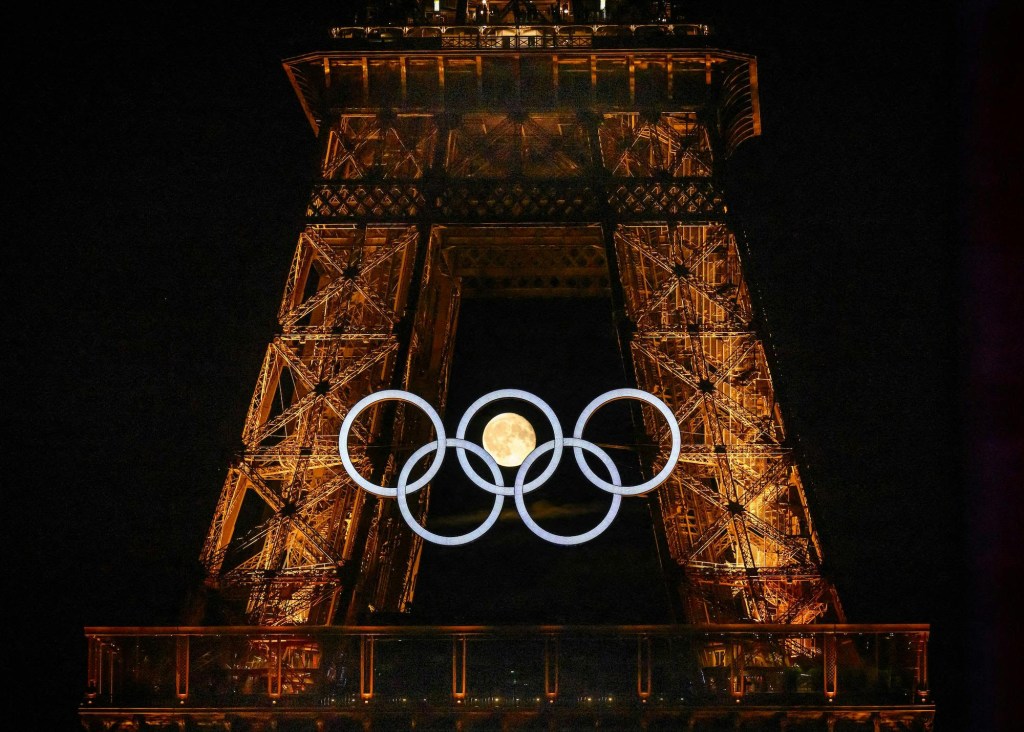
Eiffel Tower in Moonlight (Loic Venance/AFP via Getty Images)

Vincent Van Gogh captured the essence of one’s ability potential in a letter that he wrote to his brother: “…principles are good and worth the effort only when they develop into deeds…it’s good to reflect and to try to be conscientious, because that makes a person’s will to work more resolute and turns the various actions into a whole…for the great doesn’t happen through impulse alone and is a succession of little things that are brought together…it’s the same with other things as it is with artistic matters…the great isn’t something accidental; it must be willed.” 

What does it take to make a winning Olympian? Details may vary among different individuals, but I agree that greatness takes willpower which I define as grit. Research psychologist Angela Duckworth defines grit as “the power of passion plus persistence.” Grit is exercising discipline, a basic human need.

However, grit is not the only consideration in a person’s successful outcomes. One’s mental health is the secret sauce of success.

We can thank Simone Biles for educating folks about the importance of one’s mentally healthy approach to her dangerous-but-oh-so-beautiful sport. When she needed to drop out of most of the Olympic competition in Tokyo, many treated her decision harshly; she was expected to “push through,” and deny her doubts. Unfortunately, those who critiqued Biles misunderstood the situation.

Betty Okino, a 1992 Olympic medalist, explained that a gymnast can die if one cannot land on their feet (and end up landing on their head). Gymnasts call their doubts “the twisties,” a mental block where one has difficulty grasping their acute spatial ability to sense and control airborne moves. It feels as if their body and brain have a disconnect.

Biles did push through calf pain in the Paris Olympic qualification round this weekend, aiding her team in climbing to the top of the leaderboard. Biles told Hoda Kotb that she used to think of psychotherapy as a weakness. Now she has learned to speak about trauma.

Biles is not alone in addressing her mental health needs as an elite athlete. The comeback swimmer Caeleb Dressel made a decision to take 8 months off after the Tokyo Olympics to regroup in meeting his mental health needs; he has worked with a therapist weekly for 2 years.

According to Jess Bartley, senior director of psychological services for the U.S. Olympic & Paralympic Committee, 15 psychological service providers worked with 1,200 athletes last year. Athletes grapple with such questions:

  • What is the place that sport has in your life?
  • How is your identity tied up in this?
  • What does it mean to make, or not make, the Olympic Games?

The Paris Olympics has a 24/7 hotline with mental health counselors who speak 70+ languages. This year athletes may seek services until 4 years post-Olympic week. Elite athletes are role models in caretaking one’s bodymind without shame.

Pearls of Peace (PoP) Quiz 

311. How do you define your own identity?

312. When do you need extra willpower or grit in your life?   

Disability Pride Pearls

July is Disability Pride Month. We commemorate the Americans with Disabilities Act (ADA) anniversary (becoming law July 26, 1990). The ADA civil-rights goal is to prohibit discrimination against individuals with disabilities. One might ask how often the law is working for the 1 in 4 adults in the U.S. who live with a disability. Individuals with intellectual and developmental disabilities are especially challenged in finding jobs — 85% are unemployed.

Self-acceptance and pride are themes every year, but the 2024 theme for the month-long celebration is “We Want a Life Like Yours.” Being inclusive and supporting everyone is part of our Declaration of Independence: We hold these truths to be self-evident, that all men [people] are created equal, that they are endowed by their Creator with certain unalienable Rights, that among these are Life, Liberty and the pursuit of Happiness…we mutually pledge to each other our Lives, our Fortunes and our sacred Honor.” Yes, dear weekly readers, I included these words in my blog about July 4th — on the topic of immigrants who were granted citizenship over that holiday week. There seems to be a need for shoring up our memories about what our country stands for.

Boston has the distinction of being first to celebrate Disability Pride in 1990, while Chicago is first in sponsoring a Disability Pride Parade (beginning in 2004). A Disability Pride flag was created with various colors to represent different types of disabilities: green for sensory disabilities, blue for mental illnesses, white for invisible or undiagnosed disabilities, yellow for neurodivergence, and red to represent physical disabilities. One wheel-chair-bound participant looks forward to the annual parade, calling it “a family reunion.”

The idea of any parade is to celebrate something, to take notice of something important, and to pause our busy lives for a period of focus. Too often, those with disabilities are not noticed — or are noticed but then overlooked when it comes to inclusive actions. Some individuals with disabilities have to cope with ableism issues every day.

July also is National Minority Mental Health Awareness Month or BIPOC (Black, Indigenous, People of Color) Mental Health Month. We need more open dialogues about mental health in America.  

Happily, in my hometown community I watched our local high school’s summer musical with pride. The cast was extensive with a chorus line that was three-deep for many songs! Among the singer/dancer chorus were high schools students with disabilities. When I realized this, I had goose bumps. Someone at the high school notices these students. I was on the faculty of this school as a school psychologist in the 1980’s, working with troubled students who were referred to as “Behavior Disordered,” a label that I reject. Acceptance from non-special-education staff was withering.

Perhaps times are changing in a good direction. Let’s speed up progress in acceptance for everyone and their particular needs. 

Pearls of Peace (PoP) Quiz 

309. Do you personally know someone with a disability?

310. If so, how does their disability affect you?   

Courageous Pearls

In the assassination attempt on Donald Trump, the life of an innocent man ended as he sheltered his family. Two other bystanders also captured bullets. As in several other shooter profiles, the 20-year-old gunman was described as the recipient of bullying in school. Why? Who’s teaching the values of democracy which include “…insuring domestic tranquility”?  

In his book, Healing the Heart of Democracy: The Courage to Create a Politics Worthy of the Human Spirit, writer Parker J. Palmer calls for examining our inner lives to reach the “commonwealth” of compassion and creativity found in the wording in “We the People of the United States, in order to form a more perfect Union….” Palmer instructs how to focus on shared values with the claim that “the human heart is the first home of democracy.” His 5 habits of the heart are a courageous blueprint for these troubled times:

  • An understanding that we are all in this together
  • An appreciation of the value of “otherness”
  • An ability to hold tension in life-giving ways
  • A sense of personal voice and agency
  • A capacity to create community

Named one of the most important books of the early 21st Century by Democracy & Education, Palmer’s 2024 updated edition contains a discussion guide augmented by online video interviews. Let’s teach this in schools.

Another courageous source of hope lies in the community effort to end the cycle of gun violence by the Institute for Nonviolence Chicago. In partnership with Northwestern University and the University of Chicago Crime Lab, the Institute identifies community individuals who are at risk of being shot or becoming a shooter. They foster the healing of broken dreams and chaotic emotions of youth, supporting individuals though their program of “relentless engagement.” Block by block, they espouse the vision of Martin Luther King, Jr. in nonviolent problem-solving. Their 6 principles of nonviolence support Palmer’s ideas with added dimension:

  •  Nonviolence is a way of life for courageous people.
  • The Beloved Community is the goal.
  • Attack forces of evil, not persons doing evil.
  • Accept suffering without retaliation for the sake of the cause to achieve a goal.
  • Avoid internal violence of the Spirit as well as external physical violence.
  • The Universe is on the side of Justice.

The Institute creates a “culture of wellness,” including helping individuals find living-wage jobs in the legal economy. I love how their staff keep receiving training in trauma-informed care and have an offering of yoga practice. It is key to heal the healers as well as train individuals in nonviolence.

Palmer’s words inspire: “When democracy is working as it should, it is a complex and confusing mess where we can think and act as we choose, within the rule of law…and can still manage to come together for the sake of the common good.” The common good is inclusive. Democracy is inclusive.

Pearls of Peace (PoP) Quiz 

307. Which of the Institute-for-Nonviolence-Chicago principles might you work on?

308. How can you foster inclusivity in your hometown?    

Independence Day Pearls and Perils

July 4, 2024, celebrated 248 years since the birthday of the Declaration of Independence in 1776. While many Americans enjoyed celebrating July 4th another year, for some folks it marked their first Independence Day. Babies born in the past year and others who were granted citizenship marked their first July 4th holiday. I enjoyed family time along with watching an annual parade of community groups celebrating connections. The parade was energizing (even in light rain) with kids, candy bags, and colorful cars. Later in downtown Chicago, singing patriotic songs along with the Grant Park Symphony was memorable.

“If we have no peace, it is because we have forgotten that we belong to each other.” Mother Theresa’s words are timeless, but especially meaningful in today’s divided states of America. It was heartwarming to see everyone waving tiny American flags that were handed out at the concert.

U.S. Citizenship and Immigration Services (USCIS) celebrated Independence Day this year by handing out citizenship to approximately 11,000 newcomers in more than 195 naturalization ceremonies during June 28th – July 5th. Deputy Assistant to the President Blas Nuñez-Neto participated in a naturalization ceremony at George Washington’s Mount Vernon, while similar celebrations took place across the country, including Battleship in New Jersey, Gateway Arch National Park in Missouri and Fort Clatsop (Lewis & Clark National Historic Park) in Oregon.

 In 2023, USCIS welcomed 878,500 new U.S. citizens. This year USCIS made significant strides in reducing naturalization pending queues, already welcoming 589,400 citizens. USCIS Director Ur M. Jaddou summarizes: “These new citizens add diversity and character to our great nation, and we are committed to helping all who are eligible to experience the freedoms and liberties we enjoy as U.S. citizens.”

I cannot imagine leaving my country, especially if a language barrier existed. It must feel precarious to encounter uncertainty as unnerving as clinging to electrical wires. Even more daunting, I cannot imagine dealing with the traumatic conditions that can make it mandatory for some parents to carry their babies, with little else, across several countries to reach their dream of safety and second chances.

Let’s recall the Declaration of Independence intentions: We hold these truths to be self-evident, that all men [people] are created equal, that they are endowed by their Creator with certain unalienable Rights, that among these are Life, Liberty and the pursuit of Happiness…we mutually pledge to each other our Lives, our Fortunes and our sacred Honor.”   

Gaining citizenship as an immigrant is not guaranteed, but many communities across America have extended a helping hand to these newcomers. “There is no power greater than a community discovering what it cares about. Ask: ‘What’s possible?’ not ‘What’s wrong?’ Keep asking. Notice what you care about. Assume that many others share your dreams.” These words by organizational consultant Margaret Wheatley are a blueprint for moving forward.

Pearls of Peace (PoP) Quiz 

305. What meaning does July 4th hold for you?

306. How might you participate in helping others reach their American dream?

Summer Stones

Summer is in full swing! July 4th celebration plans are a big draw, although rock music fans flocked to Chicago for an early celebratory weekend with a Rolling Stones concert. Chicago rhythm-and-blues fans Mick Jagger and Keith Richards met in 1961 in London. Initially calling their band Little Boy Blue & the Blue Boys, guitarist Brian Jones snatched their more famous name from Muddy Waters’ 1950 song, Rollin’ Stone. Jones spotted the song’s LP — lying on the floor — just as he was asked by a journalist about the fledgling band’s name.

Also known by their shortened name, The Stones, band members were called to a stage by Muddy Waters for an impromptu jam in 1978. Sample this classic collaboration without having to purchase an expensive ticket: https://news.wttw.com/2024/06/27/rolling-stones-and-chicago-20-memorable-moments-band-s-rich-history-blues-capital-world 

Muddy Waters also inspired other white musicians – Elvis Presley and Bob Dylan are two examples. Dylan’s 1965 song, Like a Rolling Stone, is another Waters’ spinoff. Add the magazine copycat, Rolling Stone.

Copying an early English proverb (from around 1500), “A rolling stone gathers no moss,” an original meaning refers to cutting peat (consisting of sphagnum moss) in bogs to prepare for winter fireplaces. Any itinerant travelers were dubbed “rolling stones” as they did not gather the moss needed for heat. The Rolling Stones original duo –together for nearly 60 years — keeps gathering a fan following. Their beat can heat up memories. I still have my husband’s Rolling Stones LP, Sticky Fingers.

There is something poignant about one’s loss of innocence and encountering the “real” world. Consider The Rolling Stones signature song, I Can’t Get No Satisfaction, first released in the U.S. in 1965. It made Rolling Stone magazine’s “The 500 Greatest Songs of All Times” list in 2021 as #31. Jagger’s comments about his 60’s lyrics are eerily relevant today: “…it captures a spirit of the times…which was alienation.”

I can’t get no satisfaction
‘Cause I try and I try and I try and I try
I can’t get no, I can’t get no…

When I’m drivin’ in my car
And the man comes on the radio
He’s tellin’ me more and more
About some useless information
Supposed to drive my imagination….

I checked with a friend who went to this weekend’s concert and sure enough, I Can’t Get No Satisfaction was on The Stones’ playlist.

I wonder who might feel satisfaction after watching the presidential debate this past week. Alienation is toppling over in the U.S. today. Itinerant voters may not show up for November’s important election. However, circuitous stepping stones may bring people together. We are an interconnected bunch, although we may not acknowledge our earliest common ancestors. We need more cross-culture collaboration like Muddy Waters and the Blue Boys from London enjoyed. Without such acceptance, we act stone-like to one another. And we get no satisfaction.

Pearls of Peace (PoP) Quiz 

303. How do you define satisfaction in your life?

304. What drives your imagination?    

It Takes a Grandmother

I am fond of my book title for my first book, It Takes a Child to Raise a Parent. I receive affirmative grins and head shakes when I share this title with others. You likely helped to raise your parents in certain ways, but also have learned a thing or two from kids, either from your own or other’s children. Sometimes though, it takes a grandparent to raise consciousness about something important.

Juneteenth has been celebrated among African American families for 150+ years, yet many Americans are unaware of this aspect of our U.S. history. The history of people of color has not been covered as extensively in school textbooks as the history of Pilgrims claiming “freedom” on American soil.  

Some Americans only heard of Juneteenth when President Biden named June 19th as Juneteenth National Independence Day in 2021. While the Senate unanimously approved a bill to set aside a national day of commemoration, sadly there was opposition from 14 members of the House of Representatives. We might guess the color of their ancestors’ skin.

While President Lincoln signed the Emancipation Proclamation to end slavery on January 1, 1863, folks living in Texas did not receive this news. It was not until 2 ½ years later on June 19, 1865, that General Gordon Granger went to Galveston, Texas, to deliver the freedom tidings. Such a deliverance was not recognized by many. African Americans were wary of their actual freedom. As Harriet Tubman expressed, “I had crossed the line. I was free; but there was no one to welcome me to the land of freedom. I was a stranger in a strange land.”  

It took the grit of a grandmother, Opal Lee, to rouse the rest of the country into awareness of this vital piece of our shared history. Lee grew up in Texas, but freedom of African American residents was far from accepted practice there. When her family lived in Fort Worth in a mostly white neighborhood, as a child she survived her home being burned to the ground by white individuals on June 19, 1939.

As a retired educator, Lee worked tirelessly to gather the signatures needed to appoint the national holiday for Juneteenth. As a spry 89-year-old, Lee embarked on 2 ½-mile walks from Fort Worth to the U.S. Capitol. She was 96 years young when she finally witnessed the signing of the historic Bill creating Juneteenth as a national holiday.

Perhaps some of us have forgotten (or never knew) the little song that I learned in Sunday School: “Jesus loves the little children, all the children in the world. Red and yellow, black and white, they are precious in His sight….” For those who were not raised in this Sunday School tradition, go to any flower garden. Only some plants are white; most are colorful.

Pearls of Peace (PoP) Quiz 

301. What cause could interest you in walking across the country to gather support?  

302.  How can you foster “freedom” in your community?

Pearls of Pride

The definition of “pride” today is “a feeling that you respect yourself and deserve to be respected by other people.” This has a different connotation from an older definition which meant “inordinate self-esteem.” Likewise, our definitions of personhood are evolving.

The first Pride march in New York City took place 6-28-1970, one year after Stonewall Inn, a Greenwich Village gay bar, was raided by NYPD. Violent demonstrations followed. Stonewall became a rallying call, creating a turning point for gay rights. Pride Month was recognized nationally by President Clinton in 1999 and later endorsed by President Obama. Month-long activities highlight the courage and contributions of lesbian, gay, bisexual, transgender, queer, intersex, and asexual (LGBTQIA+) individuals.

Everyone’s story is unique. Here is one story.

Gender Magic (2023) is the book that Mx. Rae McDaniel wished they might have had as a guide when they were young. Growing up with missionary parents was challenging for this adopted child. The following words convey McDaniel’s extreme discomfort: “The journey to my nonbinary identity was like discovering I’d been walking around in shoes a half size too small. Until I was almost 30, I didn’t notice how uncomfortable and constricted I felt in my assigned gender as a woman, but after decades limping around with blisters, my cramped toes screaming for relief, something had to give.”

According to the National Library of Medicine, it is impossible to know the population size of transgender individuals in the U.S. The Census Bureau has a don’t-ask-don’t tell approach to gender- identity differences. A study searched the Cumulative Index to Nursing and Allied Health literature and estimated 1 million adults nationally are transgendered individuals.

Further study results are frightening. According to a 2008 national survey, transgender individuals were 4 times more likely to live in poverty with twice the rate of unemployment and homelessness: 28% postponed medical care due to discrimination. More traumatic, 41% attempted suicide.    

Research (June, 2022) by the Pew Research Center reports that 1.6% of U.S. adults are transgender or nonbinary; their current gender identity and assigned-at-birth sex differ. Younger adults (under age 30) are more likely to report being trans or nonbinary: 2.0% under 30 are a trans man or trans woman, while 3% identity as nonbinary which means they are neither man nor woman (or are not strictly one or the other). The American Psychological Association explains: “Transgender people, like cisgender people, may be sexually oriented toward men, women, both sexes, or neither sex.”

Those of us who do not question our gender and/or sexual identity are not as accepting of differences as we might be.  Physician and poet Jeremy Nobel (Project UnLonely: Healing our Crisis of Disconnection) has pertinent advice: let’s accept each other as “who we are and welcome hearing their story.”   

Pearls of Peace (PoP) Quiz

299. What is your experience in fostering inclusiveness for those who identify differently from you?                       

300. How might you foster cultural connotations that are inclusive of all people?    

Wear Orange: Hunt for Peace

Hostility is a trainload of energy that can go off-track. Wear Orange Weekend (June 7-9) commemorated victims and families of gun violence, which can derail entire communities. One estimate is that 120 individuals are shot and killed every day in America (with twice as many suffering wounds from gunfire).

The U.S. movement of Wear Orange began in 2013 after the tragic killing of 15-year-old Hadiya Pendleton, a student at King College Prep High School. She was shot in the back while standing with friends on a Chicago playground only one week after marching in President Obama’s inaugural parade. The 18-year-old gunman was sentenced to 84 years in prison, admitting that Hadiya was not the intended “target.”

Hadiya’s friends began honoring her life by wearing orange, the vibrant color worn by hunters to alert other hunters that they share space in the woods. It seems unbelievable but guns lead as the cause of death among American children and teens.

Prominent psychologist Abraham Maslow was asked a question in a 1968 magazine interview for Psychology Today: “If a …young psychologist came to you today and said, ‘What’s the most important thing I can do in this time of crisis?’ what advice would you give?”  Maslow replied: “I’d say: Get to work on aggression and hostility. And we need it now…time is running out. A key to understanding the evil which can destroy our society lies in this understanding.” 50+ years later we still are not addressing aggression and hostility with enough urgency.

While June 7th, Hadiya’s birth date, was the 10th National Gun Violence Awareness Day, June 8th was named National Best Friends Day by the U.S. Congress in 1935. Enthusiasm for the day has waned, but we need affirming friendships more than ever. I wonder if those who take another’s life have any best friends.

According to National Today’s survey of 1000 adults (https://nationaltoday.com/national-best-friends-day/), 19% named their dog as their best friend and 9% named their cat. When asked if they had a best friend, 15% answered no. Happily, many reported that they do not have only one best friend!

Primary-care physician and poet Jeremy Nobel authored Project UnLonely: Healing our Crisis of Disconnection (2023). His words might apply to individuals who shoot people: “When we are too lonely for too long, the way we make sense of the world changes, leaving us increasingly at risk for even greater loneliness. We fail to thrive and flourish, we get sick, we spread the affliction to others, and we die before our time.”

What signals violence ahead? There are many tracks that can lead to gun violence, but the most powerful predictor of future violence is a history of violent behavior according to the American Psychological Association. We must “get to work” on prevention.  Let’s address the needs of young children and their parents. Let’s hunt for peace.    

Pearls of Peace (PoP) Quiz

297. Is your best friend an animal?

298. Do you know anyone who seems disconnected and needs friendship?  

Writing Pearls

Illinois Women’s Press Association (IWPA) hosts a contest for writers, both professional writers and beginning writers in high school. I became a member after re-reading Natalie Goldberg’s wonderful book, Writing Down the Bones, and realizing that I too might call myself a writer even though I had only “morning pages” under my writing belt. Goldberg received sage advice from a Zen master: “Why do you come to sit meditation? Why don’t you make writing your practice? If you go deep enough in writing, it will take you everyplace.”

Yes, writing takes one everyplace. In 1995 I fell down steep stairs in Chicago on the eve of taking my firstborn to college. Unable to hobble much in my cast, I slowed down. I began writing “morning pages” according to journalist and film/TV writer Julia Cameron’s inspiring book, The Artist’s Way: A Spiritual Path to Higher Creativity. I did not imagine that later I would publish three developmental psychology books and create a weekly blog, Pearls of Peace. The word “blog” was not invented until Jorn Barger coined “weblog” in 1997; Peter Merholz reduced the concept to “blog” in 1999.  

Goldberg is strictly a pen-and-notebook (of a special kind) writer. She prefers writing in a café. I can take notes and write poems with a pen, but I prefer the keyboard at my desktop computer for books and blogs. Classical music is my companion when I write, not extraneous conversation. Reportedly, Ernest Hemingway wrote naked at a lectern. He used a pencil but switched to typing for dialogue. Each writer develops their own writing style.

Cameron wrote her “morning pages” for decades; in a lecture she commented that writing is a way to “zip up a concern.” She believed she was writing her 1992 Artist’s Way for “about 5 people.” She was shocked when 5 million copies sold! I do not have this following, but the people who do read my writing give me compassionate feedback. However, we writers are most in need of saying something when we take our pen or keyboard to hand. Among others, Cameron believes that we teach what we need to learn ourselves.

I feel lucky to discover the stimulation of writing in an encore career. I feel lucky to receive awards from my two submissions to the 2024 IWPA Mate E. Palmer Communications Contest:

  • First Place in Web & Social Media Blog, Nonprofit (Government or Educational), IWPA 2024 – “Banned Pearls” (online 10-2-23) 
  • First Place in Non-Fiction Books for Adult Readers, IWPA 2024 – Transforming Retirement: Rewire and Grow Your Legacy (published 2023)

The best part of the Award luncheon was hearing high school writers’ enthusiasm for their craft! I recommend writing at every age. Take Hemingway’s advice: All you have to do is write one true sentence. Write the truest sentence that you know.” My advice? Write a second sentence. Keep writing.

Pearls of Peace (PoP) Quiz

295. What kind of writing engages you?

296. Is there a type of writing you would like to begin?