“Fast” Talkers Live Longer

The Berlin Aging Study (BASE) is a multidisciplinary (sociology, psychology, psychiatry, and internal medicine) study of seasoned citizens (my name for older adults) between ages of 70-105. Initially, detailed information was gathered for 258 men and 258 women who lived in Berlin. The longitudinal research originated under the direction of the late German psychologist Paul B. Baltes and German sociologist Karl Ulrich Mayer. Along with his American psychologist wife, Margret Baltes, Paul Baltes viewed lifespan development in terms of “plasticity” in cognitive abilities, a context of adaptation, and multidisciplinary factors such as one’s biology, family, schooling, religious affiliation, and profession. The Baltes couple promoted successful aging through optimizing one’s cognitive functions and the ability to adapt to change, including loss. Research supported their belief that cognitive abilities can continue to develop in late adulthood with participation in stimulating activities. A current longitudinal study (BASE II) of 1600 seasoned citizens (ages 60-80) is underway at the Max Planck Institute for Human Development in Germany.

BASE research results are fascinating. General intelligence did not predict who might live longest. Instead, verbal fluency was key in long-living folks. The participants with low (versus high) verbal fluency had a median survival time that was 9 years shorter! Verbal fluency requires broad abilities, including fast information retrieval and a crystallized knowledge base. One only hopes that a fast-talking individual possesses a truthful knowledge base.

Here are a few pointers for increasing your verbal fluency. Heather Hurlock, Founder and Editor of Super Age (an online source of health and wellbeing), names the first three well-established ones.

  • Read out loud. This suggestion also is endorsed by a 30-minute-daily program, StrongerMemory, for those in mild cognitive decline. Do not wait for cognitive deficits to appear to make a reading-out-loud practice for yourself! You will build on articulation and rhythm skills when you read to yourself or others. Both skills link to verbal fluency.
  • Hand-write often. While cursive is being dropped from many elementary schools, I believe that is a mistake. There is evidence that suggests learning cursive handwriting is helpful in one’s overall learning and retention. Handwriting (but not typing) is related to letter processing which translates to successful reading in youngsters. Also, handwriting is part of the StrongerMemory workbook exercises. https://goodwinliving.org/strongermemory-the-fight-against-cognitive-decline/
  • Think (and take deep breaths) before you speak. Take mindful pauses to provide your brain with a chance to retrieve some linking thoughts. Not only will this increase your confidence level, but it may enlist a better (or more humorous) verbal outcome.
  • Give speeches or read a poem (as in open-mic venues). You have talents to share and your brain will reward you for using a variety of sensory inputs.
  • Talk regularly; ask people questions. You may surprise yourself with what you can learn about others in a few sentences.

Have fun talking!

Pearls of Peace (PoP) Quiz

413. When is the last time you wrote a letter by hand?

414. How might you practice your verbal fluency in a new way?        

How Slow-Living Are You?

Stephanie O’Dea is author of Slow Living: Cultivating a Life of Purpose in a Hustle-Driven World. She is a “slow-living coach.” This made me laugh out loud. She must not be in the midst of a major move which entails constant decision-making hustle around packing/unpacking a myriad of stuff: Will this fit in my new home? If not, what do I do with it? Then, upon arrival, this will not fit! What do I do with it? However, I do know I am making move-hustle progress because my dreams no longer are about packing; last night I dreamt about vacation, an escape from the unpacking process.

O’Dea started her slow-living journey with “A Year of Slow Cooking.” She believes that cooking is a chore, not something that she wants to do, so she loves her crockpot. I gave away my crockpot. I enjoy cooking fresh food “from scratch,” but I might need some slow-living ideas when I finish unpacking boxes.

I found out that I could “join 10,000+ Students of Life” by subscribing to the “Sloww (not a typo!) Sunday newsletter.” Instead, I chose to hustle up on this phenomenon briefly online before jumping into another book for my overcrowded bookshelves. Here are some highlights of Slow Living and the Slow Movement:

  • Organizational psychologist Geir Berthelsen created a think tank in 1999, The World Institute of Slowness, advocating that “…the best thinking comes from a walk in the slow lane…slowness is the forgotten dimension to time. Unlike chronological time, it is non-linear, time here and now, time that works for you, extraordinary time. So why be fast when you can be slow? Slowness is also about balance, so if you must hurry, then hurry slowly.” Is hurry slowly an oxymoron?
  • Nearly two decades later, Canadian journalist Carl Honoré wrote a book titled In Praise of Slowness: Challenging the Cult of Speed.
  • Beyond slow living and slow food, today there is a slew (or stew) of slowness – slow money, slow parenting, slow education, slow reading, slow medicine, slow gardening, and slow religion. In 30 countries there are 236 cities that call themselves slow cities! Who knew?
  • According to Slow Living 201 (I skipped the 101 version), there are 15 adjectives for slow living: paced, unbusy, balanced, intentional, connected, deep, purposeful, holistic, soulful, long-view, low-stress, eased, time-rich, conscious, and mindful. https://www.sloww.co/slow-living-201/

I completely agree that mindfulness is a practice well worth putting into your daily routine. I participate every morning in an online mindfulness group with 20 minutes of silent mindful reflection. I practice mindfulness at other times of the day too, especially when gardening or cooking. I find these slow-breath actions grounding — literally grounding when working with soil in my yard. But honestly, I use some hustle in other parts of my life. Do I need to read O’Dea’s Slow Living book?

Pearls of Peace (PoP) Quiz

411. Do you engage in slow living some part of your day?

412. What aspect of slow living might be beneficial for you?  

Possessed Versus Letting Go

Vicky Silverthorn is a professional organizer. She can clean up any mess in your home or study. Let’s backtrack. Why did we hang onto items that now clutter our space in the first place? Are we possessed by possessions?

According to a study cited in the Journal of Consumer Psychology, researchers find that folks link certain items to their self-worth. When they no longer have said items, they grieve for lost possessions in terms of their tie to them as part of their self-identity. There are extreme “hoarders” (2.6% of the population, according to the American Psychiatric Association) and more common “packrats” who suffer from a difficulty categorizing “an array of items with minimal value into groups.” 

My personal packrat-itis has roots. Both of my parents fit the description. They had an excuse. The nation’s depression was a major event in their early years. As the oldest of 10 children, my mother recalled not having much food to eat; she recalled having “coffee soup” (coffee over a piece of bread) as a meal. She sometimes was asked to take a skillet containing leftover gravy (over bread) down the alley to a family with less to eat than her own family. How could there be leftovers from a dozen people at their table? Such experiences were vivid for my mother many years later. She was a saver of tin foil and plastic bags for reuse, as well as much larger items that became clutter build-up. Dad had saver parents who knew they might “need” an item “someday.”  

Silverthorne advises that “Clutter can affect our mood, productivity, ability to think clearly, and overall mental processing. It can contribute to stress, impact our well-being, and really alter our focus…for a free-flowing house and a free-flowing mind, reducing clutter really helps.”

Words of wisdom may not be enough to make the letting-go process possible. In moving from a larger home to a smaller one, I encountered clutter closets that I could escape from for years with merely closing the doors. The day of reckoning came with moving: I had to face the fact that there were simply too many items to take with me…and many of them did have minimal value…to other people.  

Each “minimal value” item was attached to some memory. It was memories and the relationships attached to those memories that I did not want to let go. With practice, I am learning to give up keeping “everything,” although my learning curve is a bumpy ride. I do not find Silverthorne’s advice to ask, “What’s the worst thing that could happen?” very useful. More appropriate to my situation, I recall the person who gifted me an item, thank them silently, and then send the item into give-away land. Admittedly, this takes time. It is not as easy as it may sound.

Pearls of Peace (PoP) Quiz

409. How do you handle keeping versus giving-away decisions in your home?

410. What is your method for letting go of items of “minimal value”?

Pearls of Time

Time is both slipping by and an enduring treasure. Time has been on people’s minds, well, for a long time.

  • “Time is the most valuable thing a man [person] can spend.” — Theophrastus, Greek philosopher and naturalist (372 BC-287 BC)
  •  “People don’t take opportunities because the timing is bad, the financial side unsecure. Too many people are overanalyzing. Sometimes you just have to go for it.” —Michelle Zatlyn,  Cloudflare co-founder
  • “Time is what we want most but what we use worst.” — William Penn, British Quaker founder of Pennsylvania
  • “Every tragedy we can imagine comes back to just one: time slipping by.”
    — Simone Weil, French philosopher (1909-1943)
  • “Time management is an oxymoron. Time is beyond our control, and the clock keeps ticking regardless of how we lead our lives.” — John C. Maxwell, American writer on leadership
  • “Liminal moments. Those moments apart from time when you are gripped. Taken. When you are so fully absorbed in what you are doing that time ceases to exist.― Rebecca Wells, Divine Secrets of the Ya-Ya Sisterhood

And from my favorite timekeeper:

  • “…Doesn’t everything die at last, and too soon? Tell me, what is it you plan to do with your one wild and precious life? ― Mary Oliver, The Summer Day

Poetry cuts to the chase on most topics. Poets understand impermanence. They often embrace curiosity for one’s present time.

 Poet and naturalist Derek Sheffield became Washinton state’s 8th poet laureate on 04-30-25. Freelance writer Sarah Neilson summed up his poetry succinctly: Sheffield writes with wildness and wellness as inspiration. In Neilson’s interview for the Seattle Times, Sheffield reflected on his work with a philosophy I can endorse: “An important part of my own journey has been my sense of curiosity and my capacity to feel wonder. I will run across people who don’t seem to have that capacity and don’t seem to be curious…a fair amount of what I do in writing classes is unteaching and trying to get us back to where we all started in third grade. That space, that energy, that trust, that imagination, that engagement with our imagination.”

Yes, who were we in 3rd grade? How did that timeframe influence who we are today? Wasn’t it just yesterday? I recall loving my 3rd grade teacher, Mrs. Anderson. She encouraged creativity and was a font of positivity. I recall her constant smiles. Some teachers’ influence can last a lifetime, either in a good way or a less skillful way. We earthlings are interconnected in a circle of time’s memories.

Consider Derek Sheffield’s poem, Still Time:

“In a wide
and motionless circle, nine

Chinook salmon
below a stilled spillway,

nose to tail-fin, wait,
faint flutterings rounding their backs

in place, each moment
slipping (a white bubble

up from the dark) through the clock face
they make of creek water,

a count we might mistake
as ours.”

Pearls of Peace (PoP) Quiz

407. How do you think about your slipping-by moments?

408. What are your plans for wildness and wellness today?                                                                                                

How Many Ways Are There to Say Goodbye?

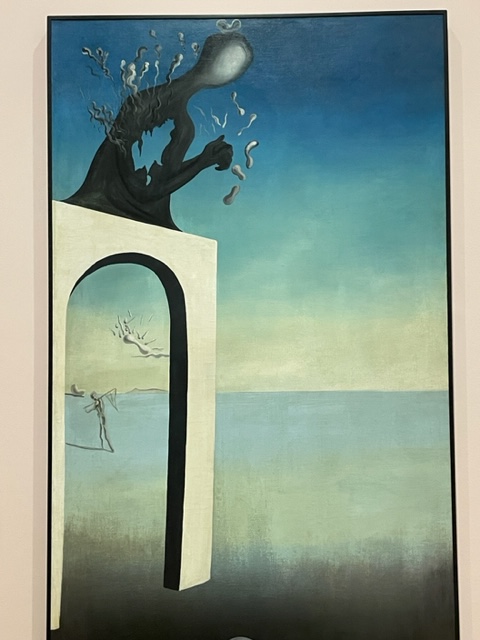
Salvador Dali, Untitled (Dream of Venus)

I confess that I do not have a ready answer to this question. In fact, I am better at asking questions than supplying answers, if you have been reading my blogs for awhile. How could I possibly know how each of you defines a “good” goodbye? I’m pretty sure that all of us have received poor goodbye versions, but straight from my parenting book, let’s keep a focus on what to do, instead of what not to do. It just is a forward-thinking and healthier route.

I have checked online to see what others think about ways to say goodbye. I was struck by one way — “Peace out” — which I have never heard anyone use! According to a definition, it is “an informal and casual way to say goodbye, often used with a sense of finality.” I have had occasion to say goodbye recently to a number of people who I believe I will never see again; saying “peace out” would have seemed strange. Saying goodbye actually derives from “God be with ye,” shortened to “Godbwye,” before becoming today’s “goodbye. 

Here are some other goodbye versions that might have been useful if I had read about them earlier:

  • This is not goodbye, it’s thank you — express gratitude for your relationship and the time spent together, focusing the farewell on fond memories. 
  • “Remember me and smile, for it is better to forget than to remember me and cry”  (Dr. Seuss) — remembering the good times, find peace in each going their separate way.
  • “Farewell is like the end, but in my heart is the memory, and there you will always be” (Disney) — acknowledge the finality of the goodbye while maintaining the enduring nature of memories.

Say yes to memories, but the recognition that you may never see someone again is grieving territory. Colin Murray Parke, a British psychiatrist, coined this version: “The pain of grief…is perhaps the price we pay for love, the cost of commitment.” In a recent discussion with others, one person made this insightful comment: when you have to say a significant goodbye, it brings up all of the other times you were in this situation and it feels sad all over again for those earlier goodbye times. There is grieving in the goodbyes in our lives and we are not fond of grieving. Do we expect everything to “last?” Well, yes.

Poetry can help us deal with the impermanence in life.

“As every flower fades and as all youth
Departs, so life at every stage,
So every virtue, so our grasp of truth,
Blooms in its day and may not last forever….”
(from “Stages” by poet and novelist Herman Hesse, in his last novel, The Glass Bead Game (which won Hesse the Nobel Prize for Literature in 1946).

Embrace impermanence and savor your ability to have significant relationships.

Pearls of Peace (PoP) Quiz

405. How do you say goodbye to someone you may never see again?

406. When can you recall  “good” goodbyes?

Communicate Perils or Pearls

Jitish Kallat, Public Notice 3 (The words communicate 2 historical moments: A speech by social reformer Swami Vivekananda on 9-11-1893 and the terrorist attacks on 9-11-2001), Art Institute of Chicago

In an interview with psychologist Jill Suttie, journalist Nicholas Carr details social media history and its variable effects upon the public. The telegraph and telephone arrived in the 1800’s. The first commercial radio station followed in 1920. As a wireless telegraph, radios provided Morse codes to ships and lighthouses where wires could not reach. Then came an onslaught of radio news, music, and perhaps most important – opinions that dominated the one-size-fits-all airwaves for mass consumption. Some complained that radio was “dumbing down the population.” A dangerous force of radio’s power was when German Nazis took over radio stations in the 1930’s and communicated their propaganda.

Carr makes the argument in his book, Superbloom: How Technologies of Connection Tear Us Apart, that more efficient communication does not equate with better communication. He refers to research that suggests that learning more about other people does not lead to liking them more or even understanding them more. In fact, finding out the various ways that another person is different from one’s self-perception can lead to disliking that person. Simply put, people tend to focus on differences more than similarities and we dislike “the other” who is “different.”

Currently our online lives can overwhelm us with massive amounts of information which we filter through our existing biases. Another problematic issue is that folks are addicted to social media. Carr states it well: “We’re not being manipulated to act in opposition to our desires. We’re being given what we want in quantities so generous, we can’t resist gorging ourselves.”

Social media outlet algorithms find what we use regularly and then load us with similar topics. With the oncoming AI locomotive barreling down media tracks, who can escape this runaway train? AI offers virtual “companions.” Is this communication or manipulation?

A sidecar in social media is the “Influencer.” The definition of an Influencer is an individual who is able to generate interest in something by posting about it on social media. Initially an Influencer was a celebrity (think Elon Musk who was, or still is, an Influencer of the U.S. President), but today’s Influencers can be anyone with a large following on social media. This is enough content about communication perils.

Where are the communication pearls? Communication skills are key in relationships, careers, and world diplomacy. We simply must teach children effective communication and problem-solving skills. Early in my career I was part of a small group of psychologists teaching Myrna Shure and collaborator George Spivak’s Interpersonal Cognitive Problem Solving, later renamed I Can Problem Solve (ICPS). I worked with Myrna at Hahnemann Medical College and Hospital (Philadelphia) and her 8-week curriculum for students from preschool to 6th grade. ICPS engages both teachers and parents in training children on how to think and communicate with an understanding of alternatives. Much communication requires alternative problem-solving steps.

Who teaches adult versions of I Can Problem Solve?

Pearls of Peace (PoP) Quiz

403. Who are your social media Influencers? ‘

404. What communication skills do you use daily? 

Down-Memory-Lane Reunions

High school class reunions are a coupling of nostalgia for one’s youthful memories and a grappling with finding out that some classmates experience serious health challenges or are no longer living. As years progress post high school, the number of attendees dwindles. I was surprised to learn that one-third of my high school classmates have died. At our gathering there were helium-filled balloons with the name of each person who had died. We released the balloons skyward following our reunion luncheon. This had not been a part of our earlier reunions; the ritual was touching, but sobering.

There is a problem with releasing balloons. As the balloons finally die, their remains often are swallowed by animals who become ill and/or die. Ribbons attached to balloons may impede wildlife also. Some states have banned the practice altogether due to the serious consequences.

This made me wonder how others handle reunions. Google had answers, but not about the deceased. Reunion-planners may give a list of questions for classmates; I found that many of the online questions could be considered judgmental. An example is asking who in the class has the longest marriage. Another question asks who has been to jail!  How would a person with a divorce or jail-record feel about such questions? The question that I found most enlightening is this one:

  • What are 3 things that you want to do in the next 5 years?

I cannot say that I found many answers to this question informally. Although one classmate asked me, “Are you still working,” it seemed that the opinion was that there must be something wrong with not fully “retiring.” Most talk was reminiscing-focused.

Curiosity expert Scott Shigeoka has a “Powerful Questions List” to engage people in thinking out-of-box.

  • What was a challenging thing you did this month?
  • When did you feel proud of yourself recently?
  • What’s something new you’d like to try?
  • What is life teaching you right now?

Survey results from Road Scholar report that 94% of older adults experience greater well-being among those who “age adventurously.” Folks reported feeling just as happy in their 50’s, 60’s, and beyond as they did in their 20’s and 30’s. There is no one size that fits all, and I am not referring to the size of your clothes, a topic of concern for some. The definition of aging adventurously might mean staying physically active by running around the yard with grandchildren, traveling more exotically than your parents’ generation, or creating a new bucket list and following through with your possibilities.

Road Scholar, a non-profit organization that creates 4000 learning adventures from birding to Beethoven for participants 50+, is celebrating its 50-year anniversary in 2025. June 8th was pronounced “Age Adventurously Day” by Road Scholar. But isn’t every day a good day for some adventure?

Pearls of Peace (PoP) Quiz

401. You knew it was coming. What are 3 things that you want to do in the next 5 years?

402. How might you define aging adventurously?       

Transition Pearls

Are you in transition? Every day is a mini-transition, but I’m asking about bigger changes, the kind rated on the Holmes and Rahe Stress Scale. The “top” 10 events on the stress scale are death of spouse, divorce, marital separation, jail term, death of close family member, personal injury/illness, marriage, fired at work, marital reconciliation, retirement…moving is #32.  

Transitions are everywhere. Consider your breath moving constantly, from inhale to exhale. As singer/songwriter George Strait, reminds, “…life’s not the breath you take, the breathing in and out / That gets you through the day ain’t what it’s all about / You might just miss the point if you don’t slow down the pace / Life’s not the breaths you take, but the moments that take your breath away.”

I have experienced moments recently that take my breath away. The reaching out of many friends cools down my stress thermometer. I am moving cross-country for a fourth time. I finished college in the Midwest and moved to Boston for graduate school and career-building. The second move was a shorter hop to Philadelphia where my husband had a new job waiting. Parents by then, we each found employment that was mind-stretching. A third move back to the Midwest was both job-related for my beloved husband and closer to extended families. We found mind-bending jobs and grew a whole lot. Death-of-spouse solo, I plan a west coast move where I will be closer to where my children have settled. They need mountains and hiking; it feels healthy for me too.

We cannot know in advance the outcome of our many transitions, but we can take notice when something “moves” us and takes our breath “away.” A cook for all seasons, Ina Garten, lived in Washington DC and was a regular hostess of dinner parties. She left her government job with the White House Office of Management and Budget decades ago to buy a cheese and gourmet shop, the Barefoot Contessa on the Hamptons. She cheerfully quipped, “You figure it out along the way!” Without knowing how her maiden entrepreneurial venture would turn out, she had a bird’s-eye view. She stepped into uncharted territory one breath at a time. On a small stage, isn’t this what we all do when we wake up each morning?

After two decades of operating her specialty shop, Garten sold her business and took a year to figure out her next stage. When she slowed down her pace, Garten next became a cookbook author in the very crowded field of cookbook authors. With cookbook success, she was offered her own TV cooking show on the Food Network, receiving inclusion in the inaugural 2021 Forbes “50 Over 50” list of leaders and entrepreneurs. Her 2024 memoir has a catchy second title, Be Ready When Luck Happens.

Garten inspires me to make big changes. Who inspires you?

Pearls of Peace (PoP) Quiz

399. When is the last time that some action took your breath away?

400. What transition calls out to you?

Memorial Mammals

Blue whale skeleton, Natural History Museum, London

Gigantic blue whales (100+ feet long) were rescued from extinction in the 1960’s. Hunters gorged on profits from whale meat, oil, and baleen. Blue whale numbers fell from nearly 350,000 to approximately 400 in the late 20th century. While these mammals slowly grow in numbers, they remain an endangered species due to marine pollution and climate change on an uptick.

Today is Memorial Day when we mourn a different mammal’s demise – humans (average height 5.5 feet). In addition to pollution and climate changes that threaten humankind, our species seems fixated on wars. It is impossible to know an approximate numbers of soldiers and civilians who lost life in war-related “hunting” in different desired profits, especially land grabs, and/or power over certain “others.”

I received an education about war and its lingering trauma effects when working with veterans in my family therapy private practice. I cannot imagine being sent to a far-away place and then hunting down the people who live there, whether soldier or civilian. How could one know from a distance if a person was the intended target? The term “collateral damage” bothers me. Civilian casualties are considered murder in circumstances not bound by military definitions. Veterans in countless wars shot their guns “in the air” rather than killing another of their kind. When we give air to all the stories from veterans, perhaps we then might engage in civil problem-solving.

However, it is no wonder that veterans decline to speak about their experiences. They carry an emotional backpack that they believe they must hide and protect. Who can make the personal decision to dishonor their government’s orders? Returning Vietnam soldiers felt scammed when realizing the war hoax of a President who did not know how to end disastrous results. Coupled with personal value systems shattered, soldiers suffer silently.

I once participated as a volunteer in an innovative program called Vet Art. We used forms of art to engage Vietnam War veterans in coping with their lingering trauma. Like my veteran clients, both men and women soldiers told war grief stories of shame and guilt. While listening to and caring for other vets in a safe group environment, soldiers discovered that their emotions were universal although each had unique ways of exiling the pain they lugged through current life.

Americans have a lot to learn about grieving from the Dutch. Beginning in 1945 Dutch citizens “adopted” the graves of 8,301 U.S. soldiers buried in the Margraten American Cemetery. Considering U.S. soldiers their liberators in preserving democracy, Dutch families have preserved this grave adoption for 70 years. Many graves are passed on, generation to generation, even writing the respectful grieving ritual into wills. Dutch families search for and contact families of their adopted fallen soldier. On Memorial Days, some biological family members attend ceremonies with their Dutch-adopting family. Might such cross-culture caring keep us from extinction?

Pearls of Peace (PoP) Quiz

397. What stories linger for you about war experiences?

398. How might you honor cross-culture sacrifices today? 

Ancestor Pearls

Ever curious, I traveled to the UK to find my English ancestors in the Yorkshire dales (Viking word for valleys). On my plane ride over the ocean I read the history of Yorkshire’s people – industrious and opinionated – check and check. I also found a new understanding about my 9-times-great grandfather. Gathering Yorkshire lore, there is a line-up of possible gene diversity in early times. My Lonely Planet travel guide gives a history of a variety of people occupying Yorkshire. Originally there was a local tribe called “Brigantes” who were linked to the Celtic goddess Brigantia. But many adventurers desired claim to the lovely rolling hills and dales of Yorkshire. A revolving door of conquering warriors settled there:

  • AD 71 — Romans fought off Brigantes, building roads and fortifications.
  •  AD 122 — Roman emperor Hadrian, born in Italica, used the fort at York for “campaigns.”
  • AD 325 — Roman priest Paulinus converted Yorkshire people to Christianity.
  • AD 410 – Roman Empire rule ended in Britain with Anglo-Saxons taking charge.
  • AD 866 — Vikings arrived, making York a successful trading post.
  • AD 954 — King Eadred of Wessex took command, ousting the Vikings.
  • AD 1066 — King Harold II held off a Norwegian invasion, only to die at the Battle of Hastings.
  • AD  1066 – Vikings rebuilt York, including the beginning of the large cathedral…
  • AD 1644 – “Civil” War nearly destroyed the city of York.

My ancestor, Joseph Whitacre (also spelled Whitaker), was born in Yorkshire in 1680. Was he part-Viking? Was he Norwegian? I already knew that he was a Quaker who set sail from Liverpool to Philadelphia on the ship Britannia in 1699. The pacifist Quakers were persecuted for their religious beliefs. They rejected the Church of England’s rituals containing elaborate ceremonies and set ways of worship. Quakers held a different understanding of divinity, believing in the “Inner Light,” or the presence of divinity within each person.

In the University of Leeds Brotherton Library basement, my daughter and I viewed microfilm records of the Quakers in Yorkshire in the 1600’s. There were so many names beginning with the letter W and my relative was not at the beginning of the W names (not listed alphabetically). The last name of Wilson might be next to Wood. When I finally saw Whitaker, John, whose father was also John, it was amazing!

Unfortunately, there was no occupation listed for his father, or his mother’s name, but I found what I was really interested in – his identity confirmed, his hometown named, and his siblings’ names. I was able to visit the site of his Quaker Meeting House, and his family’s town of Halifax, important in the wool industry at the time. Halifax was delightful, nestled in the dales of Yorkshire…one immigrant family line traced to their hometown, three lines to go.

Pearls of Peace (PoP) Quiz

395. Where did your precious ancestors live?

396. How many diverse groups of people might make up your family tree?