Swimming Times

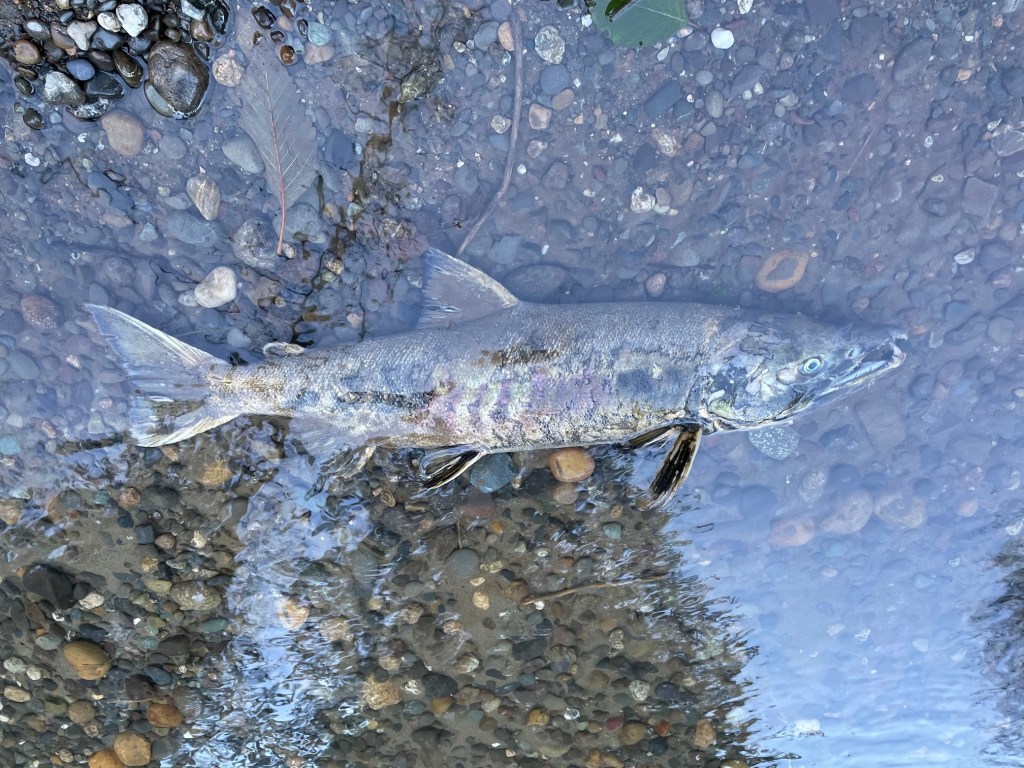
As I watched salmon swim upstream to spawn last week, I marveled at their persistence. Salmon are genetically programmed to swim to the precise water of their birth to lay their eggs. Salmon hatch in a fresh-water birth before migrating downstream to the saltwater ocean for about 4 years. Through magnetoreception and their sense of smell, most salmon know how to swim back to their birthplace. They spawn in the stones of gravel beds of small creeks. Some eggs are not under gravel for protection; I saw sea gulls trolling a stream for a take-out order of the small-pea-sized snack.

Each female salmon can lay up to 3000 eggs. After several months the eggs hatch into larvae with attached lunch bags; each “sac” holds some remaining yolk for feeding. When they run out of yolk, they must leave their gravel nest and begin eating plankton. It takes up to 3 years to become good swimmers and gain their camouflage spots. They also grow silvery scales to visually confuse future predators. Their resilience and adaptability are impressive despite dire odds. An estimate is that out of one salmon’s 2000-3000 eggs, only 4-5 survive for an ocean adulthood.

Salmon form “schools” or community with other salmon; they swim far from spawning territory to find deep-sea feeding. In returning “home” they stop eating. Despite their great stamina, they face many trials. They experience exhaustion. Death from high temperatures, parasites, and disease are possibilities for those that escaped predators such as seals, sea lions, sharks, orca whales and human fishing. The Pacific salmon and most Atlantic salmon die within a couple of weeks post-spawning. In the circle of life, salmon decomposing bodies release inorganic nutrients to the plankton. Scavenger animals descend. Change is constant.

We can identify with salmon and their challenging upstream-swimming effort. Adaptability and resilience are requirements for human constant changes.

Weather changes deliver spontaneous opportunities for adaptability. During a 1-hour morning trip to Seattle, there were 4 periods of fog suddenly dropping a dusty curtain that felt as though dusk was fast approaching. Fog is visually confusing. Cars adjusted their speed initially. With similar weather stealth, brilliant sunshine swept the highway clean each time. Sightlines were sparkling again.

Isn’t this the way one’s consciousness drifts from cognizant present time to murky moments where timely vision seems impaired? Weather changes are as sudden as consciousness changes. When murky moments take over, there can be dire consequences.

Perhaps our most important moments occur when we catch ourselves losing track of clear-sightedness. We must choose our focus. We must find our swimming community. We must be persistent. As Bob Dylan reminded us in 1964, The Times They Are A-Changin’ — “If your time to you is worth saving / Then you better start swimmin’ or you’ll sink like a stone.”

Pearls of Peace (PoP) Quiz

450. When you realize your murky moments settling like thick fog, how do you emerge from this state of mind?

451. How might you increase your resilience and adaptability?    

Tender Gratitude

“Thankfulness finds its full measure in generosity of presence, both through participation and witness. We sit at the table as part of every other person’s world…this is the essence of gratefulness…Thanksgiving happens when our sense of presence meets all other presences. Being unappreciative might mean we are simply not paying attention” (Canadian American cultural writer David Brooks, How to Know a Person: The Art of Seeing Others Deeply and Being Deeply Seen).  

Another writer’s definition of gratitude also aligns with the importance of attention in the present moment: “Gratitude is not a passive response to something we have been given; gratitude arises from paying attention, from being awake in the presence of everything that lives within and without and beside us. Gratitude is not necessarily something that is shown after the event, it is the deep, a-priori state of attention that shows we understand and are equal to the gifted nature of life” (Irish poet David Whyte, Consolations: The Solace, Nourishment and Underlying Meaning of Everyday Words).  

Yes, “presence” is key to the experience of gratitude! As Thanksgiving emerges this week into present time, it is a reminder that we might consider being present to gratitude more of the year than on the annual Thursday holiday when many of us gather together to contemplate our blessings. I am reminded that not everyone in America celebrates this day. The distorted narrative of the Pilgrims feasting with indigenous people — who had long settled this land prior to the newcomers’ landing — is disturbing.

On our precious planet we need to be “tender narrators,” a phrase delivered by Polish psychologist-turned-novelist Olga Tokarczuk when she received the Nobel Prize in Literature for her entire writing in 2018. A tender narrator considers the big picture: “…a perspective from where everything can be seen. Seeing everything means recognizing the ultimate fact that all things that exist are mutually connected into a single whole, even if the connections between them are not yet known to us…[it] also means a completely different kind of responsibility for the world, because it becomes obvious that every gesture ‘here’ is connected to a gesture ‘there,’ that a decision taken in one part of the world will have an effect in another part of it, and that differentiating between ‘mine’ and ‘yours’ starts to be debatable.” Is American soil “mine” or “ours?”

In gratitude for her genetic roots, Tokarczuk recalls curiosity about everything. Her wide-eyed life view enables her to make connections that may not be obvious initially. While she invents stories for her novels, she sums up what I endorse as a writer of nonfiction and blogs: “…I made it into a general belief…that our task is to synthesize and consolidate the world, looking for connections, both overt and hidden, and building an image of the world as a complex whole full of mutual relations.” Let’s be grateful for mutual relations.

Pearls of Peace (PoP) Quiz

448. What prompts gratitude in you?

449. How often do you express gratitude out loud?   

How Slow-Living Are You?

Stephanie O’Dea is author of Slow Living: Cultivating a Life of Purpose in a Hustle-Driven World. She is a “slow-living coach.” This made me laugh out loud. She must not be in the midst of a major move which entails constant decision-making hustle around packing/unpacking a myriad of stuff: Will this fit in my new home? If not, what do I do with it? Then, upon arrival, this will not fit! What do I do with it? However, I do know I am making move-hustle progress because my dreams no longer are about packing; last night I dreamt about vacation, an escape from the unpacking process.

O’Dea started her slow-living journey with “A Year of Slow Cooking.” She believes that cooking is a chore, not something that she wants to do, so she loves her crockpot. I gave away my crockpot. I enjoy cooking fresh food “from scratch,” but I might need some slow-living ideas when I finish unpacking boxes.

I found out that I could “join 10,000+ Students of Life” by subscribing to the “Sloww (not a typo!) Sunday newsletter.” Instead, I chose to hustle up on this phenomenon briefly online before jumping into another book for my overcrowded bookshelves. Here are some highlights of Slow Living and the Slow Movement:

  • Organizational psychologist Geir Berthelsen created a think tank in 1999, The World Institute of Slowness, advocating that “…the best thinking comes from a walk in the slow lane…slowness is the forgotten dimension to time. Unlike chronological time, it is non-linear, time here and now, time that works for you, extraordinary time. So why be fast when you can be slow? Slowness is also about balance, so if you must hurry, then hurry slowly.” Is hurry slowly an oxymoron?
  • Nearly two decades later, Canadian journalist Carl Honoré wrote a book titled In Praise of Slowness: Challenging the Cult of Speed.
  • Beyond slow living and slow food, today there is a slew (or stew) of slowness – slow money, slow parenting, slow education, slow reading, slow medicine, slow gardening, and slow religion. In 30 countries there are 236 cities that call themselves slow cities! Who knew?
  • According to Slow Living 201 (I skipped the 101 version), there are 15 adjectives for slow living: paced, unbusy, balanced, intentional, connected, deep, purposeful, holistic, soulful, long-view, low-stress, eased, time-rich, conscious, and mindful. https://www.sloww.co/slow-living-201/

I completely agree that mindfulness is a practice well worth putting into your daily routine. I participate every morning in an online mindfulness group with 20 minutes of silent mindful reflection. I practice mindfulness at other times of the day too, especially when gardening or cooking. I find these slow-breath actions grounding — literally grounding when working with soil in my yard. But honestly, I use some hustle in other parts of my life. Do I need to read O’Dea’s Slow Living book?

Pearls of Peace (PoP) Quiz

411. Do you engage in slow living some part of your day?

412. What aspect of slow living might be beneficial for you?  

Possessed Versus Letting Go

Vicky Silverthorn is a professional organizer. She can clean up any mess in your home or study. Let’s backtrack. Why did we hang onto items that now clutter our space in the first place? Are we possessed by possessions?

According to a study cited in the Journal of Consumer Psychology, researchers find that folks link certain items to their self-worth. When they no longer have said items, they grieve for lost possessions in terms of their tie to them as part of their self-identity. There are extreme “hoarders” (2.6% of the population, according to the American Psychiatric Association) and more common “packrats” who suffer from a difficulty categorizing “an array of items with minimal value into groups.” 

My personal packrat-itis has roots. Both of my parents fit the description. They had an excuse. The nation’s depression was a major event in their early years. As the oldest of 10 children, my mother recalled not having much food to eat; she recalled having “coffee soup” (coffee over a piece of bread) as a meal. She sometimes was asked to take a skillet containing leftover gravy (over bread) down the alley to a family with less to eat than her own family. How could there be leftovers from a dozen people at their table? Such experiences were vivid for my mother many years later. She was a saver of tin foil and plastic bags for reuse, as well as much larger items that became clutter build-up. Dad had saver parents who knew they might “need” an item “someday.”  

Silverthorne advises that “Clutter can affect our mood, productivity, ability to think clearly, and overall mental processing. It can contribute to stress, impact our well-being, and really alter our focus…for a free-flowing house and a free-flowing mind, reducing clutter really helps.”

Words of wisdom may not be enough to make the letting-go process possible. In moving from a larger home to a smaller one, I encountered clutter closets that I could escape from for years with merely closing the doors. The day of reckoning came with moving: I had to face the fact that there were simply too many items to take with me…and many of them did have minimal value…to other people.  

Each “minimal value” item was attached to some memory. It was memories and the relationships attached to those memories that I did not want to let go. With practice, I am learning to give up keeping “everything,” although my learning curve is a bumpy ride. I do not find Silverthorne’s advice to ask, “What’s the worst thing that could happen?” very useful. More appropriate to my situation, I recall the person who gifted me an item, thank them silently, and then send the item into give-away land. Admittedly, this takes time. It is not as easy as it may sound.

Pearls of Peace (PoP) Quiz

409. How do you handle keeping versus giving-away decisions in your home?

410. What is your method for letting go of items of “minimal value”?

Eustress/Distress: A Brain Teeter-totter

April is Stress Awareness Month (since 1992) with sponsorship by The Health Resource Network, founded by Mort Orman, M.D. https://healthresourcenetwork.org/ A non-profit in the UK, The Stress Management Society, joined sponsorship in 2023.

The theme for 2025 is #LeadWithLove. This is not some far-fetched notion but realize that “love” takes many brain moves. Love entails daily practice.  

Dr. Orman’s mission is to promote knowledge about stress and life mastery skills to cope with inevitable challenges of life. Orman lists 30 key mastery skills. Consider how often you light-up your brain for bodymind health: Emotions mastery, Relationships mastery, Advanced stress mastery, Self-discipline, Happiness creation, Honesty, Humility, Telling the truth, Integrity, Personal responsibility, Critical thinking/reasoning, Wisdom, Values, Purpose, Commitment, Communications skills, Leadership skills, Self-love, Self-esteem, Compassion, Exercise enjoyment, Love of learning, Fearless public speaking, Healthy lifestyle, Money/finances, Success mindset, Understanding human beings, Helping others, Leaving a legacy, Personal power.

Orman uses the American Psychological Association’s definition of stress: “…a normal reaction to everyday pressures but [stress] can become unhealthy…stress involves changes affecting nearly every system of the body, influencing how people feel and behave.  By causing mind-body changes, stress…affects mental and physical health, reducing quality of life.”

Most people consider stress to lead to burnout or exhaustion, but that is an incomplete understanding of stress. Stress is more similar to a brain teeter-totter; it can move in one direction, then abruptly reverse course. Stress can motivate you; it is not always negative. From a book chapter I wrote, “Families in Stress” [In S. Wadhwa Editor, Stress in the Modern World: Understanding Science and Society], there is a range to stressors in your life:  

“Endocrinologist Hans Selye made the word stress a household staple, suggesting that life would be boring without stress. Many positive family situations entail stress. Selye labeled positive stress as eustress and negative stress as distress. He created the word stressor to describe the stimulus or event that precipitates a stress response. Examples of positive stressors in the family are a child’s piano recital or sporting event, and a parent’s new job. Family distress ranges from community natural disasters like Hurricane Katrina, to inside-the-family reactions to death or illness of a loved one, to juggling a myriad of everyday decisions and deadlines. Parents need to learn how to detect smoke before their own reactions, and/or their child’s stress reactions, blaze out of control.”

Simply, we need more adults in the room, whether as models for youngsters, or as companions to other adults who have their own melt-down reactions. We all vacillate when the flames of stress reach us, but biological stress responses can save your life. Fight/fight/freeze stress reactions are biological survival mechanisms in the animal world as well as the human world.

Psychological survival is less clearcut. Many stressors relate to fear, both real and imagined future fears. “Name it to tame it,” advises psychiatrist Dan Siegel.

Pearls of Peace (PoP) Quiz

387. What is a stressor for you?

388. Is your approach lead-with-love? If not, why not? 

A Cynicism Climate vs. Warm Fuzzy Terrain

Whatever happened to warm fuzzies, defined as feelings of happiness, hope and well-being?

Stanford University professor of psychology, Jamil Zaki, directs the Social Neuroscience Lab. Zaki and his colleagues find that the rate of U.S. citizens feeling unhappy and mistrusting of others is at a high point.  His book, Hope for Cynics: The Surprising Science of Human Goodness, disagrees with a common belief that cynics are more perceptive than optimists. Research results show that cynics perform worse in cognitive tests. Cynicism is a destructive force. It can impact one’s well-being. While cynicism may appear to be protective, as in keeping people from taking advantage of you, it is linked to loneliness and losing out on potential collaboration. According to the Pew Research Center, a 2024 study surveyed 6,200 adults in English and Spanish about their well-being and social connections; they found that 1 in 6 Americans feel lonely or isolated most of the time.

Cynicism is easy. Anyone can do it. Change is hard. That takes us.” Cody Keegan, speechwriter for President Obama, wrote his own speech for a New York University commencement address; this was his advice to graduates.

Jamil Zaki advocates “hope mixed with fury” to inspire genuine change. He suggests that one needs to fact-check their cynicism through increasing a sense of curiosity and first questioning their own beliefs. When one engages in conversations with strangers, or those known to hold opposing political viewpoints, there is an opportunity for two-way growth. 

Having an open mind is a hope-fueled possibility. Hope promotes personal happiness. Zaki fosters a positive spin on collective hope: “Hope doesn’t mean accepting that things are actually great when they’re not — it means acknowledging that things are awful, but that many, many people want them to improve.”

Psychologist Andrea F. Polard, founder of Zen Psychology and author of A Unified of Happiness: An East-Meets-West Approach to Fully Loving Your Life, is another peddler of hope. Her recommendations for taming your inner cynic are the following:

  1. Look deeper, feel deeper

Embrace your own cynicism by looking more deeply into your anger. Anger often hides our disappointment. Sometimes we project our disappointment onto the whole of society. Be brave. Confront the pain that your cynicism may hide.

  1. Find inner peace. 

Relate to others by identifying your own attachments. Admit your own biases and shortcomings. Make peace with your own human condition. [Remember, it takes us, all of us.]

  1. Try to work with imperfections constructively. 

A person does not change because someone despises them. Participate in dialogues. Be assertive against injustice and hypocrisy but lead with examples of alternative behaviors.

Be as strong as a pussy willow branch. In spite of a wild spring snowstorm that threatened a tornado, catkins flourished on strong branches that could bend in the wind, hail, and snow.

Pearls of Peace (PoP) Quiz

381. How often do you catch yourself in a cynical part of your personality?

382. What might you do to increase your hopefulness?                 

Broaden-and-build Purls and Pearls

I cannot give away my grandmother’s crochet hook…yes, this is a scarcity mindset at work (see Pearls of Peace, 1-13-25). I am hooked on warm memories of my childhood hours in my grandparents’ home. I recall many hours that Grandma sat in her rocker, wearing her hand-sewn apron and dress, making one doily after another to gift the many females in her family and friend network. I never learned knit-and-purl stitches, but I watched with fascination as Grandma created with her crochet hook, building one stitch upon the next to broaden her handiwork. Handmade gift-giving was on her unofficial resume.  

Psychologist Barbara Frederickson created her broaden-and-build theory when she realized that there was a greater amount of research on negative emotions than positive emotions. For every positive emotion, there appear to be 3 negative ones! The reason for this disparity is that negative emotions are linked to our survival in big and small ways.

The broaden-and-build theory emphasizes that the expression of positive emotions can expand one’s repertoire of psychological, social, cognitive, and physical resources. Positiveness improves one’s resilience. It may help one’s coping skills. This approach is not meant to erase negative emotions but instead allows for the co-existence of both kinds of emotions.

A negative emotion is a protective signal that something does not “feel right.” When such emotions are brushed off, sometimes there could be dire consequences. The bodymind is a listening machine, always on lookout to protect one from physical and/or psychological harm. The idea with broaden-and-build theory is to make space for ALL emotions.

Expressing frustration in a trusted relationship is often necessary before gaining access to a more centered space where one can choose a positive action. The key is having an awareness of your positive emotions so that you can repair touchy situations. Building upon a growth mindset reminds one that others roll with negative emotions also.    

Here is a list of positive emotions that you can broaden-and-build for more resiliency. You probably do not need a list of negative emotions, as they seem ever-ready for action. However, you may miss out on positivity time if you do not have these positives tucked in your pocket for ready use:  

  • Admiration  
  • Affection
  • Altruism
  • Amusement
  • Anticipation
  • Awe
  • Cheerfulness
  • Confidence
  • Enjoyment
  • Enthusiasm
  • Euphoria
  • Gratitude
  • Happiness
  • Hope
  • Inspiration
  • Interest
  • Joy
  • Love
  • Optimism
  • Pride
  • Relief
  • Serenity
  • Surprise

Best of all, positive emotions are keep-on-giving gifts. I took interest in “crewel” (Welsh word for wool) embroidery when I was in graduate school dealing with a dissertation committee at odds with one another. I needed to broaden my outlook to create something that was positive, one stitch after another, for my own well-being. I realized that one situation is not destiny. Looking back on Grandma’s knit-and-purl self-therapy, I wonder what she was working through in her mind.  

Pearls of Peace (PoP) Quiz

361. When have you used an art form to increase your positive coping skills?  

362. How often do you catch yourself with an initial negative emotion in situations?

Pearls of Awe

Moments of awe are artfully described by psychologist David Elkins (who studied under Viktor Frankl): “… the most important, transformative experiences of life…Awe is a lightning bolt that marks in memory those moments when the doors of perception are cleansed, and we see with startling clarity what is truly important in life.”And yet,in our rush to accomplish the next thing on invisible to-do lists, we skip momentary opportunities of basking in awe.    

I am enjoying reading psychotherapist Jake Eagle and physician Michael Amster’s 2023 book, The Power of Awe: Overcome Burnout & Anxiety, Ease Chronic Pain, Find Clarity & Purpose—In Less Than 1 Minute Per Day. I am usually dubious of what might “stick” in less than 1 minute per day, but I believe these two mindfulness-instructor authors have their eyes on a simple prize. Afterall, life is lived in present moments. When you pay attention, in everyday as well as special moments, there is an aliveness that grabs you, perhaps by oozing goose bumps or watery eyes. You tend to remember such moments.

The authors advise: “Finding awe isn’t a goal. Goals are for the future. Awe is here now, a sense of wonder coming from firsts, lasts, and experiences that continue to amaze us…Firsts: First kiss…first time you rode a bike, swam in the ocean…Lasts: The last mountain you’ll climb, your last kiss…last words you’ll hear [from someone]… Experiences that continue to amaze: Sunrise. Shooting stars. Redwood trees…a sense of oneness…the depth of love we can feel.”

To help you tune in more frequently to awe, the 3-part A.W.E. Method is free online as “A.W.E. Guide and Journal” at https://thepowerofawe.com/  — where A.W.E. represents Attention, Wait, Exhale and Expand in five-to-fifteen-second intense moments of focus. The research on the health benefits of this 1-minute “microdosing mindfulness” (in just 3 awe-filled segments each day) is impressive.

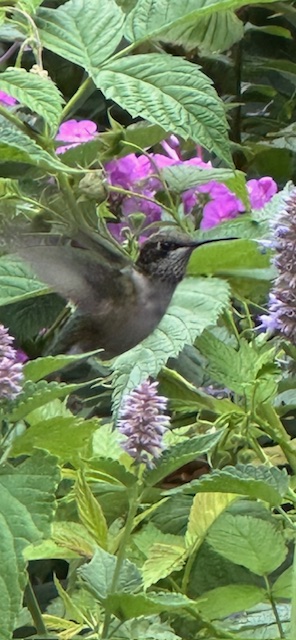
The magic happens when you have the intention for ATTENTION, then pause — or in this model termed WAIT – WAIT with intention before elongating an EXHALE-and-EXPAND consciousness. I offer a recent example from my garden. With intention, I was admiring a profusion of phlox plumes when suddenly, a hummingbird darted in front of me and landed on a nearby ‘Blue Fortune’ hyssop plant. With as much stealth as I could muster, I slowly removed my cell phone from my pants pocket and etched my memory with those fluttering feathers. Usually when I attempt this move with birds or butterflies, they flit away. For some reason, this hummer was not threatened by my presence. I shared close-up eye contact with awe.  

Psychologist Dacher Keltner also wrote a book on awe – AWE: The New Science of Everyday Wonder and How It Can Transform Your Life (2023). I’m all in on this topic! Keltner believes that                               awe is “almost always nearby.”

Let’s savor awesome moments!

Pearls of Peace (PoP) Quiz 

319. When did you recently experience an awe-filled moment?  

320. Would you be willing to share this awesome time in the comment section?