Mothers with Soft Power

Wellesley Centers for Women (WCW) held a colloquium (October, 2025) for 120 participants, “Mothers Without Borders: The Phenomenology of Mothers’ Soft Power in Peace Building.” The event was coordinated by Senior International Scholar-in-Residence Hauwa Ibrahim, J.D., S.J.D., M.L. In a keynote address former WCW executive director Susan McGee Bailey, Ph.D., explained the importance of this initiative: “Mothers understand that shaping a better world starts with each of us…We can’t change everything quickly, but we can change everything…By believing in ourselves and our vision, we can initiate major changes, not only in our own homes, but throughout the world.”

In her keynote address, Her Royal Highness, Nahla Al-Qassimi, Ph.D., associate professor and chair of Women Empowerment Council at Ajman University, United Arab Emirates, echoed mother-power: “A mother’s love is the most borderless thing on Earth…when mothers connect, the world becomes kinder, brighter, and stronger.”

Nigerian lawyer Ibrahim outlined mothers’ soft power (using persuasion, not coercion) with a poignant story. In Nigeria 337 girls were kidnapped in 2014 by Boko Haram, an insurgency opposing Western culture influences in their country. One captured kidnapper was tortured for 3 years because he refused to speak with authorities about his actions. However, when his mother was allowed to talk with him, she needed only 3 words before her son broke his silence. Ibrahim outlined women’s quiet resistance and soft power in influencing decision-making in men in power, especially regarding governing without use of force.

Women Without Borders has big plans for the world’s big problems. Her Royal Highness Dr. Al-Qassimi introduced soft-power initiatives in Beijing at the Global Engineering Congress. Lt. Gen. Fernando Giancotti of the Italian Air Force took the concept home with him to Rome after attending the colloquium. Assistant Inspector General Aishatu Abubakar Baju, Nigeria’s senior female police officer, carried mothers’ soft-power thinking to Johannesburg where she spoke at the African Women in Law Enforcement Conference.

On a sunny afternoon at San Diego Zoo and Safari Park, I saw 2 lions communicating; the male lion roared first. The female roared back. Back and forth for a few loud moments, there were clear signs of some relationship. Then the tour guide said the lions were brother and sister. But what was the message? Here are possibilities:

  • Bro: “Can you believe that breakfast this morning?”   
  • Sis: “We can’t really complain because we did not have to hunt all night for today’s food.”  
  • Bro: “You always stick up for the Government of Zoo.
  • Sis: “I am living in the present moment.”                                                                                               

Consider some soft-power behaviors within meerkat packs. They take turns watching out for their pack while most are digging 5-8 hours above ground for food. If a predator threatens, the patrol-kat whistles a high-pitched alert. Young pups have many helpers in their pack. We will make progress on our precious planet when human mothers and fathers understand and use soft power.

Pearls of Peace (PoP) Quiz

464. When have you used soft power?

465. Have you ever regretted using aggressive/coercive power?  

Solstice and Meditation Pearls

This year the winter solstice is also World Meditation Day, thanks to the United Nations. Both events hold a reverence for our place in the Universe.

The solstice honors Earth’s axis slanting away from Sun, delivering the shortest day and longest night of the year in the Northern Hemisphere (reversed in the Southern Hemisphere) on December 21st. It is a long-celebrated event around the world. While the earliest solstice celebration is unknown, archeologists Peter Biehl and Francois Bertemes made a fascinating discovery in Germany in 2002. They excavated a 7,000-year-old enclosed circle near the Halle-Wittenberg University, finding that the Goseck Henge has two “gates.” These openings line up with the start of the summer and winter solstices. Might this be the world’s first solar observatory?

Other places are better known as solstice subscribers as they have impressive structures that frame Sun as it rises: Ireland’s Newgrange, England’s Stonehenge (on the same latitude as Goseck and nearly the same longitude), and Mexico’s Chichén Itzá. Each bears witness to how observant early people were about Earth’s rhythm of changing seasons. Celebrating winter solstice may have begun as a gratefulness for completed harvest time, making time for rest and reflection. Feasts often accompany solstice festivals.

Ancient Rome celebrated Saturnalia to honor the sun god Saturn with offerings and gift-giving. By the 1st century BCE this celebration morphed into week-long partying. Many believe that Saturnalia festivals set the stage for modern-day Christmas traditions of feasting, candle-lighting, and exchanging gifts.

Indigenous people in the U.S. also had early celebrations on winter solstice. Hopi Native People celebrated Kachina Season with ritual ceremonies and dancing. Kachina figures have been found on rock art from 1350 CE. There is a reverence for kachinas, symbolic protective spirits. Kachina dolls, symbolizing prayer wishes, are given as gifts to young girls.

World Meditation Day links with solstice traditions in terms of reverence for and celebration of life. This United-Nations-recognized global event received unanimous adoption in the General Assembly on 12-06-24. The 2025 theme embraces all people’s traditions and faiths: “Inner Peace, Global Harmony.” There is an emphasis on an individual’s stillness and mindfulness as ingredients that lead to compassion, mental wellness, and peaceful actions. Mindfulness is the practice of paying attention to what is happening in the moment rather than focusing on fixing the past or fantasizing futures.

As a star-gazing fan, I applaud those who mindfully watched seasonal changes set to solstice times. And I embrace the global emphasis of World Meditation Day. As a daily meditator, I’d like to see meditation taught in our schools. Rather than waiting for behavior problems to crop up on the playground and in school hallways, why not be proactive and teach mindfulness practices to children and adolescents? Meditation, journaling, and focused mindfulness practices can transcend many differences among individuals.  

Pearls of Peace (PoP) Quiz

456. What does winter solstice mean to you?

457. How might you engage in mindfulness practices and create more inner peace for yourself?

Emodiversity Complexity

Computer Complexity

It turns out that negative emotions are useful. Whether you initially agree or not, stay tuned for a different slant on pesky emotions. Jordi Quoidbach has a Ph.D. in Psychology from University of Liège, Belgium, and spent several years as a Postdoctoral Fellow at Harvard; he studies happiness and decision-making. Quoidbach’s research into emodiversity (a piggyback idea from biodiversity) suggests, “…people who experience a diverse range of emotions…tend to be healthier, mentally and physically.” With increased emodiversity, his research found decreased depression, number of doctor visits, and days hospitalized per year in participants. 

Having emodiversity means acknowledging a variety of emotions in your day — allowing for frustration, disgust, jealousy, gratitude, tranquility, and elation. Quoidbach explains: “…it is not just having a diverse range of positive emotion, but we also find that having a diverse range of negative emotion is better than having a narrower range of negative emotion.”

My understanding of so-called “negative” emotions is that they are protectors, often shielding an individual from some unacknowledged small-t trauma situation (or a big-T trauma such as a natural disaster). When one can accept that there is a reason why a “negative” emotion pops into consciousness, there is a possibility of coping with one’s history. It is not useful to ban emotions when they can serve as maps that lead to problem solving. Often the mapping of a “negative” emotion takes one on a follow-the-memory consciousness back to an earlier year when some event triggered alarm. Such memories still sting from youngster years.

Quoidbach’s research relates to correlation, not causality. However, his steps to increase emodiversity might serve as stepping stones for a deeper dive down memory lane’s complexity:

  1. Create an Emotions Matrix
    • Audit your emotions for a week. Jot down each emotion you recognize in quadrants: 1. Pleasant, high-energy emotions (joy or excitement are examples); 2. Pleasant, low-energy emotions (perhaps serenity or relief); 3. Unpleasant, high-energy emotions ( such as anger or disgust); 4. Unpleasant, low-energy emotions (boredom or sadness are examples).
    • Ask, “Why am I not more diverse? Am I afraid of experiencing specific feelings? Maybe [that’s] because I’m afraid that some stuff will come out?”

       2. Put Yourself in Situations That Evoke Certain Emotions

    • Establish the areas in which you may want to expand your emotional life. Recognize how often you evoke those feelings.
    • Recognize if you never feel angry; it may suggest that some inner conversations could prove useful.
    • Also, if you are constantly chatty and cheerful, consider experiences that allow for you to be still and calm.

    3. Expand Your Emotional Vocabulary

    • Make an effort to name your emotions. Then expand your emotional vocabulary. It could prove useful to use words from ancestral native languages.
    • Quoidbach relates, “When you learn new words for emotions, you start paying attention to situations differently… you expand the range of emotions you experience.”

    Pearls of Peace (PoP) Quiz

    452. When are you most aware of your emotions?

    453. Are there times when you feel shame for an emotion?

    Swimming Times

    As I watched salmon swim upstream to spawn last week, I marveled at their persistence. Salmon are genetically programmed to swim to the precise water of their birth to lay their eggs. Salmon hatch in a fresh-water birth before migrating downstream to the saltwater ocean for about 4 years. Through magnetoreception and their sense of smell, most salmon know how to swim back to their birthplace. They spawn in the stones of gravel beds of small creeks. Some eggs are not under gravel for protection; I saw sea gulls trolling a stream for a take-out order of the small-pea-sized snack.

    Each female salmon can lay up to 3000 eggs. After several months the eggs hatch into larvae with attached lunch bags; each “sac” holds some remaining yolk for feeding. When they run out of yolk, they must leave their gravel nest and begin eating plankton. It takes up to 3 years to become good swimmers and gain their camouflage spots. They also grow silvery scales to visually confuse future predators. Their resilience and adaptability are impressive despite dire odds. An estimate is that out of one salmon’s 2000-3000 eggs, only 4-5 survive for an ocean adulthood.

    Salmon form “schools” or community with other salmon; they swim far from spawning territory to find deep-sea feeding. In returning “home” they stop eating. Despite their great stamina, they face many trials. They experience exhaustion. Death from high temperatures, parasites, and disease are possibilities for those that escaped predators such as seals, sea lions, sharks, orca whales and human fishing. The Pacific salmon and most Atlantic salmon die within a couple of weeks post-spawning. In the circle of life, salmon decomposing bodies release inorganic nutrients to the plankton. Scavenger animals descend. Change is constant.

    We can identify with salmon and their challenging upstream-swimming effort. Adaptability and resilience are requirements for human constant changes.

    Weather changes deliver spontaneous opportunities for adaptability. During a 1-hour morning trip to Seattle, there were 4 periods of fog suddenly dropping a dusty curtain that felt as though dusk was fast approaching. Fog is visually confusing. Cars adjusted their speed initially. With similar weather stealth, brilliant sunshine swept the highway clean each time. Sightlines were sparkling again.

    Isn’t this the way one’s consciousness drifts from cognizant present time to murky moments where timely vision seems impaired? Weather changes are as sudden as consciousness changes. When murky moments take over, there can be dire consequences.

    Perhaps our most important moments occur when we catch ourselves losing track of clear-sightedness. We must choose our focus. We must find our swimming community. We must be persistent. As Bob Dylan reminded us in 1964, The Times They Are A-Changin’ — “If your time to you is worth saving / Then you better start swimmin’ or you’ll sink like a stone.”

    Pearls of Peace (PoP) Quiz

    450. When you realize your murky moments settling like thick fog, how do you emerge from this state of mind?

    451. How might you increase your resilience and adaptability?    

    School Days…Golden Rule Days?

    “…Let’s take a trip on memory’s ship / Back to the bygone days… / School days, school days / Dear old Golden Rule days / ‘Reading and ‘riting and ‘rithmetic / Taught to the tune of the hick’ry stick….”

    Did you sing this in childhood? OK, I’m dating myself. As a youngster in rural Indiana, it was a well-known song. Thankfully, I never was spanked either at home or in school, although many children receive this wayward discipline. The 1907 song was composed by Will D. Cobb and Gus Edwards. Imagined crooners were adults looking back on childhood experiences in elementary school. Were Cobb or Edwards paddled in school?

    As a new school year is in first gear, it rattles my psychology training that in 2025 corporal punishment remains “legal” in private schools in every U.S. state except Illinois, Iowa. Maryland, New Jersey and New York. What educational textbooks are these educators reading? And to make it clear that private education is not the only believer in spanking, it is also “legal” in 17 states in public schools (supposedly “practiced” in 12 states). Spanking is not a healthy choice for either the inflicted child or the perpetrator doing the spanking. As a family therapist, I taught parents and kids, “Hands are for hugging, cooking, playing and ____________________; hands are not for hitting.”

    An online Newsweek article (8-22-25) reports that a nonprofit organization, Lawyers for Good Government, has investigated corporal punishment. Sadly, their findings are that Black children comprise 37.3% of the inflicted, and disabled children make up 16.5% of the incidents. This discrimination is disgraceful.

    In case you wonder, here are the 17 states allowing corporal punishment in schools: Alabama, Arizona, Arkansas, Connecticut, Florida, Georgia, Indiana, Kansas, Kentucky, Maine, Missouri, New Hampshire, North Carolina, South Carolina, South Dakota, Texas, and Wyoming. Florida made a recent concession – parents must give consent — and “it depends upon the school” in 4 more, Louisiana, Oklahoma, Mississippi, and Tennessee.

    There is hope for change to archaic discipline in schools. According to Elizabeth Gershoff, Professor of Human Development and Family Sciences, University of Texas at Austin, “…school principals either realize that school corporal punishment is not effective at improving student behavior, that it is not necessary, is cruel and physically harmful, or that it could lead to lawsuits from parents of children injured by school corporal punishment.” 

    Sarah Font, Associate Professor of Sociology and Public Policy, Pennsylvania State University, suggests, “…instilling proper respect for authority figures” and adults who received spankings believing they learned something, are reasons the outdated practice exists, despite research that corporal punishment does not improve long-term behavior.

    Justin Driver, Professor of Law, Yale Law School, states, Public school students are the only group of people in American society who government officials strike with impunity for modest transgressions.”

    Who is educating government officials? Who educates the educators?

    Pearls of Peace (PoP) Quiz

    423. Were you spanked in childhood at home or school?

    424. What effects have you observed in individuals who were hit by teachers and/or parents?

    Communicate Perils or Pearls

    Jitish Kallat, Public Notice 3 (The words communicate 2 historical moments: A speech by social reformer Swami Vivekananda on 9-11-1893 and the terrorist attacks on 9-11-2001), Art Institute of Chicago

    In an interview with psychologist Jill Suttie, journalist Nicholas Carr details social media history and its variable effects upon the public. The telegraph and telephone arrived in the 1800’s. The first commercial radio station followed in 1920. As a wireless telegraph, radios provided Morse codes to ships and lighthouses where wires could not reach. Then came an onslaught of radio news, music, and perhaps most important – opinions that dominated the one-size-fits-all airwaves for mass consumption. Some complained that radio was “dumbing down the population.” A dangerous force of radio’s power was when German Nazis took over radio stations in the 1930’s and communicated their propaganda.

    Carr makes the argument in his book, Superbloom: How Technologies of Connection Tear Us Apart, that more efficient communication does not equate with better communication. He refers to research that suggests that learning more about other people does not lead to liking them more or even understanding them more. In fact, finding out the various ways that another person is different from one’s self-perception can lead to disliking that person. Simply put, people tend to focus on differences more than similarities and we dislike “the other” who is “different.”

    Currently our online lives can overwhelm us with massive amounts of information which we filter through our existing biases. Another problematic issue is that folks are addicted to social media. Carr states it well: “We’re not being manipulated to act in opposition to our desires. We’re being given what we want in quantities so generous, we can’t resist gorging ourselves.”

    Social media outlet algorithms find what we use regularly and then load us with similar topics. With the oncoming AI locomotive barreling down media tracks, who can escape this runaway train? AI offers virtual “companions.” Is this communication or manipulation?

    A sidecar in social media is the “Influencer.” The definition of an Influencer is an individual who is able to generate interest in something by posting about it on social media. Initially an Influencer was a celebrity (think Elon Musk who was, or still is, an Influencer of the U.S. President), but today’s Influencers can be anyone with a large following on social media. This is enough content about communication perils.

    Where are the communication pearls? Communication skills are key in relationships, careers, and world diplomacy. We simply must teach children effective communication and problem-solving skills. Early in my career I was part of a small group of psychologists teaching Myrna Shure and collaborator George Spivak’s Interpersonal Cognitive Problem Solving, later renamed I Can Problem Solve (ICPS). I worked with Myrna at Hahnemann Medical College and Hospital (Philadelphia) and her 8-week curriculum for students from preschool to 6th grade. ICPS engages both teachers and parents in training children on how to think and communicate with an understanding of alternatives. Much communication requires alternative problem-solving steps.

    Who teaches adult versions of I Can Problem Solve?

    Pearls of Peace (PoP) Quiz

    403. Who are your social media Influencers? ‘

    404. What communication skills do you use daily? 

    Memorial Mammals

    Blue whale skeleton, Natural History Museum, London

    Gigantic blue whales (100+ feet long) were rescued from extinction in the 1960’s. Hunters gorged on profits from whale meat, oil, and baleen. Blue whale numbers fell from nearly 350,000 to approximately 400 in the late 20th century. While these mammals slowly grow in numbers, they remain an endangered species due to marine pollution and climate change on an uptick.

    Today is Memorial Day when we mourn a different mammal’s demise – humans (average height 5.5 feet). In addition to pollution and climate changes that threaten humankind, our species seems fixated on wars. It is impossible to know an approximate numbers of soldiers and civilians who lost life in war-related “hunting” in different desired profits, especially land grabs, and/or power over certain “others.”

    I received an education about war and its lingering trauma effects when working with veterans in my family therapy private practice. I cannot imagine being sent to a far-away place and then hunting down the people who live there, whether soldier or civilian. How could one know from a distance if a person was the intended target? The term “collateral damage” bothers me. Civilian casualties are considered murder in circumstances not bound by military definitions. Veterans in countless wars shot their guns “in the air” rather than killing another of their kind. When we give air to all the stories from veterans, perhaps we then might engage in civil problem-solving.

    However, it is no wonder that veterans decline to speak about their experiences. They carry an emotional backpack that they believe they must hide and protect. Who can make the personal decision to dishonor their government’s orders? Returning Vietnam soldiers felt scammed when realizing the war hoax of a President who did not know how to end disastrous results. Coupled with personal value systems shattered, soldiers suffer silently.

    I once participated as a volunteer in an innovative program called Vet Art. We used forms of art to engage Vietnam War veterans in coping with their lingering trauma. Like my veteran clients, both men and women soldiers told war grief stories of shame and guilt. While listening to and caring for other vets in a safe group environment, soldiers discovered that their emotions were universal although each had unique ways of exiling the pain they lugged through current life.

    Americans have a lot to learn about grieving from the Dutch. Beginning in 1945 Dutch citizens “adopted” the graves of 8,301 U.S. soldiers buried in the Margraten American Cemetery. Considering U.S. soldiers their liberators in preserving democracy, Dutch families have preserved this grave adoption for 70 years. Many graves are passed on, generation to generation, even writing the respectful grieving ritual into wills. Dutch families search for and contact families of their adopted fallen soldier. On Memorial Days, some biological family members attend ceremonies with their Dutch-adopting family. Might such cross-culture caring keep us from extinction?

    Pearls of Peace (PoP) Quiz

    397. What stories linger for you about war experiences?

    398. How might you honor cross-culture sacrifices today? 

    Black History & Herstory Month

    To Craft a Double Consciousness or Two-faced, Theaster Gates, 2018, Art Institute of Chicago

    Black History month has a predominant focus on men who championed racial equality — with some exceptions.

    On Rosa Parks’ birthday (2-4-25), Congresswoman Joyce Beatty (Ohio) spoke passionately about Parks’ enduring legacy in U.S. voting-rights progress. The Rosa Parks Commemorative Coin Act was initiated to honor the lifelong peaceful equal-rights activist.

    In 1996 Parks was honored with the Presidential Medal of Freedom and the Congressional Gold Medal in 1999. A department store seamstress, Parks received a nearly 100% affirmation vote with only Representative Ron Paul (Texas) in dissent for her Gold Medal. Parks observed the voting from her Detroit home where she had moved due to the firing from her seamstress job and her family enduring threats.

    Upon her death in 2005, Parks was honored to lie in state in the U.S. Capitol Rotunda. In 2013 the Postal Service recognized Parks’ “soft” power with a Forever Stamp on her 100th birthday and Congress approved Parks’ statue in Statuary Hall for her importance in “forming a more perfect union” and “establishing Justice.” Her seated granite statue, dressed similarly to that momentous day on the Montgomery, Alabama bus, was the first full-length statue of an African American individual in the Hall. Her statue joined busts of Martin Luther King, Jr. (1986 placement) and Sojourner Truth (2009 placement).

    Rosa Parks was a member of the NAACP and was elected secretary. She had knowledge of many injustices in mandated racial segregation in public places. When she was ordered to give up her bus seat to a white passenger, she merely sat still. Arrested, she was pronounced guilty of “disorderly conduct and violating a local ordinance.”

    As Joyce Beatty took the Congressional podium, she elaborated on the iconic memory of Parks refusing to give up her bus seat: “Rosa Parks was more than one moment… as America nears its 250th birthday, we must honor not only our founding fathers but also the mothers of our democracy.”

    Let’s honor more mothers of democracy as “first” Black women to crack ceilings: Barbara Jordan – Black Southern woman elected to Congress, Rebecca Lee Crumpler – Black woman graduate in U.S. medical school, Ida Lewis – editor-in-chief of Essence magazine, Ruth Batson – Black woman on Democratic National Committee, Ketanji Brown Jackson – Black woman on Supreme Court, and Kamala Harris among others.

    A first National Youth Poet Laureate, youth role model Amanda Gorman took another Washington, DC podium. Invited by Jill Biden to address the nation at President Biden’s inauguration, Gorman’s words from “The Hill We Climb” are especially poignant at this time in U.S. history/herstory:

    “…We lay down our arms
    so we can reach out our arms
    to one another
    We seek harm to none and harmony for all
    Let the globe, if nothing else, say this is true:
    That even as we grieved, we grew
    That even as we hurt, we hoped
    That even as we tired, we tried”

    Pearls of Peace (PoP) Quiz

    371. What story do you tell for “a more perfect union?”

    372. How are you growing from grief?                     

    Hope for Your Hills

    “The question is not so much ‘What do I learn from stories?’ as “What stories do I want to live?” suggests Zen teacher David Loy. What story meanings that you have heard throughout your lifetime do you want to live?

    In Greek mythology stories, Sisyphus was punished by the gods with a sentencing to roll a boulder up a hill for eternity, only to have it roll back down every time he came close to the hilltop. Sisyphus was the Greek king of Ephyra (later named Corinth). According to one version of the story, Sisyphus was a tyrant who angered Greek gods by killing his visitors as a show of his power. He disobeyed xenia, a law of hospitality, considered vital to Greek culture both morally and politically.

    One meaning of this myth is that life is an endless struggle, with no opportunity to ever achieve a goal. This is a hopeless version. According to some research, only 8% achieve their New Year’s goals by the end of the year. Is this true about you? All of us experience some stiff uphill climbs to reach certain goals, only to backslide, sometimes repeatedly, when “things” do not work out. Yet, there could be lessons, such as asking, “What is my part in this?” A second meaning of the Sisyphus myth is the importance of perseverance when one is faced with adversity. No story has only two sides. There are other meanings. Take your pick.

    For now, let’s go with the second meaning. I’m a big believer in resilience and hope. One of my graduate school professors was keen on reminding newbie psychologists of the most important thing to accomplish by the end of each therapy session: “leave the client with hope.” I often reminded myself of this early lesson when in the middle of contentious family therapy sessions. If one’s therapist gives up, how can the client walk out the door with a silver-lining sliver of hope for themselves?

    Recent recipient of the Presidential Medal of Freedom, conservationist Jane Goodall is another proponent of hope: “I do have reasons for hope: our clever brains, the resilience of nature, the indomitable human spirit, and above all, the commitment of young people when they’re empowered to take action.” Each generation holds out hope that the next generation will be more talented in fixing what ails families, communities, and countries. We will leave the younger set many hills to climb, but we can engender hope in them by continuing to be steady climbers ourselves.

    Do not see your goals as Sisyphean or goals that are futile; see progress in taking baby steps. Babies do not give up when they learn to stand and take their first fledgling steps. They get up, repeatedly, and take their next best step.

    Pearls of Peace (PoP) Quiz

    357. What stories do you live by?

    358. If you have lost hope, what is one baby step you can take in reviving a sense of hope for our collective future?

    Compassion: The Peace Within

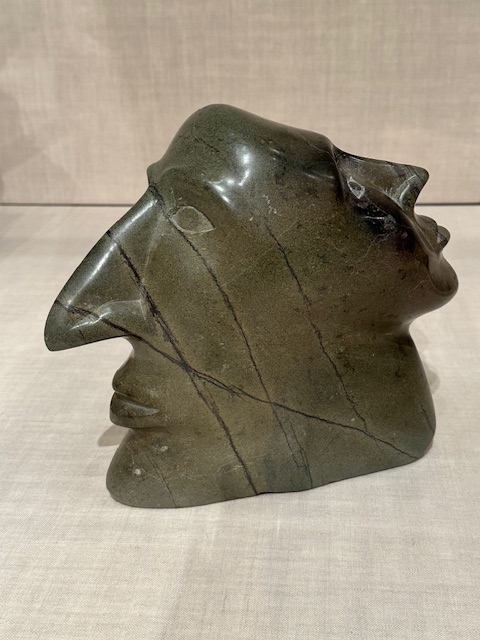
    Inuit, Unknown carver, Art Institute of Chicago

    Tania Israel, Professor of Counseling Psychology at University of California (Santa Barbara) is  author of the 2024 book, Facing the Fracture: How to Navigate the Challenges of Living in a Divided Nation. Rather than focusing on differences between voters, Israel takes a compassionate (and researched) approach: “We have more in common than we realize.”

    • There is a tendency to overestimate the distance between our viewpoints; two-thirds of Americans do not belong to either extreme of the political continuum. While voters may disagree on whether there is environmental climate change, many who voted for different candidates are exhausted by the divisiveness of today’s political climate.
    • Most Americans share core values, such as service, patriotism, and bipartisanship.
    • There are over 500 organizations that are working in earnest in the bridging movement to bring people together in the Listen First Project, a global nonpartisan nonprofit that was founded in 2013. The goal is to strengthen social cohesion and democratic principles.
    • Listen First conversations happen by following these 3 tips: 1) Listen with curiosity. 2) Speak from your own experience. 3) Connect with respect.
    • Our actions can change our beliefs. Look for unifying causes. Check out these brief You Tube clips: https://www.youtube.com/@ListenfirstprojectOrg/videos
    • Despite social media outlets that foster conflict, 53% of Americans across political lines report changing their social media diet in favor of more constructive choices.

    Researchers are working on ways to reduce division. In a large study of online interventions, 23 of 25 reduced partisan animosity. Reducing support for undemocratic practices and partisan violence were intervention goals. Correcting misperceptions about “the other side” was one useful approach. Most individuals were found to value resilient and safe communities where healthy families can thrive.

    Social psychologist Peter T. Coleman, Professor of Psychology and Education, Teachers College at Columbia University, initiated the Polarization Detox Challenge – a 20-day skill-building online experience designed to shape new habits for political tolerance and compassion. His ongoing research is one that you can join: https://startswith.us/pdc/exercises/

    The Polarization Detox Challenge takes as little as 5 minutes a day. This is not an assignment! No one grades you. Dropping out is an option. Day One of The Detox Challenge is finding out (via a quick survey with results immediately) how much you believe in change. No surprise, I believe in people’s capacity for change!

    “Research on more intractable conflicts has found that… when people believe that groups and situations are mutable and sometimes can change, they are much more likely to work to do so. Making this simple shift in mindset helps make it conceivable to see and realize possible solutions to problems where others see inevitable dead ends. The consequences of this simple difference have been shown by decades of research to be profound.”

    Hanging on to a fixed mindset halts evolving problem-solving. Let’s correct any misperceptions with facts while embracing values that we hold in common. 

    Pearls of Peace (PoP) Quiz

    343. What are your thoughts about people who voted opposite from you?

    344. How might you dialogue together?