Social Media: The Good, the Bad

“Go to where you are kindest,” writes Jaron Lanier, computer scientist, composer of chamber and orchestral music, visual artist and author. Adolescents might not appreciate Lanier’s book, Ten Arguments for Deleting Your Social Media Accounts Right Now. Teens spend an average of 9 hours per day online, excluding their schoolwork, according to the American Academy of Child & Adolescent Psychiatry. How much of that time is “kindness” a theme?

Among his many writings, Lanier states in his book, Dawn of the New Everything: Encounters with Reality and Virtual Reality, “TV and video games draw people into a zombielike trance.” And yet, he cites the incredible range for good in Virtual Reality (VR) — as in treating veterans’ PTSD or aiding physicians in performing delicate surgery.  

In 2005 Foreign Policy honored Lanier as one of the 100 most Public Intellectuals. In 2018 Wired named Lanier one of the top 25 most influential people over the last 25 years of technological history. However, his personal history was challenging by any standard. His mother was a concentration camp survivor. When Lanier was 9 years old, she was killed in a car accident. For extended periods Lanier lived in tents with his father before this brilliant youth helped design a geodesic dome home, a project encompassing 7 years. At age 13 he began college, studying mathematics that led to computer programming.

Other challenged adolescents find it difficult to imagine such productivity. Instead of savoring and mastering school, they barely handle the VR barrage. Some kill themselves or others. On three initiating dates in the academic calendar — the latest on April 11, 2025 — the non-profit “Beyond Differences” sponsors a student-led social justice project to change the culture of teen angst in schools. Middle school and high school students are targeted to respond to one another at school and online with decency. This year’s theme is “Unmute Your Kindness.” https://www.beyonddifferences.org/national-programs/

The social-emotional learning (SEL) goals of this pay-it-forward effort are twofold: stopping online social isolation, and empowering students to find a sense of community that engages them in taking future positive actions. The message to students is simple and yet profound:

  • Know Your Classmates.
  • No One Eats Alone.
  • Be Kind Online.


As an offshoot of the Sandy Hook Promise Foundation, teachers can download free resources from “Beyond Differences” which feature a training workshop and curriculum. Parents can ask their home school to gain access to the lessons and student-led leadership guide.

Now, can we please get adults to plug into “Unmute Your Kindness?”

Kindness and goodness seem to be in short supply today. My mantra is, “Make something good happen every day.” All of us might benefit from kindness post-it notes to ourselves. Consider Maya Angelou’s poetic summons: “Try to be a rainbow in someone’s cloud.”

Pearls of Peace (PoP) Quiz

385. How often do you observe people treating others with kindness?

386. What is your version of a kindness post-it note?                 
Library Perils and Pearls

“Anyone who writes is a seeker. You look at a blank page and you’re seeking. The role is assigned to us and never removed. I think this is an unbelievable blessing,” proposed Louise Glück, U.S. poet and Nobel laureate. Alongside writers, let’s include readers as seekers. Readers seek ideas and knowledge to whet their curiosity appetite.

1950’s research found that Americans were spending less money on books; instead, they purchased radios (remember those?), TV’s, and musical instruments! Concerned that citizens were reading less, the American Library Association (ALA) and the American Book Publishers formed a nonprofit to bolster reading. National Library Week was born in 1958 to re-invigorate readers. The first theme was “Wake Up and Read;” this year’s theme is “Drawn to the Library.” Notice, the word “reading” is absent.

In this 67th year of the event, April 6-12, 2025, National Library Week offers far greater services than 1950’s libraries. Besides books, contemporary libraries supply patrons with internet training/usage, career workshops, museum passes, video games and toys! National Library Week includes a focus on the increasing ways libraries create community by bringing people together.

Yes to community bonding, but who reads books? The Bureau of Labor Statistics Time Use study found that the time Americans devote to reading has dropped over the past 20 years. A Gallop survey in 2022 found that Americans simply are reading fewer books per year than previously. Social media has dethroned books. Bookshelves are lonely. AI tools are eclipsing reading and writing. Research with college students using AI-generated summaries reveals convenience and time-saving as plusses, but “text engagement” suffers; AI was “less effective in promoting deeper understanding.” 

Research at Duke University presented participants with reading and writing tasks, followed by reading comprehension questions. Complete reliance on AI for writing tasks led to a 25.1% reduction in accuracy. When using AI in the reading task, there was a 12% decline in participants’ reading comprehension. https://papers.ssrn.com/sol3/papers.cfm?abstract_id=4567696

Censorship dictates what U.S. readers might read. A government directive to the Naval Academy Library demanded the removal of nearly 400 books this past week. The “State of America’s Libraries Report” offers a canary-in-the-coal-mine view of what faces the U.S. in general. ALA President Emily Drabinsky outlines both the challenges and the resilience of libraries: “The unprecedented wave of organized censorship intensifies, particularly in our public libraries. Adverse legislation that would undermine librarian agency and authority is getting a hearing in legislatures across the country. Climate change continues to impact libraries, damaging buildings in some areas and turning libraries into recovery centers in others. Budget cuts and staffing challenges undermine our ability to fulfill our missions. In these extraordinary times, libraries take action.”

As an avid reader/writer, I am glad that libraries offer diverse experiences, but sad that reading is slipping through diverse educational cracks. What does this say about what Americans are seeking? Is reading going underground?

Pearls of Peace (PoP) Quiz

383. What meaning does reading hold for you?

384. How often do you visit your public library?       

A Cynicism Climate vs. Warm Fuzzy Terrain

Whatever happened to warm fuzzies, defined as feelings of happiness, hope and well-being?

Stanford University professor of psychology, Jamil Zaki, directs the Social Neuroscience Lab. Zaki and his colleagues find that the rate of U.S. citizens feeling unhappy and mistrusting of others is at a high point.  His book, Hope for Cynics: The Surprising Science of Human Goodness, disagrees with a common belief that cynics are more perceptive than optimists. Research results show that cynics perform worse in cognitive tests. Cynicism is a destructive force. It can impact one’s well-being. While cynicism may appear to be protective, as in keeping people from taking advantage of you, it is linked to loneliness and losing out on potential collaboration. According to the Pew Research Center, a 2024 study surveyed 6,200 adults in English and Spanish about their well-being and social connections; they found that 1 in 6 Americans feel lonely or isolated most of the time.

Cynicism is easy. Anyone can do it. Change is hard. That takes us.” Cody Keegan, speechwriter for President Obama, wrote his own speech for a New York University commencement address; this was his advice to graduates.

Jamil Zaki advocates “hope mixed with fury” to inspire genuine change. He suggests that one needs to fact-check their cynicism through increasing a sense of curiosity and first questioning their own beliefs. When one engages in conversations with strangers, or those known to hold opposing political viewpoints, there is an opportunity for two-way growth. 

Having an open mind is a hope-fueled possibility. Hope promotes personal happiness. Zaki fosters a positive spin on collective hope: “Hope doesn’t mean accepting that things are actually great when they’re not — it means acknowledging that things are awful, but that many, many people want them to improve.”

Psychologist Andrea F. Polard, founder of Zen Psychology and author of A Unified of Happiness: An East-Meets-West Approach to Fully Loving Your Life, is another peddler of hope. Her recommendations for taming your inner cynic are the following:

  1. Look deeper, feel deeper

Embrace your own cynicism by looking more deeply into your anger. Anger often hides our disappointment. Sometimes we project our disappointment onto the whole of society. Be brave. Confront the pain that your cynicism may hide.

  1. Find inner peace. 

Relate to others by identifying your own attachments. Admit your own biases and shortcomings. Make peace with your own human condition. [Remember, it takes us, all of us.]

  1. Try to work with imperfections constructively. 

A person does not change because someone despises them. Participate in dialogues. Be assertive against injustice and hypocrisy but lead with examples of alternative behaviors.

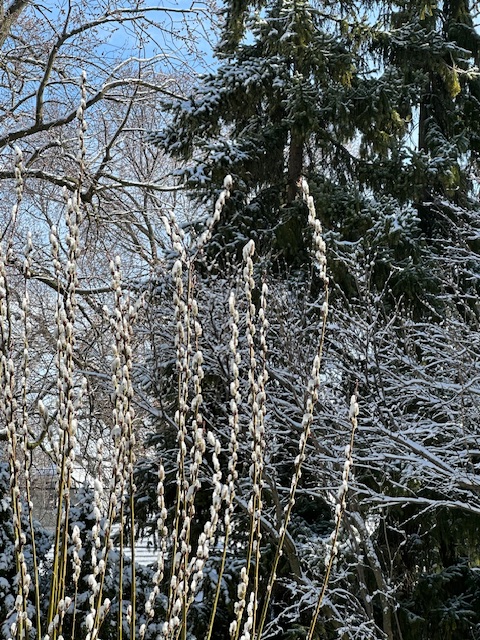
Be as strong as a pussy willow branch. In spite of a wild spring snowstorm that threatened a tornado, catkins flourished on strong branches that could bend in the wind, hail, and snow.

Pearls of Peace (PoP) Quiz

381. How often do you catch yourself in a cynical part of your personality?

382. What might you do to increase your hopefulness?                 

Can Springtime Jumpstart Social Prescribing?

Winter aconite bulbs in buttercup family (Ranunculaceae)

There is something magical about the warming of days and the return of blooming bulbs unfurling upward, while trees are budding outward, after their winter hibernation. Spring (or vernal) equinox occurred March 20th. Vernal equinox comes from Latin vernal (new or fresh), aequus (equal) and nox (night). Spring equinox delivers daylight in equal amounts of approximately 12 daylight hours and 12 darkness hours as the sun is above the equator at midday.

March equinox in the Northern Hemisphere is the warming trend signaling that summer is not far away as this section of Earth begins showing more hours of sunlight than darkness. Look north for the Big Dipper to be at a high point. In the Southern Hemisphere, March equinox is the polarized opposite; as this region begins tilting away from the sun, the beginning of autumn occurs. According to EarthSky, the fastest sunsets and sunrises of the year occur on the equinoxes. Another Nature tidbit — auroras’ sky dances frequently happen around autumn and spring equinoxes when geomagnetic storms on the sun cause rippling disruptions in Earth’s magnetic field. This awesome feature of Mother Nature reportedly is one of the earliest patterns ever recorded by scientists. https://earthsky.org/sun/aurora-season-auroras-equinox-connection/

I was in Washington state before spring equinox and received an aurora alert on my cell phone! Being an avid sky observer, I set my phone alarm to get up at the prescribed possibility time, but a clear sky did not unfurl any aurora beams of beauty. However, just this possibility of seeing a blooming sky made me smile.

There is something healthy-feeling about warmer temperatures, as more people gather outside and enjoy Nature’s bounty. Doctors are learning to administer social prescriptions. Physicians Alan Siegel and Carla Perissinotto offer this description: “Social prescribing means connecting of people to activities, groups, and support that improve their health and well-being. These often include a range of social services, the arts, nature, volunteerism, movement, companionship and community-building.” Social prescribing is active in 32 countries. I wonder if social prescriptions are refilled more frequently in Nature’s pharmacy in springtime.

Massachusetts has a statewide program in social prescribing. For example, a hypertension research study (Brigham and Women’s Hospital in Boston) utilizes social prescriptions through an art-prescribing company, Art Pharmacy. Based in Atlanta, Art Pharmacy partners with programs in California, Connecticut, Georgia, Massachusetts and New York. Founded in 2022, one goal of Art Pharmacy is to address the loneliness and mental health crises of U.S. citizens. Traditional physical and mental health care can have serious gaps in reaching many individuals’ needs. Social Prescribing USA, a national advocacy organization, has 8 states with pilot projects.

Springtime means the beginning of gardening season for me. All of us need sunshine, both literally and figuratively. Spring delivers more literal sunshine, but the figurative sunshine of well-being is elusive for many.

Pearls of Peace (PoP) Quiz

379. What does springtime mean to you?

380. How might you write your own prescription for social well-being this spring? 

Pearls of Brain Awareness

Brain scan data, Human Connectome Project: Credit Matthew F. Glasser, David C. Van Essen

Growing up in farmland with paternal grandparents who produced their own beef and pork, I was offered cow brains for dinner in butcher season. While my parents relished this delicacy, I recoiled and could not partake of this unique delicacy. I had no awareness about missing the nutritional benefits of beef brains (vitamins A, B6, B12, C, D, E, K, phosphatidylserine, folate, niacin, magnesium, zinc, and choline, among others), but I still am not a proponent today. I am a proponent of taking care of one’s own 3-pound brain at mealtimes, sleep times, exercise times, and well, any time!

I like the global focus on Brain Awareness Week (the third week of every March), which serves as an annual launch for year-round brainy activities. This is the 30th annual Brain Awareness Week, the “brainchild” (I could not resist) of the Dana Alliance for Brain Initiatives and the European Dana Alliance for the Brain. The Dana Foundation is a nonprofit organization with the lofty goal of promoting brain science internationally to create better futures for everyone.

Dana foundation-sponsored programs such as one in Bamenda, Cameroon, and promoted by physician, Mundih Noelar Njohjam (founder of Cameroon Epilepsy Awareness and Aid Foundation), delivered brain science education to 5000 students. Njohjam provided her grant feedback: It was really interesting to watch [the students] as we explained the wonderful nature of the brain and how neurological diseases occur…especially epilepsy, because in our country epilepsy is often attributed to witchcraft. After listening to us talk, one student openly told us that before we came, he was one of those who usually stigmatized people with epilepsy,” she said. “So many confessed after the presentation that their mindset about epilepsy has really changed.” Truth matters.

Consider some facts offered by the Global Council on Brain Health: https://extension.illinois.edu/blogs/family-files/2025-02-24-celebrate-brain-awareness-week-all-year-long

  • Most of us are capable of learning at ANY age, especially getting involved with cognitively stimulating activities such as meeting new people, growing new hobbies or expanding knowledge.
  • Dementia is NOT normal aging. Typical age-related changes in the brain are different from those caused by disease.
  • Children are not the only ones who can master a foreign language – age does not prevent you from learning a new language.
  • Memory skills can improve with practice. The adage, “Use it or lose it,” is as important to memory skill training as it is to taking care of one’s physical health. 
  • Retaining details is just easier for some people than others, but this is true for all ages.
  • Strategies can ripen your memory. Chunk information into smaller bits for enhanced memorization. Use mnemonic devices. Practice retrieval (spacing out repetition works better than cramming). Make flash cards. Quiz yourself.
  • Neurons are created throughout your lifetime.

Being a life-long learner is invigorating! I am grateful for my many opportunities to keep my workhorse brain on the move.

Pearls of Peace (PoP) Quiz

377. What new learning have you embraced recently?

378. How might you become a better caretaker of your brain? 

Women’s Herstory Month 

“Women are like teabags. We don’t know our true strength until we are in hot water.” Whether First Lady Eleanor Roosevelt actually said this is unknown, but women’s true strengths often go unrecognized, even by women themselves. Let’s reflect on a mostly unknown woman’s story and her accomplishments.

Austrian-American Gerda Hedwig Lerner taught American history and initiated the first college course on women’s history in 1963 while an undergraduate in New York’s New School for Social Research. Subsequently, she created the first known master’s degree program in women’s history at Sarah Lawrence College and first doctoral woman’s history program at University of Wisconsin-Madison. Her mission was simple: she wanted to offer studies in “people who did not have a voice in telling their own stories.”

Lerner’s early history included anti-Nazi resistance in Austria as a Jewish woman. She volunteered for “Red Aid” to help those who were arrested. Along with her mother, Lerner was jailed for 6 scary weeks, spending her 18th birthday imprisoned. She lived in a cell with two Christian women who were detained for political reasons. Her cell mates shared food with her as Jews received restricted meals. Lerner was able to immigrate to America with the aid of a sponsor – the family of her resistance fiancé. There are many poignant immigrant stories of individuals who escape dire circumstances to later enrich our collective history.

With her second husband, Lerner co-authored the screenplay of Black Like Me based on white journalist John Howard Griffin’s epic 6 weeks of traveling in the South disguised as a black man. Her doctoral dissertation told the story of resistance sisters from a slaveholding family who left their Southern home to become abolitionists in the North.

Learner became a founding member of the National Organization for Women (NOW) and began publishing books on women’s history with such titles as Black Women in White America (1972), and The Female Experience: An American Documentary (1976). She organized the first Women’s History Week in 1979, modeling it after a weeklong celebration of women’s contributions to culture and community by the Sonoma, California school district.

President Carter followed up with the first presidential proclamation to assign the week of March 8 as National Women’s History Week in 1980. Congress passed a resolution declaring a national celebration the following year. With the support of the National Women’s History Project, in 1987 Congress extended this recognition of women to our current month-long event every March. The United Kingdom and Australia followed to celebrate every March. Canada chose October for their women’s history recognition to correspond with their Persons Day on October 18th.

The 2025 theme of Women’s History Month, “Moving Forward Together,” celebrates equality and women’s collective strength. Equality includes children and men. Equality includes immigrant families. My equality ancestors were immigrants. How about your equality ancestors?

Pearls of Peace (PoP) Quiz

375.  How many women do you know who accomplish great things but are mostly unknown?

376. What women’s stories can you tell in Women’s Herstory Month?       

The Ants Go Problem-solving

As a child did you sing, “The ants go marching one by one…hurrah, hurrah… they all go marching down, to the ground, to get out of the rain…the ants go marching two by two…hurrah, hurrah…they all go marching down, to the ground, to get out of the rain…?” My family and I witnessed ants marching – in a long line – from the patio door to the kitchen of our timeshare condo in Spain. Initially we thought the ants marched two by two until we realized that it was a double line. Some ants were coming. Some ants were going. They had constructed an ant highway to their kitchen!

Scientists at the Weizmann Institute of Science in Israel conducted a fascinating study of ants and their big cousins, humans. The study goal was to assess the collective problem-solving skills of humans when contrasted with longhorn crazy ants (Paratrechina longicornis) who are 3 millimeters in size. The “crazy” labeling comes from the ants’ mislabeled erratic, frenetic movements. This David-and-Goliath match-up is fascinating as both ants and humans are among nature’s few species known to cooperatively transport large objects.

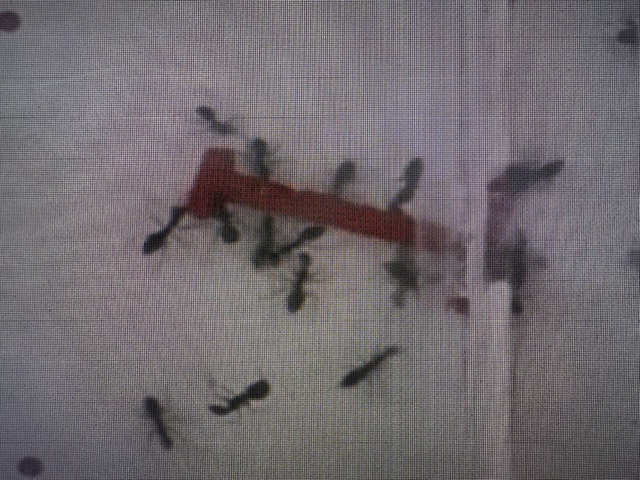
The research task involves maneuvering an odd-T-shaped item through a maze with tight spaces and around corners. The puzzle affectionately is dubbed the “piano-movers’ problem.” Ants are tricked into believing that T-thing was food needing to be transported to their nest. Trial-and-error attempts for the ants with their tiny maze versus the humans with their big-boy-and-girl-sized maze suggest that ants may know how to work together better than adult humans! When collective ant families teamed up, they were able to more efficiently guide the item through complex spatial challenges than a group of humans motivated by competition!

Complexity science researcher Ofer Feinerman and his team worked on this experiment for 3 years with 1,250+ individuals and multiple ant colonies. https://studyfinds.org/ants-smarter-than-humans/ Larger ant teams performed significantly better than smaller groupings or solo ants; the opposite was true for humans when they were not allowed verbal communication or nonverbal gestures; humans wore masks and sunglasses. Human teams “deteriorated” compared to solo human participants. Humans simply worked better ALONE. Researchers summarized: “Each person egoistically thinks they have the most relevant information — and the wisest assessment of it — to accomplishing the overall goal.”

What are the takeaways? Researchers concluded that individual ants do not grasp the “big picture,” but collectively ants develop problem-solving skills by working together. Ants show persistence, cooperation, and perhaps collective intelligence. My takeaway is that humans lose out when they do not affirm the “soft” power of cooperation. In today’s state-of-complexity world we might consider how cooperation can win over competition. Do ants really have a cooperative edge over humans?

South African bishop and anti-apartheid activist Desmond Tutu understood cooperation: “My humanity is bound up in yours, for we can only be human together.”

Pearls of Peace (PoP) Quiz

373. What applications do you see from this ant-versus-human research?

374. How best do you solve your problems – individually or with group support?

Black History & Herstory Month

To Craft a Double Consciousness or Two-faced, Theaster Gates, 2018, Art Institute of Chicago

Black History month has a predominant focus on men who championed racial equality — with some exceptions.

On Rosa Parks’ birthday (2-4-25), Congresswoman Joyce Beatty (Ohio) spoke passionately about Parks’ enduring legacy in U.S. voting-rights progress. The Rosa Parks Commemorative Coin Act was initiated to honor the lifelong peaceful equal-rights activist.

In 1996 Parks was honored with the Presidential Medal of Freedom and the Congressional Gold Medal in 1999. A department store seamstress, Parks received a nearly 100% affirmation vote with only Representative Ron Paul (Texas) in dissent for her Gold Medal. Parks observed the voting from her Detroit home where she had moved due to the firing from her seamstress job and her family enduring threats.

Upon her death in 2005, Parks was honored to lie in state in the U.S. Capitol Rotunda. In 2013 the Postal Service recognized Parks’ “soft” power with a Forever Stamp on her 100th birthday and Congress approved Parks’ statue in Statuary Hall for her importance in “forming a more perfect union” and “establishing Justice.” Her seated granite statue, dressed similarly to that momentous day on the Montgomery, Alabama bus, was the first full-length statue of an African American individual in the Hall. Her statue joined busts of Martin Luther King, Jr. (1986 placement) and Sojourner Truth (2009 placement).

Rosa Parks was a member of the NAACP and was elected secretary. She had knowledge of many injustices in mandated racial segregation in public places. When she was ordered to give up her bus seat to a white passenger, she merely sat still. Arrested, she was pronounced guilty of “disorderly conduct and violating a local ordinance.”

As Joyce Beatty took the Congressional podium, she elaborated on the iconic memory of Parks refusing to give up her bus seat: “Rosa Parks was more than one moment… as America nears its 250th birthday, we must honor not only our founding fathers but also the mothers of our democracy.”

Let’s honor more mothers of democracy as “first” Black women to crack ceilings: Barbara Jordan – Black Southern woman elected to Congress, Rebecca Lee Crumpler – Black woman graduate in U.S. medical school, Ida Lewis – editor-in-chief of Essence magazine, Ruth Batson – Black woman on Democratic National Committee, Ketanji Brown Jackson – Black woman on Supreme Court, and Kamala Harris among others.

A first National Youth Poet Laureate, youth role model Amanda Gorman took another Washington, DC podium. Invited by Jill Biden to address the nation at President Biden’s inauguration, Gorman’s words from “The Hill We Climb” are especially poignant at this time in U.S. history/herstory:

“…We lay down our arms
so we can reach out our arms
to one another
We seek harm to none and harmony for all
Let the globe, if nothing else, say this is true:
That even as we grieved, we grew
That even as we hurt, we hoped
That even as we tired, we tried”

Pearls of Peace (PoP) Quiz

371. What story do you tell for “a more perfect union?”

372. How are you growing from grief?                     

Attachment in Deeds

“Soft power” in politics, especially in international politics, is the practice of shaping another’s point of view through non-coercive means — as opposed to the “hard power” of coercion.  Political scientist Joseph S. Nye Jr., Professor Emeritus and former Dean of Harvard’s Kennedy School of Government, popularized the term in his 1990 book, Bound to Lead: The Changing Nature of American Power.  He further explored his theory in his 2004 book, Soft Power: The Means to Success in World Power. Nye once served as Assistant Secretary of Defense for International Security Affairs in the US. According to Nye, a country’s soft power depends upon 3 important factors in that country:

  • Culture (as attractive to others),
  • Political values (when upheld both at home and abroad), and
  • Foreign policies (when others view them as legitimate as well as possessing moral authority).

I suspect that a leader is far more capable of exercising “soft power” if they possess a secure attachment (See Pearls of Peace blogpost 02-03-25).

On a small scale compared to international political diplomacy, but no less important, let’s understand how one might participate in “soft power.” As I explained in my “Attachment in Words” blog, it is possible to develop a secure attachment even when that is not a caretaker gift offered in earliest childhood.

Let’s consider teddy bear power. I found a teacher example of transforming school discipline into a version of super-soft power. Good teachers mentor in multiple directions. In 2022 New York City middle school teacher Karen Feldman wanted to change the climate among her students. She noticed a rise in hate speech and wanted to take proactive steps. Partnering with Bear Givers, a 501(c)(3) non-profit with a “Leading with Kindness Initiative,” Feldman guided her students in detention in decorating teddy bears to be given to hospitalized children. The students added art and messages on the teddy T-shirts. They attached supportive letters.

The motto of Bear Givers is Making life more bearable (yes) through giving & receiving.” Feldman grasped the importance of having students focus on others’ plight. School populations catching onto this “soft power” approach now extend to students beyond detention walls. Teddy-bear diplomacy has included groups outside schools, such as Bar/Bat Mitzvah, Confirmation, Sweet Sixteen, and others. Bear Givers has donated over 500,000 bears and 500+ charity events have been sponsored with 100+ partnerships. https://www.beargivers.org/about

Mother Bear Project is an international 501(c)(3) non-profit that gives hand-knit or crocheted bears to children, predominantly orphans and those affected by HIVAIDS in Africa. Mother Bear knitters are individuals from all over the US and the world; both women and men knit — from ages ranging from 6-99! While there is one pattern, each creation is unique and bears (yes) the name of it’s Mother Bear. “Mother Bear” Karen McDowell, a retired teacher, shares her photo of some of her bears awaiting shipment. http://motherbearproject.org/

Pearls of Peace (PoP) Quiz

369. When have you exercised “soft power”?

370. What are your ideas for “leading with kindness?”    

Attachment in Words

Are you aware of how your words land on a listener’s ear? Words can be like poison arrows or love letters. Both your flying-missile words and thoughtful spoken or written words of caring have staying power. They are not taken back easily. Words can boomerang across generations.

Whose words are you speaking on a regular basis? We do not ask ourselves this question, as we may not be aware of the answer.  I can recall the stunned look on a client’s face when she admitted that she suddenly caught herself “sounding just like her mother” in a heated exchange with her feisty teenager in my therapy office. Her insight provided an incredible starting place for real change in the parent-child relationship. Admitting that her lashing-out response was not what she had intended, but it just “slipped out,” was a healing moment for broader family dynamics.

Much of the time adults attempt to manage activated parts of their personalities with little recognition that they replicate another’s response patterns. Generations share not only DNA but some embedded ways of speaking to one another. Rage reactions do not “come out of the blue,” but often are solidly anchored in caretaker attachment issues. Early relationships in childhood can set the pace for later attachments.

Neuropsychiatrist Dan Siegel suggests that (as early as age 7) children pick up on attachment patterns of adults in their world. Based on the early theory of British psychiatrist John Bowlby and later research by American-Canadian psychologist Mary Ainsworth and others, there are four attachment patterns. Here are representative take-away words from each pattern:

  • Secure — “People will respect what I say.”
  • Avoidant/dismissive – “I did not get what I needed; I don’t need anybody for anything.”
  • Anxious/ambivalent – “I don’t know if you are my friend or not.”
  • Disorganized – “I can’t regulate my emotions; I fragment. Under stress I can’t think straight.”

Michigan poet Will Carleton cautions: “Boys flying kites haul in their white winged birds; you can’t do that when you’re flying words. ‘Careful with fire,’ is good advice we know. ‘Careful with words,’ is ten times doubly so.”

Dan Siegel believes that parents are capable of creating secure attachments with their children even if they did not receive such caring from their caretakers. The key is being aware of an honest and coherent narrative of one’s own upbringing.

Siegel’s 4 S’s remind us how to foster secure attachments. ALL adults can improve their approach to family life and work life. Employers, heads up!

What a different world we would have if parents and employers had secure attachments!

Pearls of Peace (PoP) Quiz

367. What are your words for making sense of your childhood?

368. How do you view your attachment pattern today?