The Ants Go Problem-solving

As a child did you sing, “The ants go marching one by one…hurrah, hurrah… they all go marching down, to the ground, to get out of the rain…the ants go marching two by two…hurrah, hurrah…they all go marching down, to the ground, to get out of the rain…?” My family and I witnessed ants marching – in a long line – from the patio door to the kitchen of our timeshare condo in Spain. Initially we thought the ants marched two by two until we realized that it was a double line. Some ants were coming. Some ants were going. They had constructed an ant highway to their kitchen!

Scientists at the Weizmann Institute of Science in Israel conducted a fascinating study of ants and their big cousins, humans. The study goal was to assess the collective problem-solving skills of humans when contrasted with longhorn crazy ants (Paratrechina longicornis) who are 3 millimeters in size. The “crazy” labeling comes from the ants’ mislabeled erratic, frenetic movements. This David-and-Goliath match-up is fascinating as both ants and humans are among nature’s few species known to cooperatively transport large objects.

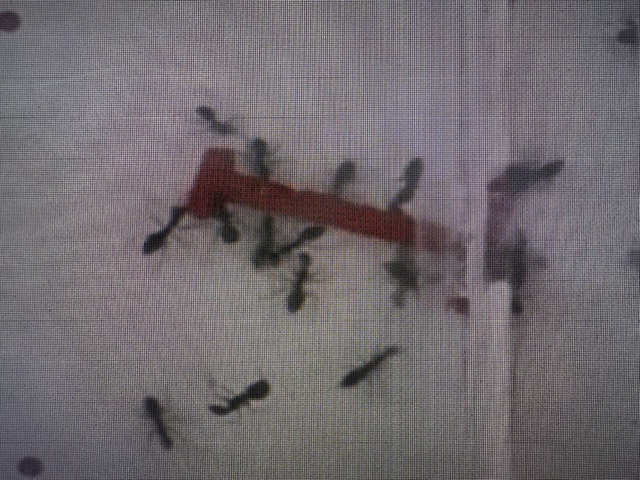
The research task involves maneuvering an odd-T-shaped item through a maze with tight spaces and around corners. The puzzle affectionately is dubbed the “piano-movers’ problem.” Ants are tricked into believing that T-thing was food needing to be transported to their nest. Trial-and-error attempts for the ants with their tiny maze versus the humans with their big-boy-and-girl-sized maze suggest that ants may know how to work together better than adult humans! When collective ant families teamed up, they were able to more efficiently guide the item through complex spatial challenges than a group of humans motivated by competition!

Complexity science researcher Ofer Feinerman and his team worked on this experiment for 3 years with 1,250+ individuals and multiple ant colonies. https://studyfinds.org/ants-smarter-than-humans/ Larger ant teams performed significantly better than smaller groupings or solo ants; the opposite was true for humans when they were not allowed verbal communication or nonverbal gestures; humans wore masks and sunglasses. Human teams “deteriorated” compared to solo human participants. Humans simply worked better ALONE. Researchers summarized: “Each person egoistically thinks they have the most relevant information — and the wisest assessment of it — to accomplishing the overall goal.”

What are the takeaways? Researchers concluded that individual ants do not grasp the “big picture,” but collectively ants develop problem-solving skills by working together. Ants show persistence, cooperation, and perhaps collective intelligence. My takeaway is that humans lose out when they do not affirm the “soft” power of cooperation. In today’s state-of-complexity world we might consider how cooperation can win over competition. Do ants really have a cooperative edge over humans?

South African bishop and anti-apartheid activist Desmond Tutu understood cooperation: “My humanity is bound up in yours, for we can only be human together.”

Pearls of Peace (PoP) Quiz

373. What applications do you see from this ant-versus-human research?

374. How best do you solve your problems – individually or with group support?

Black History & Herstory Month

To Craft a Double Consciousness or Two-faced, Theaster Gates, 2018, Art Institute of Chicago

Black History month has a predominant focus on men who championed racial equality — with some exceptions.

On Rosa Parks’ birthday (2-4-25), Congresswoman Joyce Beatty (Ohio) spoke passionately about Parks’ enduring legacy in U.S. voting-rights progress. The Rosa Parks Commemorative Coin Act was initiated to honor the lifelong peaceful equal-rights activist.

In 1996 Parks was honored with the Presidential Medal of Freedom and the Congressional Gold Medal in 1999. A department store seamstress, Parks received a nearly 100% affirmation vote with only Representative Ron Paul (Texas) in dissent for her Gold Medal. Parks observed the voting from her Detroit home where she had moved due to the firing from her seamstress job and her family enduring threats.

Upon her death in 2005, Parks was honored to lie in state in the U.S. Capitol Rotunda. In 2013 the Postal Service recognized Parks’ “soft” power with a Forever Stamp on her 100th birthday and Congress approved Parks’ statue in Statuary Hall for her importance in “forming a more perfect union” and “establishing Justice.” Her seated granite statue, dressed similarly to that momentous day on the Montgomery, Alabama bus, was the first full-length statue of an African American individual in the Hall. Her statue joined busts of Martin Luther King, Jr. (1986 placement) and Sojourner Truth (2009 placement).

Rosa Parks was a member of the NAACP and was elected secretary. She had knowledge of many injustices in mandated racial segregation in public places. When she was ordered to give up her bus seat to a white passenger, she merely sat still. Arrested, she was pronounced guilty of “disorderly conduct and violating a local ordinance.”

As Joyce Beatty took the Congressional podium, she elaborated on the iconic memory of Parks refusing to give up her bus seat: “Rosa Parks was more than one moment… as America nears its 250th birthday, we must honor not only our founding fathers but also the mothers of our democracy.”

Let’s honor more mothers of democracy as “first” Black women to crack ceilings: Barbara Jordan – Black Southern woman elected to Congress, Rebecca Lee Crumpler – Black woman graduate in U.S. medical school, Ida Lewis – editor-in-chief of Essence magazine, Ruth Batson – Black woman on Democratic National Committee, Ketanji Brown Jackson – Black woman on Supreme Court, and Kamala Harris among others.

A first National Youth Poet Laureate, youth role model Amanda Gorman took another Washington, DC podium. Invited by Jill Biden to address the nation at President Biden’s inauguration, Gorman’s words from “The Hill We Climb” are especially poignant at this time in U.S. history/herstory:

“…We lay down our arms
so we can reach out our arms
to one another
We seek harm to none and harmony for all
Let the globe, if nothing else, say this is true:
That even as we grieved, we grew
That even as we hurt, we hoped
That even as we tired, we tried”

Pearls of Peace (PoP) Quiz

371. What story do you tell for “a more perfect union?”

372. How are you growing from grief?                     

Attachment in Deeds

“Soft power” in politics, especially in international politics, is the practice of shaping another’s point of view through non-coercive means — as opposed to the “hard power” of coercion.  Political scientist Joseph S. Nye Jr., Professor Emeritus and former Dean of Harvard’s Kennedy School of Government, popularized the term in his 1990 book, Bound to Lead: The Changing Nature of American Power.  He further explored his theory in his 2004 book, Soft Power: The Means to Success in World Power. Nye once served as Assistant Secretary of Defense for International Security Affairs in the US. According to Nye, a country’s soft power depends upon 3 important factors in that country:

  • Culture (as attractive to others),
  • Political values (when upheld both at home and abroad), and
  • Foreign policies (when others view them as legitimate as well as possessing moral authority).

I suspect that a leader is far more capable of exercising “soft power” if they possess a secure attachment (See Pearls of Peace blogpost 02-03-25).

On a small scale compared to international political diplomacy, but no less important, let’s understand how one might participate in “soft power.” As I explained in my “Attachment in Words” blog, it is possible to develop a secure attachment even when that is not a caretaker gift offered in earliest childhood.

Let’s consider teddy bear power. I found a teacher example of transforming school discipline into a version of super-soft power. Good teachers mentor in multiple directions. In 2022 New York City middle school teacher Karen Feldman wanted to change the climate among her students. She noticed a rise in hate speech and wanted to take proactive steps. Partnering with Bear Givers, a 501(c)(3) non-profit with a “Leading with Kindness Initiative,” Feldman guided her students in detention in decorating teddy bears to be given to hospitalized children. The students added art and messages on the teddy T-shirts. They attached supportive letters.

The motto of Bear Givers is Making life more bearable (yes) through giving & receiving.” Feldman grasped the importance of having students focus on others’ plight. School populations catching onto this “soft power” approach now extend to students beyond detention walls. Teddy-bear diplomacy has included groups outside schools, such as Bar/Bat Mitzvah, Confirmation, Sweet Sixteen, and others. Bear Givers has donated over 500,000 bears and 500+ charity events have been sponsored with 100+ partnerships. https://www.beargivers.org/about

Mother Bear Project is an international 501(c)(3) non-profit that gives hand-knit or crocheted bears to children, predominantly orphans and those affected by HIVAIDS in Africa. Mother Bear knitters are individuals from all over the US and the world; both women and men knit — from ages ranging from 6-99! While there is one pattern, each creation is unique and bears (yes) the name of it’s Mother Bear. “Mother Bear” Karen McDowell, a retired teacher, shares her photo of some of her bears awaiting shipment. http://motherbearproject.org/

Pearls of Peace (PoP) Quiz

369. When have you exercised “soft power”?

370. What are your ideas for “leading with kindness?”    

Attachment in Words

Are you aware of how your words land on a listener’s ear? Words can be like poison arrows or love letters. Both your flying-missile words and thoughtful spoken or written words of caring have staying power. They are not taken back easily. Words can boomerang across generations.

Whose words are you speaking on a regular basis? We do not ask ourselves this question, as we may not be aware of the answer.  I can recall the stunned look on a client’s face when she admitted that she suddenly caught herself “sounding just like her mother” in a heated exchange with her feisty teenager in my therapy office. Her insight provided an incredible starting place for real change in the parent-child relationship. Admitting that her lashing-out response was not what she had intended, but it just “slipped out,” was a healing moment for broader family dynamics.

Much of the time adults attempt to manage activated parts of their personalities with little recognition that they replicate another’s response patterns. Generations share not only DNA but some embedded ways of speaking to one another. Rage reactions do not “come out of the blue,” but often are solidly anchored in caretaker attachment issues. Early relationships in childhood can set the pace for later attachments.

Neuropsychiatrist Dan Siegel suggests that (as early as age 7) children pick up on attachment patterns of adults in their world. Based on the early theory of British psychiatrist John Bowlby and later research by American-Canadian psychologist Mary Ainsworth and others, there are four attachment patterns. Here are representative take-away words from each pattern:

  • Secure — “People will respect what I say.”
  • Avoidant/dismissive – “I did not get what I needed; I don’t need anybody for anything.”
  • Anxious/ambivalent – “I don’t know if you are my friend or not.”
  • Disorganized – “I can’t regulate my emotions; I fragment. Under stress I can’t think straight.”

Michigan poet Will Carleton cautions: “Boys flying kites haul in their white winged birds; you can’t do that when you’re flying words. ‘Careful with fire,’ is good advice we know. ‘Careful with words,’ is ten times doubly so.”

Dan Siegel believes that parents are capable of creating secure attachments with their children even if they did not receive such caring from their caretakers. The key is being aware of an honest and coherent narrative of one’s own upbringing.

Siegel’s 4 S’s remind us how to foster secure attachments. ALL adults can improve their approach to family life and work life. Employers, heads up!

What a different world we would have if parents and employers had secure attachments!

Pearls of Peace (PoP) Quiz

367. What are your words for making sense of your childhood?

368. How do you view your attachment pattern today?     

Understand Compassion in Grieving

“I write to understand as much as to be understood,” explained Elie Wiesel, Romanian-American Holocaust survivor and Nobel laureate. Isn’t this true for all writers? If writing is one’s career, there is motivation to put groceries on one’s table, but writing also is a powerful way to grasp and then share some deep understanding of a topic.

The tragic airline crash into Potomac River in Washington, DC grabbed people’s grief strings. An airplane carrying 64 individuals from Wichita, Kansas, and a helicopter carrying 3 soldiers collided just as the larger plane was preparing to land — on a crystal-clear evening. Undoubtedly, passengers were anticipating their meet-up with relatives and rides. Perhaps they were enjoying DC lights and sights. Aviation attorney and experienced pilot Arthur Wolk noted how numerous lights in this crowded airspace can conflict with flight instructions.

Soldiers in the helicopter were conducting a “routine training mission” to practice evacuating government officials if deemed necessary in an emergency. Instead of leading anyone to safety, the unthinkable occurred. Two days later a jet-ambulance crashed in Philadelphia, killing 7 and injuring 22 on the ground, a further tragedy. Smashed dreams and shattered families frighten even those without relationships with the victims. Encountering another’s trauma activates branches of trauma memories in one’s own life.

Journalist Rebecca Soffer, co-founder of online Modern Loss, is keenly aware of sudden death. She was 30 when her mother was killed in a car accident, one hour after giving Rebecca a ride from family camping. Then at age 34, Rebecca’s father died of a heart attack while on a cruise. Co-founder Gabrielle Birkner began her journalism career writing obituaries for a local newspaper. While 27-year-old Gabrielle was in the newsroom working on obituaries, she received unthinkable news that her father and stepmother were murdered in a home invasion. Both young adults sought companionship and compassion from those who might understand their grief.

Gabrielle interviewed psychiatrist M. Katherine Shear, founding director of Columbia University’s Center for Prolonged Grief at Columbia’s School of Social Work. Here is Dr. Shear’s definition of compassion: “Compassion is defined as the feeling of wanting to help someone who is hurting or suffering or has had to confront an untoward experience. Compassion means having a sympathetic awareness of that person’s pain along with a desire to ease the suffering.” She further pointed out that women are better at taking care of others than taking care of themselves. Often women feel that it is selfish to have self-compassion.   

Actually, one needs to hone their self-compassion to be capable of compassion for another’s suffering. It is possible to learn self-compassion skills. Allow yourself to address grief as a form of interdependent love, both for yourself and others. I can vouch for writing 3 things, large and small, in a daily-gratitude journal as one runway to land self-compassion.

Pearls of Peace (PoP) Quiz

365. When have you used writing (in any form) to cope with grieving?

366. In what ways do you show compassion for others?        

Is Your Screen-time Diet a Pacifier?

The same parent that tries to discourage a child’s thumb or pacifier later hands their youngster a digital babysitter to keep the kid pacified or occupied. Yet, recent surveys show that 70% of America adults have concerns over how technology is affecting their own mental health, including their personal relationships. Other research finds that the average U.S. adult spends 70% less time with friends than they did two decades ago.                                                   

Nearly half of Americans report cutting back on screen time; 67% cut out digital cookies. Were these your New Year’s resolutions? 62% of American adults admit to digital-device addiction. What will this percentage be when today’s addicted-to-gadget toddlers reach adulthood?

American Academy of Pediatrics well-being guidelines for technology usage are not being followed from my observation of many children today:

  • Under 18 months – Zero screen time, unless video communication is with family and/or friends;
  • 18-24 months – May begin screen time co-viewing with a parent or caregiver;
  • 2-5 years — No more than 1 hour per day, limited to educational programming;
  • 6+ years – Limit screen time by setting limits and boundaries (using parental controls); avoid using screens as a pacifier or babysitter.

How difficult is it to turn off all screens during family meals and outings? Parents are role models in the usage of technology for their families. Do you use a digital device while you eat? I am always amazed when I see a couple in a restaurant, sitting across from one another, both ensconced on cell phones for long periods of time. I wonder why they are not relating to each other in the present moment. In addition to the practical uses of our cell phones, The Smartphone as a Pacifying Technology (in Journal of Consumer Research) outlines these emotional benefits: “feelings of psychological comfort and actual stress relief.”

There are many possibilities for stress relief. What hobbies have you pushed to the back shelf of your mind? Is it time to develop a new interest in your life?

Whether cell phone usage becomes addictive is an individual assessment. Psychotherapist Peter Levine defines addiction: “Addiction is people needing some way to blunt their pain, attempt to regulate; until people find an alternative, they will continue [their] addiction.” Perhaps we need the AMA (American Medical Association) to write a prescription for adult screen time.

Do you need a digital detox recipe? Here are some possibilities:

  • Make a “grocery” list of replacement ingredients to the pacifier of screen time.
  • Stir face-to-face social bonding into your week.                              
  • Blend mindfulness into your daily activities.  

If you choose to detox from too much screen time, you avoid a diet of information overload. Side-dish benefits include better sleep, better concentration, better physical and mental health, better creativity, and better relating with others. Who does not wish for things to be “better”?

Bake your cookies. 

Pearls of Peace (PoP) Quiz

363. Have you ever considered whether you are addicted to screen time?

364. What possibilities do you have to redeem your personal time, starting TODAY?  

Broaden-and-build Purls and Pearls

I cannot give away my grandmother’s crochet hook…yes, this is a scarcity mindset at work (see Pearls of Peace, 1-13-25). I am hooked on warm memories of my childhood hours in my grandparents’ home. I recall many hours that Grandma sat in her rocker, wearing her hand-sewn apron and dress, making one doily after another to gift the many females in her family and friend network. I never learned knit-and-purl stitches, but I watched with fascination as Grandma created with her crochet hook, building one stitch upon the next to broaden her handiwork. Handmade gift-giving was on her unofficial resume.  

Psychologist Barbara Frederickson created her broaden-and-build theory when she realized that there was a greater amount of research on negative emotions than positive emotions. For every positive emotion, there appear to be 3 negative ones! The reason for this disparity is that negative emotions are linked to our survival in big and small ways.

The broaden-and-build theory emphasizes that the expression of positive emotions can expand one’s repertoire of psychological, social, cognitive, and physical resources. Positiveness improves one’s resilience. It may help one’s coping skills. This approach is not meant to erase negative emotions but instead allows for the co-existence of both kinds of emotions.

A negative emotion is a protective signal that something does not “feel right.” When such emotions are brushed off, sometimes there could be dire consequences. The bodymind is a listening machine, always on lookout to protect one from physical and/or psychological harm. The idea with broaden-and-build theory is to make space for ALL emotions.

Expressing frustration in a trusted relationship is often necessary before gaining access to a more centered space where one can choose a positive action. The key is having an awareness of your positive emotions so that you can repair touchy situations. Building upon a growth mindset reminds one that others roll with negative emotions also.    

Here is a list of positive emotions that you can broaden-and-build for more resiliency. You probably do not need a list of negative emotions, as they seem ever-ready for action. However, you may miss out on positivity time if you do not have these positives tucked in your pocket for ready use:  

  • Admiration  
  • Affection
  • Altruism
  • Amusement
  • Anticipation
  • Awe
  • Cheerfulness
  • Confidence
  • Enjoyment
  • Enthusiasm
  • Euphoria
  • Gratitude
  • Happiness
  • Hope
  • Inspiration
  • Interest
  • Joy
  • Love
  • Optimism
  • Pride
  • Relief
  • Serenity
  • Surprise

Best of all, positive emotions are keep-on-giving gifts. I took interest in “crewel” (Welsh word for wool) embroidery when I was in graduate school dealing with a dissertation committee at odds with one another. I needed to broaden my outlook to create something that was positive, one stitch after another, for my own well-being. I realized that one situation is not destiny. Looking back on Grandma’s knit-and-purl self-therapy, I wonder what she was working through in her mind.  

Pearls of Peace (PoP) Quiz

361. When have you used an art form to increase your positive coping skills?  

362. How often do you catch yourself with an initial negative emotion in situations?

Do You Have a Scarcity Mindset?

Quasi, 2016, Ronnie van Hout, New Zealand

The phrase “less is more” was coined by German architect Ludwig Mies van der Rohe. His modern buildings are characterized by minimalism with “few architectural elements to avoid clutter.” Everyone has their own definition of minimalism.

Capturing the bare minimum of a person (perhaps one’s hand) is the Quasi sculpture produced by New Zealand multimedia artist Ronnie van Hout. He used his own face for his minimal man, naming his controversial art for Quasimodo, a tragic hero who was the bellringer in Victor Hugo’s 1831 novel, The Hunchback of Notre-Dame. The prefix quasi- comes from the Latin quasi, meaning “as if, as though.”

When I saw Quasi, I was intrigued. Most people like it or hate it with few in-between opinions. Some find the looming 16-foot sculpture (standing on two fingers on a rooftop) downright disturbing. After five years of controversy among New Zealanders, Quasi was taken down for a second time! Quasi’s first “home” was atop an art gallery in Christchurch and his second airy launch was the roof of City Gallery in Wellington. After receiving flak, Ronnie van Hout responded, “Perhaps the monster just wants to be loved?”

How might wanting-to-be-loved relate to minimalism?

Devin VonderHarr, interior designer and founder of The Modern Minimalist, a weekly newsletter, might respond that one needs to make a list of loved items you want to keep, then review your list, gift new homes the rest, and savor the abundance in your life. She offers “therapy” for your relationship to your home!

VonderHarr believes that a minimal home interior leaves an opening for “an intentional life… aligning soul + space healing.” She defines a scarcity mindset: “…a fear-based mentality that typically is passed down generationally, is learned from parents, or [from] traumatic events that make us see the world as an unsafe place. It can manifest in a variety of ways, but in the home, we see it as the fear of letting go.”

An abundance mindset is freeing according to VonderHarr: “…believing there is always enough. This can apply to food, money, clothes, friends…in the home, it looks like being able to let go of things without emotional resistance.” 

Here are her possible precursors of scarcity mindsets:

  • You experienced poverty or the loss of your home or belongings due to natural disaster traumas or theft.
  • You worry about having enough food, clothing, people in your life, or time.
  • You fear that you may “run out” of money, no matter how much you make or save.
  • You frequently feel like you are “running behind” on your to-do list or in your finances.
  • You have trouble saying no to things because you wonder if another similar opportunity could happen for you.

Minimalist art forms leave one with multiple possibilities for their own interpretations. Whether minimalism in your home leads to more abundance is open for discussion.

Pearls of Peace (PoP) Quiz

359. Do you identify with a scarcity mindset or an abundance mindset?

360. What do you think leads to an intentional life?                           


Hope for Your Hills

“The question is not so much ‘What do I learn from stories?’ as “What stories do I want to live?” suggests Zen teacher David Loy. What story meanings that you have heard throughout your lifetime do you want to live?

In Greek mythology stories, Sisyphus was punished by the gods with a sentencing to roll a boulder up a hill for eternity, only to have it roll back down every time he came close to the hilltop. Sisyphus was the Greek king of Ephyra (later named Corinth). According to one version of the story, Sisyphus was a tyrant who angered Greek gods by killing his visitors as a show of his power. He disobeyed xenia, a law of hospitality, considered vital to Greek culture both morally and politically.

One meaning of this myth is that life is an endless struggle, with no opportunity to ever achieve a goal. This is a hopeless version. According to some research, only 8% achieve their New Year’s goals by the end of the year. Is this true about you? All of us experience some stiff uphill climbs to reach certain goals, only to backslide, sometimes repeatedly, when “things” do not work out. Yet, there could be lessons, such as asking, “What is my part in this?” A second meaning of the Sisyphus myth is the importance of perseverance when one is faced with adversity. No story has only two sides. There are other meanings. Take your pick.

For now, let’s go with the second meaning. I’m a big believer in resilience and hope. One of my graduate school professors was keen on reminding newbie psychologists of the most important thing to accomplish by the end of each therapy session: “leave the client with hope.” I often reminded myself of this early lesson when in the middle of contentious family therapy sessions. If one’s therapist gives up, how can the client walk out the door with a silver-lining sliver of hope for themselves?

Recent recipient of the Presidential Medal of Freedom, conservationist Jane Goodall is another proponent of hope: “I do have reasons for hope: our clever brains, the resilience of nature, the indomitable human spirit, and above all, the commitment of young people when they’re empowered to take action.” Each generation holds out hope that the next generation will be more talented in fixing what ails families, communities, and countries. We will leave the younger set many hills to climb, but we can engender hope in them by continuing to be steady climbers ourselves.

Do not see your goals as Sisyphean or goals that are futile; see progress in taking baby steps. Babies do not give up when they learn to stand and take their first fledgling steps. They get up, repeatedly, and take their next best step.

Pearls of Peace (PoP) Quiz

357. What stories do you live by?

358. If you have lost hope, what is one baby step you can take in reviving a sense of hope for our collective future?

New Year’s Pledges

Abdias do Nascimento, 1973, African Symbiosis No. 3

The symbol of ouroboros, a serpent eating its tail, is presumed to come from ancient Egypt. A 14th century BCE Egyptian religious text found in King Tutankhamen’s tomb held the earliest known ouroboros (from Greek words oura, meaning tail, and boros, meaning eating). The symbol was associated with the Egyptian goddess Wadjet, representing the eternal cycle of life, death and rebirth. Wadjet often was depicted as a cobra, but she also might have the form of a lioness or a woman. The ouroboros serpent offers us a reminder of ancient wisdom and present healing. The shedding of a snake’s skin suggests symbolic regeneration where humans might release old habits and renew or heal themselves.

Also, the ouroboros captures the notion of unity. In Norse traditions, the ouroboros serpent Jörmungandr was believed to wrap itself around the entire world. The ouroboros in Hindu cosmology represents a foundational holding up of Earth. Gnostic philosophers (2nd century BCE) considered the ouroboros symbol as representing dual natures – life and death, male and female, light and dark, mortality and divinity. The ouroboros in African spirituality considers the cycles of life as constant looping — every ending leads to a new beginning. This looping is a useful metaphor for ending one year and welcoming the new year.

The first-recorded custom of celebrating the new year and setting resolutions (initially called pledges) comes to us from 4000 years ago in ancient Babylonia (modern-day Iraq) when the new year began in mid-March at planting time. We in the Western world celebrate the coming year in January ever since Roman king Numa Pompilius (who ruled from 715-673 BCE) decided to replace March as the “first” month. Some scholars credit Numa as originator of January, named for Roman god Janus, a god of all beginnings. March celebrated a different deity, Mars, the god of war.

It seems unbelievable that so many centuries later, wisdom is at a premium and war is a constant preoccupation. What might our planet accomplish if we pledged to shed our warring ways? How long will it take for healing traumas in a way that does not destroy one’s so-called “enemies?” A pledge for world peace seems like a distant reality, but each one of us can see what we might do in our own families and communities to plant peace.    

Swiss psychiatrist Carl Jung adopted the ouroboros as a psychological archetype to signify the human desire to continually regenerate or be “reborn.” Whenever you decide that it is a new year for you, you can plant seeds for a good crop of attitudes and actions, a fresh field of possibilities for tomorrow. As songwriter Martin Charnin’s lyrics from the musical Annie remind us, “…tomorrow, tomorrow / I love ya tomorrow / You’re always, a day away.”    

Pearls of Peace (PoP) Quiz

355. What needs regeneration in your life for a meaningful tomorrow?

356. How many pledges will you make, and more importantly, keep, in this new year?